Amazon Subscribe and Save for Airbnb consumables: the 23-item setup that saves me 40 minutes a week
Hoststock Team
19 June 2026
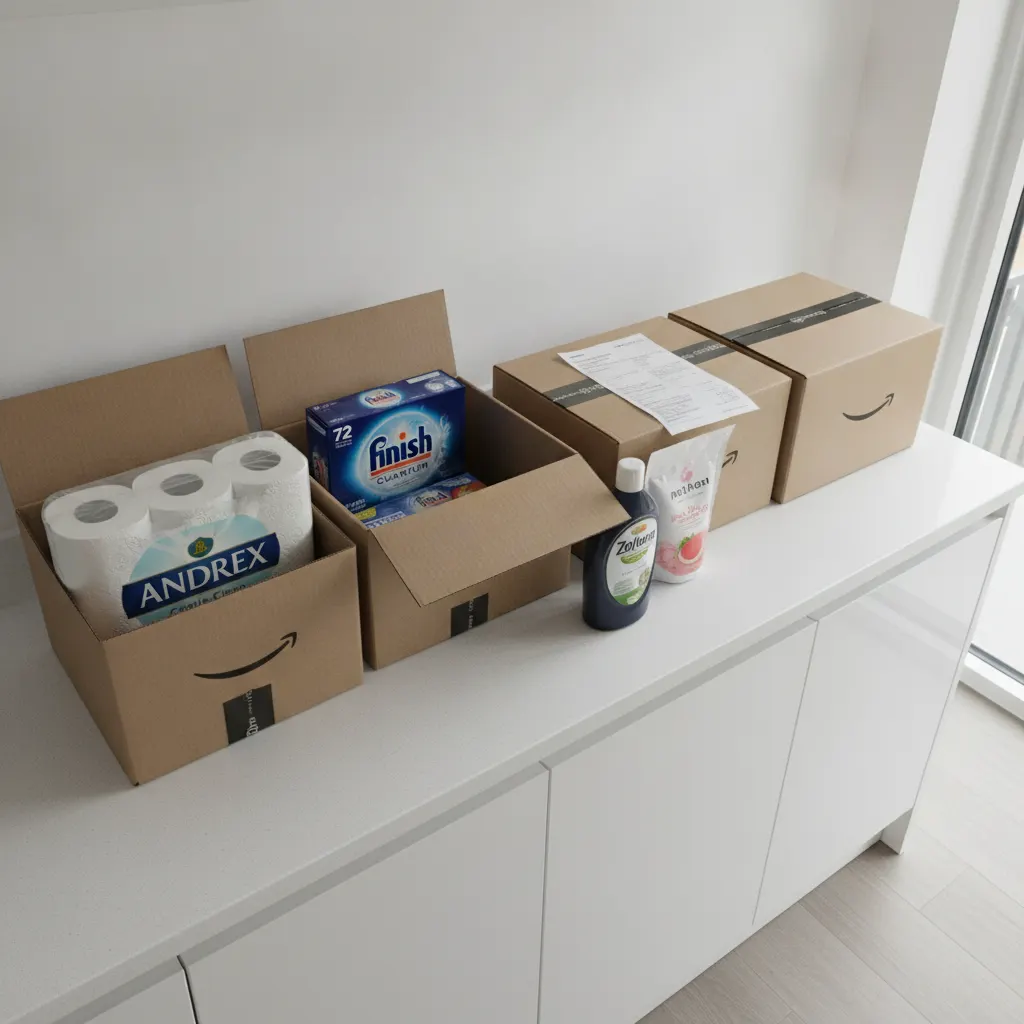
Sunday evenings used to involve me sitting at the kitchen table going through a mental list of what each property was running low on, cross-referencing with what I'd noticed during the week, and placing four or five separate Amazon orders. It took about forty minutes and I hated it — not because it was hard, but because it was exactly the kind of task that doesn't feel like real work but still eats real time.
In January 2024, I set up Amazon Subscribe & Save subscriptions for twenty-three consumable lines across four properties. Forty minutes a week is now about five minutes a week — checking that the upcoming deliveries are still right, adjusting quantities occasionally. The subscriptions mostly just run.
Here's how I set it up and what I've learned about where it works and where it doesn't.
What Subscribe & Save is and how the discount works
Amazon Subscribe & Save lets you set up recurring deliveries of eligible products at a discount — typically 5% on any subscription, rising to 15% if you have five or more active subscriptions arriving in the same delivery month to the same address. You choose the frequency: every one, two, three, or six months.
The 15% discount (on five or more subscriptions to one address) is meaningful if you're buying high-turnover consumables like toilet paper, dishwasher tablets, and cleaning products. On a monthly order that might otherwise be £60–80 worth of supplies for one property, 15% is £9–12 back. Across four properties, that's potentially £36–48 a month in saved spend — roughly £430–570 per year — for zero additional effort once the subscriptions are set up.
The key variable is the "same address" part. Subscriptions go to one delivery address, which means the discount calculates per property, not across your whole portfolio. You need five active subscriptions per delivery address to hit 15%.
My twenty-three-item setup
Not all of these are at every property — some are property-specific based on what the kitchen or laundry setup needs. But here's the full list of what I subscribe to:
Bathroom consumables: toilet paper (Andrex Gentle Clean 24-roll), hand soap refill (Method Pink Grapefruit), shower gel refill (Radox), shampoo individual sachets for guest sets.
Laundry: non-bio laundry pods (Surcare, because at least one guest per property per year mentions sensitive skin), fabric conditioner, tumble dryer sheets.
Kitchen: dishwasher tablets (Finish Quantum), washing-up liquid, kitchen roll, bin bags (various sizes), dish cloths in packs of ten.
Cleaning: Zoflora disinfectant (Linen Fresh, 500ml), toilet cleaner (Harpic), bathroom spray refills, microfibre cloths in packs.
Miscellaneous: AA batteries (for remote controls and some smart locks), tea bags (Yorkshire Gold 240-bag boxes), ground coffee for the cafetière in Edinburgh.
Most of these I order every two months per property. Toilet paper and dishwasher tablets I order monthly — they go fast with busy bookings. Batteries every six months. Zoflora every three months.
Why STR hosting is well-suited to Subscribe & Save
Most supply management advice about Subscribe & Save centres on predicting variable household consumption. The reason STR hosting works better than most use cases: consumption is largely predictable from booking data.
If I know I average eighteen guest-nights per month in the Brighton flat (which is roughly where it sits at 60% occupancy on a monthly average), I can calculate that I need approximately eighteen toilet rolls, around three 20-tablet packs of dishwasher tablets, one or two shower gel refills, and so on. The numbers aren't exact — a four-night booking with four guests uses more than a four-night solo stay — but they're close enough that a monthly subscription with a modest buffer keeps me from running out.
Compare this to a household where consumption varies wildly depending on who's home, who's cooking, whether you hosted a dinner party last month. The predictability of STR consumption per guest-night makes subscription planning much more tractable.
Setting delivery frequency: the calculation I use
For any item, I work out: how many I use per guest-night, multiplied by average guest-nights per month, plus 20% buffer. Round up to the nearest delivery-size unit. Then pick the frequency.
Example: dishwasher tablets in Edinburgh. The flat sleeps four. Guests typically run the dishwasher once a day for multi-night stays. That's roughly one tablet per guest-day, so at twelve guest-nights per month, I use about twelve tablets. A 24-tablet pack with 20% buffer gets me through eight weeks. So I subscribe to a 24-pack every two months.
It takes five minutes per item to work out the first time. After that, you just check occasionally whether the buffer feels right and adjust frequency if occupancy changes significantly.
Where it doesn't work
Some consumables have variable enough usage that Subscribe & Save isn't worth it. Coffee pods are the main one — some guests use two a day, some use twelve. I don't subscribe to pods; I order those manually from Nespresso UK based on actual stock levels.
Anything with a short shelf life and unpredictable usage — fresh items, obviously, but also things like welcome pack components that depend on booking type — stays off the subscription list.
Some items also aren't available through Subscribe & Save at all, or the eligible products change. I've had subscriptions automatically switch to a different size or variant when the original went out of stock — worth checking your order history occasionally to catch these.
Amazon Business vs personal account
I run Subscribe & Save through a personal Amazon account, not an Amazon Business account. Business accounts have different pricing and different Subscribe & Save terms — the 15% multi-subscription discount isn't available in the same form on Business accounts as of the time I set this up, though Amazon's terms change frequently.
For most small-portfolio STR hosts, a personal Prime account with Subscribe & Save will give better per-unit pricing on consumables than the Business account pricing I've seen. If you have a portfolio large enough to be buying pallets of supplies from trade wholesalers, that calculation changes — but at five properties or fewer, the personal account is probably the better call for Subscribe & Save specifically.
The practical management bit
Amazon sends you an email a few days before each scheduled delivery with a "manage your upcoming delivery" link. This is when I do my five-minute weekly check: scan through what's coming, adjust quantities if a property has had lower occupancy than usual, skip a delivery if the stock is still high. You can also add one-off items to an upcoming Subscribe & Save delivery for free shipping, which is useful.
I have a recurring calendar reminder on the 20th of each month to check upcoming deliveries for all four properties. Takes five minutes. That's it.
What it's actually saved me
Honest estimate across roughly sixteen months of running this properly: around £340 in spend (the subscription discounts), and approximately forty-five minutes per week of mental load — the Sunday evening ordering sessions I've almost completely eliminated.
I still place one-off orders for things outside the subscription system. But the baseline consumables that I was reordering every few weeks anyway now just arrive without me thinking about them. For a small portfolio run without a virtual assistant or operations manager, that's a meaningful quality-of-life improvement alongside the cost saving.
Ready to streamline your inventory?
Start managing your rental inventory smarter with automated stock tracking.
Start Free Trial