Bath mats for Airbnb: GSM, anti-slip backs, and how often I replace them
Hoststock Team
16 June 2026
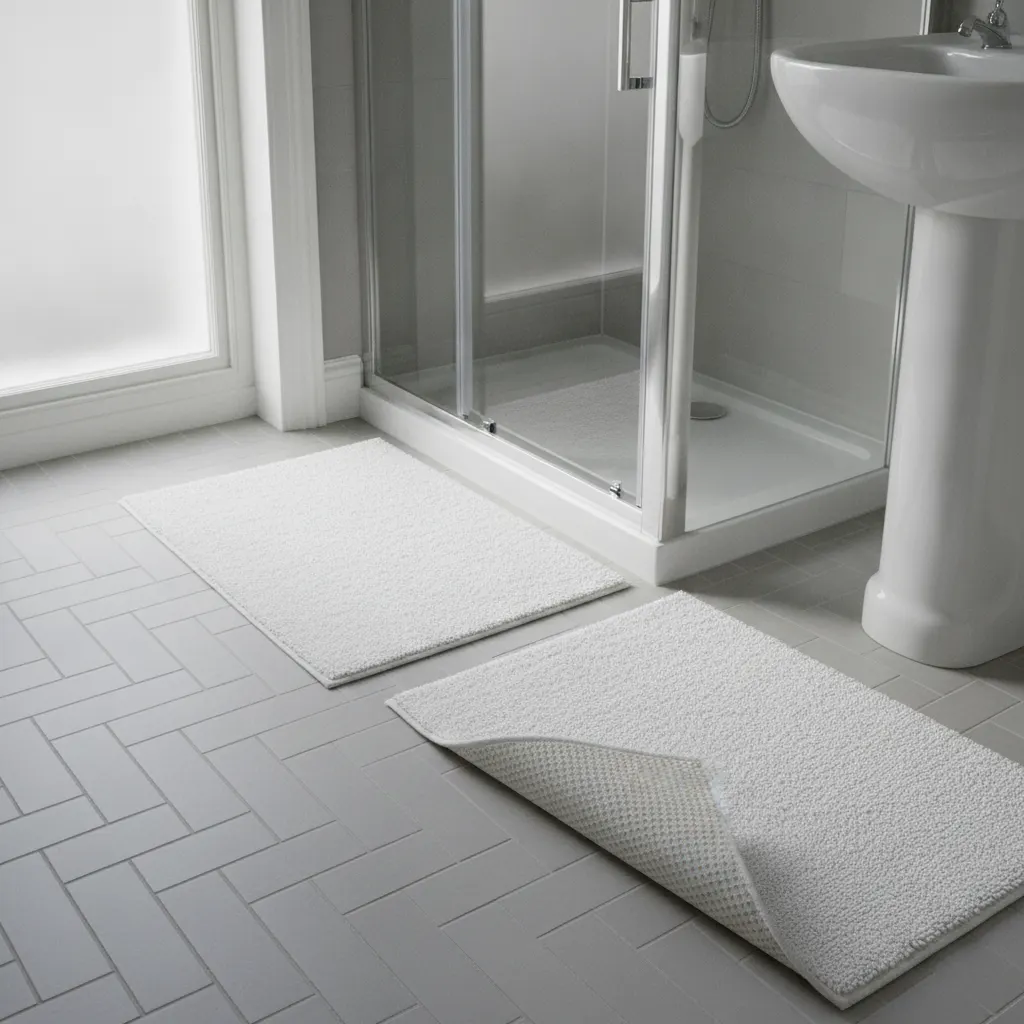
I replaced four bath mats in a single week last October. Not because a guest had complained — though one came close — but because I'd been ignoring them since the previous spring and they'd quietly gone horrible. Stiff, that greyish tinge on the white cotton, small patches of rubber backing peeling off at the edges.
I'd bought Toftbo mats from IKEA when I set up my Brighton flat. Dense, felt decent, reasonable price. Bought twelve across five properties, felt smug about it, moved on. The problem with bath mats is they deteriorate slowly enough that you don't notice until they're already embarrassing.
So I started paying attention to bath mats. Here's what I found.
What GSM means in practice
GSM is grams per square metre — the same weight measurement used for towels and bedding. Higher GSM means more fibre per square metre: denser, heavier, more absorbent, and generally longer-lasting. For bath mats, the practical range runs from about 400 GSM at the budget end up to 700 GSM for the thick hotel-corridor versions.
The difference underfoot is real. A 400 GSM mat at twenty wash cycles feels noticeably thinner and scratchier than a 600 GSM mat at the same count. Guests notice this. They might not articulate it in a review, but the general impression of a bathroom — whether it feels looked after or slightly tired — comes from details like this.
What doesn't get said enough: raw GSM isn't the whole story. Fibre quality and loop construction matter too. A cheap 700 GSM mat made from short-staple cotton will degrade faster than a well-made 550 GSM one. I learned this when I bought a batch of "700 GSM luxury" mats from an Amazon third-party seller that felt rougher after ten washes than my existing Toftbo mats at thirty. That was an annoying fifty quid's worth of lesson.
My standard across four of my five properties: 550–600 GSM, cotton or cotton-polyester blend. The polyester helps the mat dry faster — which matters when you're turning a flat in sixty minutes and the washing machine is still finishing. Pure cotton at 600 GSM takes a long time to dry in an airing cupboard.
Anti-slip backing: where cheap mats really fail
There are two main types of anti-slip backing. First: a sprayed latex or rubber coating applied directly to the base of the weave. Second: a separate rubber or PVC grid bonded onto the back. The sprayed coating is more common at the budget end of the market. It's also the one that falls apart first.
At 60°C — the temperature I run all guest linen at for hygiene — the sprayed backing starts to degrade after roughly fifteen to twenty cycles. You'll see it as rubber crumbs in the washing machine drum, or the mat starting to slide on bathroom tile, or (the worst version) small rubber fragments working into tile grout that you have to pick out by hand during a turnover clean.
The grid-backed version holds up considerably longer. I've had grid-backed mats survive forty-plus wash cycles without visible breakdown. At three turnovers a week — a normal busy summer for my Brighton flat — fifteen washes is gone in five weeks. A mat already degrading by week six of the season isn't worth buying.
The IKEA Almtjärn range uses a grid-style backing and holds up better than Toftbo. Dunelm's mid-range cotton mats generally do too, though it varies by batch. Worth turning one over before you order a case of twenty online.
The brands I've actually used
IKEA Toftbo — dense, soft, pleasant fresh from packaging. Rubber backing is inconsistent batch to batch. Some lasted fifteen months; others started peeling at month four. At around £4–5 each, hard to be too angry. I'd still use them for lower-occupancy properties where the washing cycle is gentler.
IKEA Almtjärn — more reliable grid backing, slightly less plush underfoot, dries faster. Currently what I use in my Edinburgh flat and the Lake District cottage. Not glamorous but consistently durable.
Dunelm Luxury Cotton Bath Mat — holds up well over time, reasonable GSM. Dries slowly. If you have a tumble dryer at every property this is fine; if you're relying on an airing cupboard between back-to-back turnovers, the drying time creates problems.
Amazon Basics bath mat — bought once, regretted it almost immediately. The backing came loose on the third hot wash and left rubber crumbs in the drum that then transferred to the next load of white towels. Genuinely don't buy these.
Christy hotel-grade bath mats — around £12–15 each, more than double the IKEA price. But they last. I've been using them in the Brighton flat for two years without replacing a single one. For a high-occupancy property where the bathroom features prominently in listing photos, they're worth the extra spend per mat. For a small ensuite in a second bedroom, probably not.
How many per bathroom
Two. One in front of the bath or shower, one in front of the basin.
Not a runner across the floor, not a mat by the toilet. Just two.
The basin mat was something I added about two years ago, initially because I was tired of cleaning dripped water off the tile every turnover. But it also photographs well — a matched pair of mats makes a bathroom look more considered in listing images. Worth about £5 of effort and materials for something that's visible in your most-viewed listing photo.
For a two-bed with two bathrooms: four mats in active use, two spares per property, six total. At £6–9 each for something decent, that's £36–54 upfront per property. Not much, in the context of everything else you spend on a new listing.
When to replace them
My rule: if it's gone stiff, visibly thinner than the spares, has any backing damage, or has developed a smell that won't shift after three washes — it goes. I don't wait for a guest to mention it.
In practice, across five properties at different occupancy rates, I'm replacing bath mats every eight to fourteen months. Brighton at 70% occupancy: eight or nine months. The Lake District cottage at around forty bookings a year: closer to fourteen months.
I keep a "last replaced" column in my stock notes for bath mats. Takes thirty seconds to update per property and stops me catching deteriorating mats six months too late.
Buying in batches
I buy in batches of twelve to twenty. Matching sets across properties look more considered in turnover handovers and listing photography — mismatched mats in different shades of off-white look accidental in photos. Buying in volume also means I'm reordering the same item rather than hunting for something similar that's gone out of stock.
White or off-white, always. It bleaches when it goes yellow, photographs clean against any tile colour, and works with any bathroom scheme. I tried slate grey in Edinburgh once. The mats looked tired faster, showed marks more obviously, photographed darker than I wanted in the listing. Back to white within four months.
The mould problem nobody warned me about
Warm weather, closed bathroom, bath mat left flat on the floor between turnovers: the rubber or grid backing will develop mould within forty-eight hours. This caught me out in the Brighton flat in late June — when I lifted the mat, the tile underneath had a faint black outline of the grid pattern. Not something I want to explain to a cleaning team or a guest.
Fix: mats hang over the side of the bath after every clean, not flat on the floor. Bathroom window left cracked an inch. It's a thirty-second habit that stopped the problem entirely. Worth adding explicitly to your cleaner handover document.
The actual maths
Five properties, six mats each, average replacement at ten months: thirty-six mats per year. At £7 average, that's £252 annually across the portfolio. Not a significant line item.
But if I were buying sprayed-backing mats at £3 each that needed replacing every three months at high-turnover properties, I'd be buying sixty-plus mats a year. That's £180 in purchase cost — seemingly cheaper — plus the time cost of more frequent replacement orders, rubber crumbs in the laundry, and the occasional passive-aggressive guest review comment about the bathroom.
Buy the slightly better mat. Replace it less often. It's a dull conclusion. It's the right one.
The short version
550–600 GSM minimum. Grid backing over sprayed coating. Test-wash one before ordering twenty. Two per bathroom, six per two-bed property including spares. White. Replace every eight to fourteen months depending on occupancy. Hang over the bath edge between stays in warm weather.
And don't buy Amazon Basics bath mats. The rubber crumb situation is worse than you'd expect.
Ready to streamline your inventory?
Start managing your rental inventory smarter with automated stock tracking.
Start Free Trial