Duvet tog for short-term lets: 10.5 tog in a November Lake District cottage nearly cost me a Superhost badge
Hoststock Team
17 June 2026
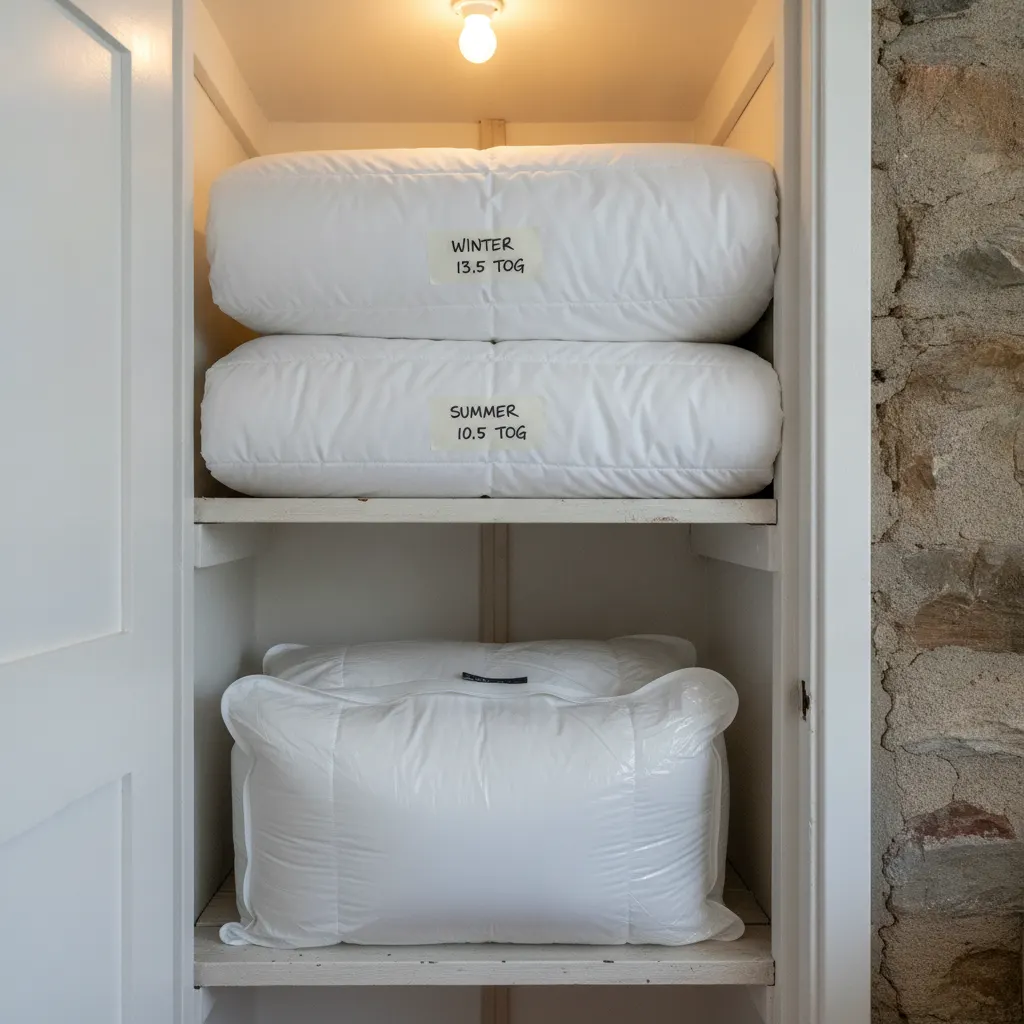
In November 2023, I got a three-star review from a guest at my Lake District cottage. The comment, roughly: the bedroom was cold, the duvet wasn't warm enough for October weather, they'd had to sleep with extra blankets.
I'd put a 10.5 tog duvet in that room. Fine for July. Not fine for a stone cottage in Cumbria in late October when the heating kicks off at 10pm and the walls take an hour to warm up. I knew this in retrospect. I just hadn't thought about it before I bought the duvet.
I've since replaced duvets across three properties and developed an opinion about tog ratings that I wish I'd had two years ago.
What tog actually means
Tog is a measure of thermal resistance — specifically, the resistance to heat flow through the duvet. A higher tog traps more warmth. Lower tog, less warmth, better for summer. It's a simple scale from around 1.5 (very summer-weight) up to 15.0 (Scandinavian winter weight), with most of the market sitting between 4.5 and 13.5.
The catch for short-term let hosts: you're buying one duvet that will be slept under in June and December, by guests who run hot and guests who run cold, in properties that have wildly different insulation levels depending on their age.
My Brighton flat is a 1960s mid-terrace conversion. Decent double-glazing, gas central heating that responds quickly, not much in the way of draughts. A 10.5 tog duvet there is comfortable for most of the year.
The Lake District cottage is a stone building from the 1890s. It heats up slowly, cools down quickly when the heating's off, and in October feels about three degrees colder than the thermostat suggests. A 10.5 tog duvet there in autumn is not comfortable. Lesson learned.
The options: what you're actually choosing between
You've got three practical approaches as an STR host:
Single year-round duvet — one tog rating for all seasons. If you're doing this, 10.5 tog is the conventional wisdom for UK year-round use: warmish enough for most people in winter, manageable in summer if the property has decent ventilation or a guest can kick it off. But it depends heavily on your property's thermal character.
Seasonal swap — a lighter duvet (4.5 or 7.5 tog) for summer, heavier (13.5 tog) for winter. Doubles your storage requirement and creates a changeover task in spring and autumn, but it means guests always have the right thing. This is what I now do at the cottage.
All-season duvet — two layers that button together: a lighter layer (typically 4.5 tog) and a medium layer (typically 9.0 tog), giving you 4.5, 9.0, and 13.5 tog depending on combination. In theory elegant. In practice, most guests don't know how to combine them, you'll regularly find the layers separated, and photographing a combined all-season duvet in a fresh listing photo is harder than it sounds. I tried this at the Edinburgh flat. It created more confusion than it solved.
What I've settled on across five properties
Brighton flat (well-insulated 1960s building): 10.5 tog year-round. Works for roughly 90% of stays without complaint. I leave an extra throw on the foot of each bed as a fail-safe — a Dunelm fleece throw at about £8 each — which handles the occasional cold-running guest.
Edinburgh Old Town flat (Victorian tenement, stone stairwell): 10.5 tog with a 4.5 tog spare in the linen cupboard with an instruction card telling guests it's there. Edinburgh in January genuinely gets cold and old tenement flats hold onto cold air in a way that modern buildings don't. But summer bookings from continental European guests who find 10.5 tog stifling need the lighter option available.
Lake District cottage (1890s stone, slow-to-heat): 13.5 tog from September to April, swapped to 10.5 from May to August. It's an extra job twice a year. It has eliminated cold-duvet complaints entirely since I made the change.
Specific brands worth mentioning
IKEA FJÄLLBRÄCKA all-season duvet — the two-layer button-together system. Roughly £55–65 for a double. Good warmth-to-weight ratio, washes well, doesn't clump badly after repeated laundering. The issue is the all-season concept itself: I don't recommend it for STR unless you're happy briefing guests how to configure it.
IKEA LUNDKAKTUS (10.5 tog) — a reliable mid-weight duvet for year-round use in well-insulated properties. Reasonably priced, washes well at 60°C in a standard machine — which matters for hygiene between stays. Currently using these in Brighton and doing fine with them.
The Fine Bedding Company Eco Comfort — better fill quality than the IKEA options, holds its loft longer over repeated washing. Around £45–65 for a double depending on retailer and sale. I use these in Edinburgh where I care a bit more about how the bedding looks and feels because the flat photographs well and gets a clientele who notice.
Soak&Sleep own-brand duvets — strong quality, available in 4.5, 10.5 and 13.5 tog, good for bulk purchases. They do hospitality orders if you have a portfolio large enough to make it worthwhile. Worth a call if you're kitting out three or more properties at once.
The washing question
Most domestic duvets can be machine-washed at 40 or 60°C if you have a machine large enough — you need at least an 8kg drum for a double duvet, 10kg ideally. At 40°C you're not really hitting hygiene temperatures; at 60°C some cheaper fill materials will start to clump. Worth checking the care label before you buy in bulk.
I rotate duvets out every twelve to eighteen months regardless of visible condition. That's roughly one full set of replacements per year across the portfolio — not a huge cost if you're buying in the £30–50 range for doubles.
Between stays, duvets get aired, not washed every time — that's too many wash cycles and too much wear on the fill. I wash them after longer stays (five nights or more) and at the seasonal changeover, and spot-check them otherwise.
The spare-duvet storage problem
If you're doing seasonal swaps, you need somewhere to put the summer duvets in winter and vice versa. Vacuum storage bags are the answer — a king duvet compresses to about the size of a sleeping bag. I keep the off-season duvets for each property in a labelled storage box under the bed of the main bedroom. It takes up space. It's still the better option than a 10.5 tog duvet in a draughty stone cottage in November.
Label everything clearly. I learned this when I sent a cleaning team to the cottage with instructions to "swap the duvets" and they weren't sure which bag contained which weight. A black marker on the vacuum bag saying "WINTER 13.5 TOG" fixes that.
Guest communication about duvets
I now include a single line in my pre-arrival message for autumn and winter bookings at the cottage: "The bedroom has a warm 13.5 tog duvet — if it's too warm, there's a lighter spare in the linen cupboard." That's it. One sentence. It sets the expectation and gives them an option without making the message feel like an operations manual.
For summer bookings at the Edinburgh flat, I include: "There's a lighter spare duvet on the top shelf of the linen cupboard if the 10.5 feels too warm." Again, one sentence.
You'd think guests would figure this out. Some do. Some prefer to write a review comment about it.
The actual cost of getting this wrong
One three-star review mentioning a cold duvet in a Lake District cottage. In the context of Superhost requirements — 4.8 stars across all properties — that single review from a single stay dropped my average below 4.8 for the following quarter. It took six subsequent reviews to bring it back up.
The replacement 13.5 tog duvet cost £42. The storage bag cost £4. Changing the duvet twice a year takes about twenty minutes per property. That's the trade-off against one bad review that costs you the Superhost badge for a quarter.
Worth doing the maths on your own properties and making a deliberate choice. Just make a choice — don't default to "one duvet, all year" without thinking about whether your specific building actually works that way.
Ready to streamline your inventory?
Start managing your rental inventory smarter with automated stock tracking.
Start Free Trial