Sofa beds for Airbnb: the two I replaced after three-star reviews and the one I've kept for two years
Hoststock Team
20 June 2026
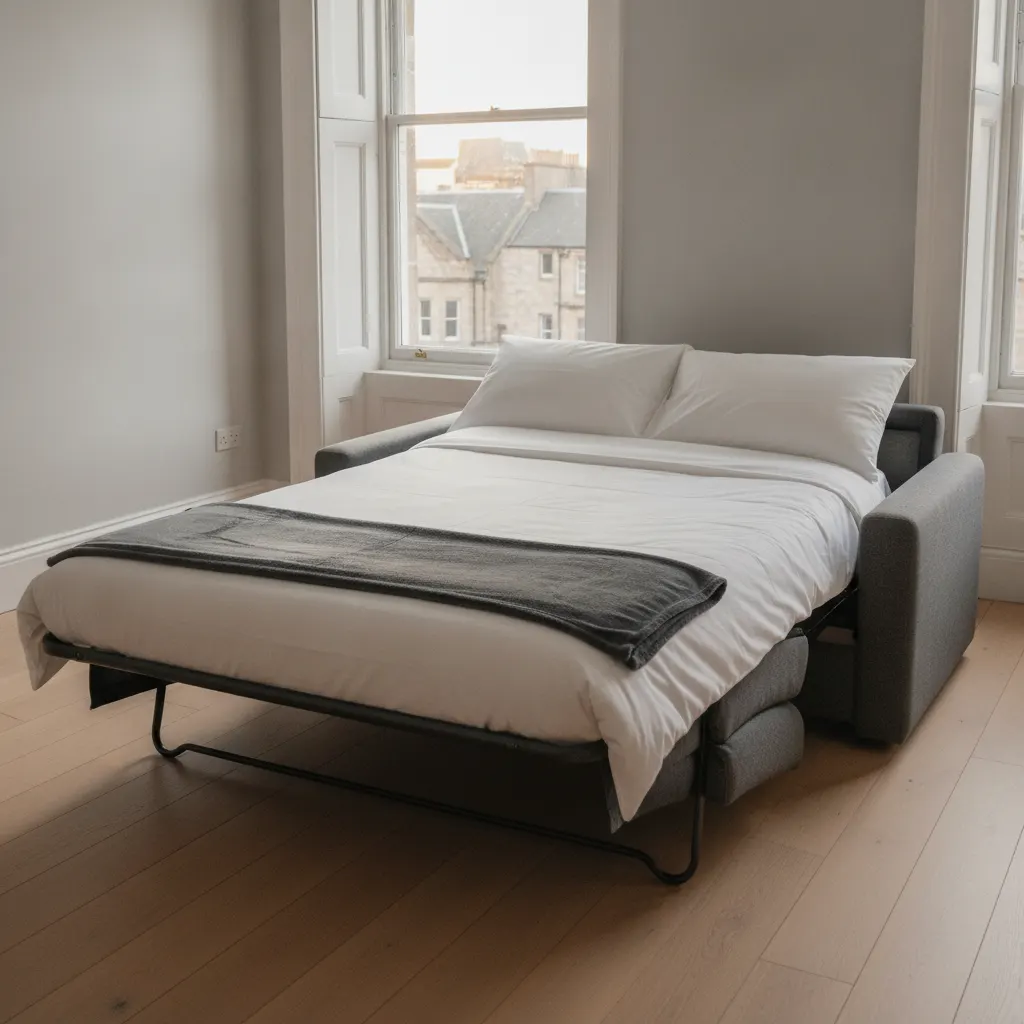
I've bought three sofa beds across my five properties. One is still there. The other two generated guest reviews I still wince at — not scathing ones, just the mild, polite complaints that are somehow harder to shake than outright negative feedback. "The sofa bed was a bit uncomfortable." "The pullout wasn't as comfortable as expected." You know the kind.
Here's what I got wrong, what I've figured out, and what actually works when you need a sofa bed in an Airbnb listing.
Why sofa beds are a specific problem for STR hosts
In a normal household, a sofa bed gets used a handful of times a year — when family visits, when a friend needs somewhere to sleep. Wear is slow. Comfort matters but isn't critical to your ongoing quality of life.
In an Airbnb, a sofa bed that sleeps "up to four" means that listing gets booked by groups of four, all of whom expect a reasonable night's sleep on the pullout. It might get used one hundred times in a year. The bar isn't "fine for the occasional guest" — it's "comfortable enough for paying guests expecting five-star value."
Most sofa beds aren't built for that. Even many that are marketed as suitable for regular sleeping use aren't actually comfortable for more than a few consecutive nights. The gap between what a sofa bed photograph promises and what a guest experiences at 11pm pulling out the mattress is where reviews are lost.
Frame types and what they mean for comfort
There are three main frame mechanisms you'll encounter:
Click-clack — the sofa back folds flat. No separate mattress; the sofa cushions become the sleeping surface. These are fine for occasional guest overflow; they're not fine as the primary sleeping accommodation for adults paying to stay in your listing. The cushion-as-mattress surface is uneven and the frame mechanism often creates a ridge right where your hips end up. I've seen enough click-clack sofa beds in STR listings to know they're a reliable source of one-star sub-ratings on "accommodation."
Traditional fold-out with integrated mattress — the sofa folds out on a metal frame and reveals a rolled or folded mattress inside. This is the most common type and has the widest quality range. At the cheap end (think Argos, basic Amazon listings, DFS budget range), the mattress is typically 8–10cm thick and lies on a metal bar frame that guests can feel through it. At the better end — Jay-Be, some John Lewis own-brand options — you get a 12–15cm mattress with proper pocket sprung construction and a frame designed to not create pressure points.
Futon-style — a roll-out mattress over a flat surface, Japanese-inspired. These work well when the mattress is good quality (some futon specialist brands sell decent options) and are easier to make up neatly for photos. Less common in UK STR listings but worth knowing about if you're considering alternatives.
Mattress thickness is the thing that matters most
Whatever the frame type, the mattress thickness and construction determine whether guests sleep well. Specifically:
Anything under 10cm is likely to be uncomfortable for adults — they'll feel the metal bars of the frame below. 12–15cm with pocket springs or high-density foam is the practical minimum for comfortable regular use. Some of the better integrated sofa bed mattresses hit 17–18cm, which gets genuinely close to a proper bed sleep experience.
The Jay-Be Linea Sofa Bed uses their e-fibre spring unit and sits at around 13cm. It's notably more comfortable than the budget options and folds away cleanly. I have one in the Edinburgh flat — it replaced a cheaper sofa bed I bought when I set up the flat and that guests repeatedly described as "fine but not the most comfortable." The Jay-Be costs considerably more (£600–800+ depending on size and retailer), but I've had zero sofa-bed comfort comments since fitting it. That's the trade-off.
The IKEA FRIHETEN question
The FRIHETEN comes up constantly in STR host discussions. It's a popular sofa bed, reasonably priced, and it does have an actual mattress rather than cushions. The mattress is around 12cm thick — not bad by sofa bed standards.
My experience: it's acceptable but not great for regular adult guest use. The mechanism is easy enough that guests can deploy it themselves. The mattress is decent. But the metal frame creates a slight ridge at shoulder height when you're sleeping on it, and the foam mattress doesn't breathe particularly well, which is noticeable in warm weather.
If budget is a real constraint and you need a sofa bed in a listing, the FRIHETEN is defensible. If you're adding "sleeps 4" to a listing and charging for the extra capacity, I'd budget for something better.
What the listing says vs what guests experience
This is worth being honest about. If your listing says "sleeps 4 (sofa bed in living room)," guests booking for four people are expecting to sleep four people comfortably. If two of those people are getting an 8cm foam mattress on a metal bar frame, the mismatch between expectation and experience shows up in reviews.
I've started being more specific in listings that include a sofa bed: "The living room has a comfortable fold-out sofa bed suitable for adults, with a 13cm pocket-sprung mattress." That sets a more accurate expectation than "sleeps 4," and it's the kind of detail that actually helps guests self-select — couples are more likely to book confidently, large groups less likely to assume it's equivalent to a second bedroom.
Making up the sofa bed in photos
Listing photos of sofa beds almost always show the bed made up with crisp linens — which looks fine in a photo but can mislead guests who are trying to assess actual size and comfort. I'd encourage showing the sofa in sofa mode (so guests can see what the room looks like functionally) and including one photo of the bed deployed with an honest width visible.
In my listing for the Edinburgh flat, I show both — the FRIHETEN [now replaced with the Jay-Be] as a sofa, and then deployed as a bed with standard bedding. It's more honest and it reduces the "oh, it's smaller than I thought" comments.
The mattress topper fix
One cheap improvement for a sofa bed that's serviceable but not quite comfortable: a 5cm memory foam mattress topper, rolled up in the storage compartment or a nearby cupboard. A decent topper runs £25–40 and adds noticeable comfort to a thin sofa bed mattress — it's a way of improving an existing sofa bed without replacing it.
I use this at the Lake District cottage where the sofa bed doesn't get used often enough to justify the spend on a Jay-Be, but where I still want occasional guests to sleep comfortably. The topper lives in a zip bag in the underbed storage.
What I'd do if starting from scratch
If I were fitting out a new two-bed listing and needed a sofa bed for a living room: budget at minimum £400–500 for the sofa bed itself, aim for a 12cm+ mattress, avoid click-clack mechanisms, and be honest in the listing about what "sleeps 4" actually means in practice.
The last thing I set up — which sounds administrative but actually stopped another three-star incident — was tracking replacement dates in HostStock. You buy the better sofa bed, log it, and it flags you when the mattress is due for replacement before the reviews tell you first.
The extra spend versus a cheap option is usually recovered within a few months of avoided one-star comfort reviews and their downstream effect on booking conversion. The sofa bed review comment is one of the more reliably preventable sources of sub-five-star ratings — it just requires spending the money upfront to get the right product.
Ready to streamline your inventory?
Start managing your rental inventory smarter with automated stock tracking.
Start Free Trial