Airbnb AirCover damage claims: three claims, six months, what I actually got paid
Hoststock Team
1 July 2026
Airbnb's AirCover for Hosts is marketed as covering up to $3 million in host damage protection. That sounds reassuring. In practice, it's more complicated — not necessarily bad, but not as straightforward as the headline figure suggests. I've filed three claims over the past couple of years, and each one taught me something I wish I'd known before the damage happened.
None of my claims involved anything dramatic. No flooded bathrooms, no fires, no parties that ended in police involvement. Two were furniture damage. One was a stained mattress that required a replacement. But even those relatively mundane claims required more documentation than I had, tested my patience more than I expected, and delivered outcomes that weren't always what I'd assumed they'd be.
Here's what happened with each, and what I changed in my documentation process as a result.
Claim one: broken dining chairs and a damaged wall
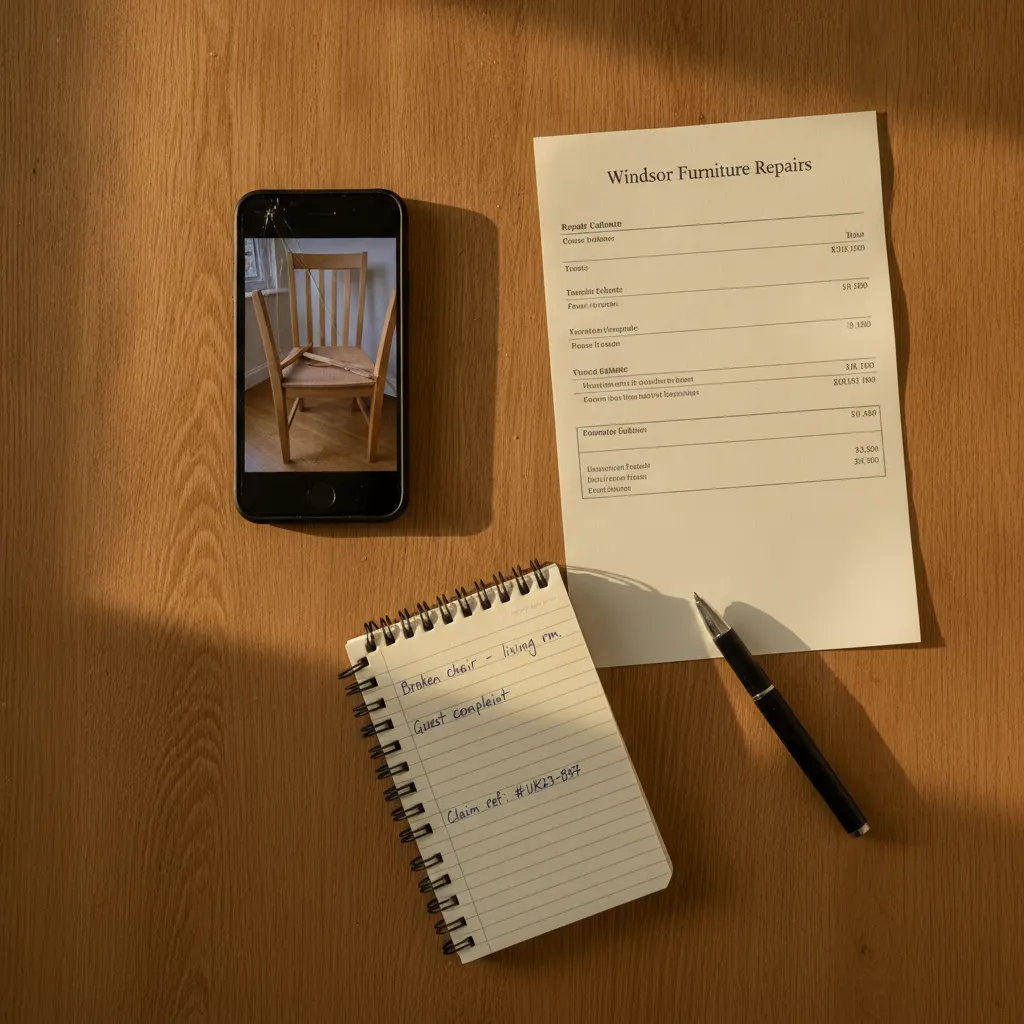
Brighton flat. Six guests (the maximum the listing allows). Checkout morning, my cleaner messaged me: two of the four dining chairs had broken supports, and there was a gouge in the hallway wall about 30cm long. The kind of gouge that suggests furniture being moved carelessly, not a gentle scuff.
I had photos from my last post-checkout inspection — about three weeks earlier. The chairs were intact in those photos. The wall was clean. I also had the cleaner's checkout photos from immediately after the previous guests, showing the same. So I had a reasonable evidence chain that the damage occurred during this booking.
I filed via the Resolution Centre within 48 hours of checkout, which Airbnb requires — actually the rule is you have 14 days from checkout to file, but the guest must be given 24 hours to respond before Airbnb will step in. I filed the claim, uploaded the photos (before and after, plus a written description of the damage), got a replacement quote from a local furniture supplier, and submitted a wall repair estimate from my handyman.
The guest pushed back. They said the chairs were 'already wobbly' when they arrived. Which, honestly, wasn't impossible — they were Ikea 365+ dining chairs that had been through a lot of guests. But my pre-stay inspection photos showed no obvious defects, and I'd noted in my welcome message that guests should let me know immediately if anything wasn't right. No such message came during the stay.
Airbnb sided with me, mostly. They paid out for the two chairs at what they called 'depreciated value' — not replacement cost, but a figure that accounted for the age and wear of the original chairs. My replacement cost was about £180 for two good dining chairs. I received £94. The wall repair came through at roughly what I'd quoted. Total paid: about £210 of my claimed £280.
Timeline: 22 days from filing to final payment. Not bad.
Claim two: mattress replacement after a stain
This is the one that took 11 weeks and tested my ability to compose calm emails. Edinburgh flat. Checkout revealed a large stain on the mattress that had soaked through the mattress protector. I won't describe it in detail. You can probably imagine.
The mattress was about 14 months old. I had the purchase receipt. I had the checkout photo from the previous guests showing a clean protector and no visible staining on the mattress (you could see the corner lifted in the photo — my cleaner does this as standard). I had photos of the damage from checkout morning. I had a receipt from a cleaning company I'd called in to attempt a clean before accepting that the mattress was beyond saving. I had a replacement quote.
What I didn't have was a photo of the mattress itself being clean at the start of the stay in question. I had a photo from six weeks earlier. Airbnb's initial response raised this gap — they asked for evidence that the mattress wasn't damaged at the time of check-in, not just that it was clean six weeks prior.
This caused a back-and-forth that ran to four exchanges over about seven weeks. I sent the cleaner's checkout report from the previous stay. I sent a statement from the cleaner confirming the mattress protector was intact and odour-free at the start of the stay. Airbnb kept requesting documentation of what the 'undamaged mattress' looked like at check-in.
Eventually, 11 weeks after the claim was filed, I received payment for the mattress at depreciated value: about £180 on what I'd paid £350 for 14 months earlier. Plus a partial contribution to the cleaning costs. Total: roughly £225.
What I changed after this: my cleaner now photographs the mattress protector and the visible mattress surface (corner lifted) at the start of every stay, not just at checkout. The photo goes into a shared folder by property and booking date. It takes 30 seconds and has saved me from this argument once already since.
Claim three: broken window handle and two scratched worktop sections
Lake District cottage. A family stay, longer than usual — seven nights. Checkout revealed a broken window handle on the bedroom casement window (replaceable but a specific heritage-style fitting, about £60 to source) and two sections of scratched kitchen worktop, which appeared to have had something dragged across them repeatedly. The worktop was solid wood — the scratches would have required professional sanding and re-oiling to fix properly.
This claim I lost, partly. Airbnb determined that the window handle showed 'evidence of pre-existing wear' — it's a Victorian-style property and the furniture and fittings are appropriately aged. Fair enough, arguably. The window handle felt borderline to me and I didn't fight it.
The worktop was the frustrating part. The scratches were visible, deep, and clearly recent — you could see fresh wood grain. But I had no pre-stay photo of that specific worktop section. I had general kitchen photos from my listing, which are deliberately flattering and don't show worktop condition in detail. I had a checkout photo of the damage. But no clean comparison photo.
Airbnb offered a partial credit of £85, which they described as a contribution towards repair costs, noting that I'd been unable to provide pre-stay documentation of the worktop condition. The actual repair cost was closer to £260.
What I changed: I now have a standard 'start of stay' photo set for every property that includes the kitchen worktop, the bathroom surfaces, and the main bedroom floor. It's a ten-photo checklist that my cleaner runs through at the end of each turnover — so it documents the condition at check-out of the previous stay, which functions as the check-in documentation for the next.
What AirCover doesn't cover — and the bits that surprised me
Normal wear and tear. Airbnb is explicit about this. A dining chair that was already wobbly before your guests sat in it is not covered, even if they broke it. A mattress protector that let a stain through because it was old and the waterproofing had degraded — that's going to be contested. Keep your inventory fresh enough that 'normal wear and tear' isn't a credible defence for damage.
Standard checkout cleaning — dishes, laundry, rubbish — isn't covered. This isn't damage, it's just checkout cleaning, and Airbnb is right not to cover it. What is covered is extra cleaning costs: professional stain removal, odour treatment, specialist services beyond your standard turnover clean. Keep the receipts for these separately.
Guest injuries are explicitly not covered. Neither is any liability for a guest who hurts themselves on your property. This is where your own STR insurance matters — AirCover doesn't replace a proper policy.
The documentation routine I run now
After three claims and a lot of back-and-forth, here's the system:
- Post-checkout photos by my cleaner after every turnover: all rooms, focusing on surfaces, furniture, and any items with previous wear. These photos go into a shared folder labelled by property and date.
- A standard 10-photo start-of-stay set: kitchen worktop, bathroom surfaces, main bedroom floor and mattress protector (corner lifted), living room furniture, any specific items that have been damaged previously.
- All purchase receipts for furniture and fittings stored in a folder per property. I need the receipt to establish original value for any depreciation calculation.
- Any pre-stay inspection notes — if I've noticed a scuff or crack before guests arrive, I log it briefly so I can't be blamed for it post-stay.
And the rule I repeat to anyone who asks: file the claim quickly. You have 14 days from checkout, but waiting only means your evidence gets older. I file within 48 hours of finding damage now. Not because I'm itching for a fight, but because the documentation is freshest, the cleaner's recollection is clearest, and the sense of urgency helps when Airbnb support prioritises cases.
AirCover is genuinely useful. But it rewards hosts who document carefully and doesn't particularly reward those who don't. Which, when you think about it, is fairly reasonable.
Ready to streamline your inventory?
Start managing your rental inventory smarter with automated stock tracking.
Start Free Trial