Fragrance-free Airbnbs: switching detergents, removing diffusers, and listing it so allergy guests actually book
Hoststock Team
3 October 2026
I got a message from a guest with a nut allergy once — which was fine, I don't put nuts in welcome packs — but she also mentioned she had a fragrance sensitivity and asked whether I used scented candles or plug-in air fresheners. I didn't at the time. But I had Pine Fresh toilet cleaner, Lenor fabric conditioner on the linen, and a cheap reed diffuser in the bathroom that I'd put there because a previous guest left a review saying the flat smelled "a bit stale." I'd overcorrected.
She stayed without incident and left a very good review. But it made me think about what I was putting in my properties without really knowing what was in it. Fragrance sensitivity and contact allergies are common enough that, statistically, a reasonable number of my guests have them. Most don't mention it and just deal with it. Some mention it and cancel. A few mention it and get a positive experience if you've set up properly. That last group are worth targeting explicitly.
What fragrance-free actually means in an STR
Fragrance-free means no synthetic fragrances in the products that come into direct contact with skin or that guests breathe in continuously. That's a narrower definition than "natural" — plenty of natural essential oil products trigger reactions in sensitised people. It means genuinely unscented formulations.
The items to check:
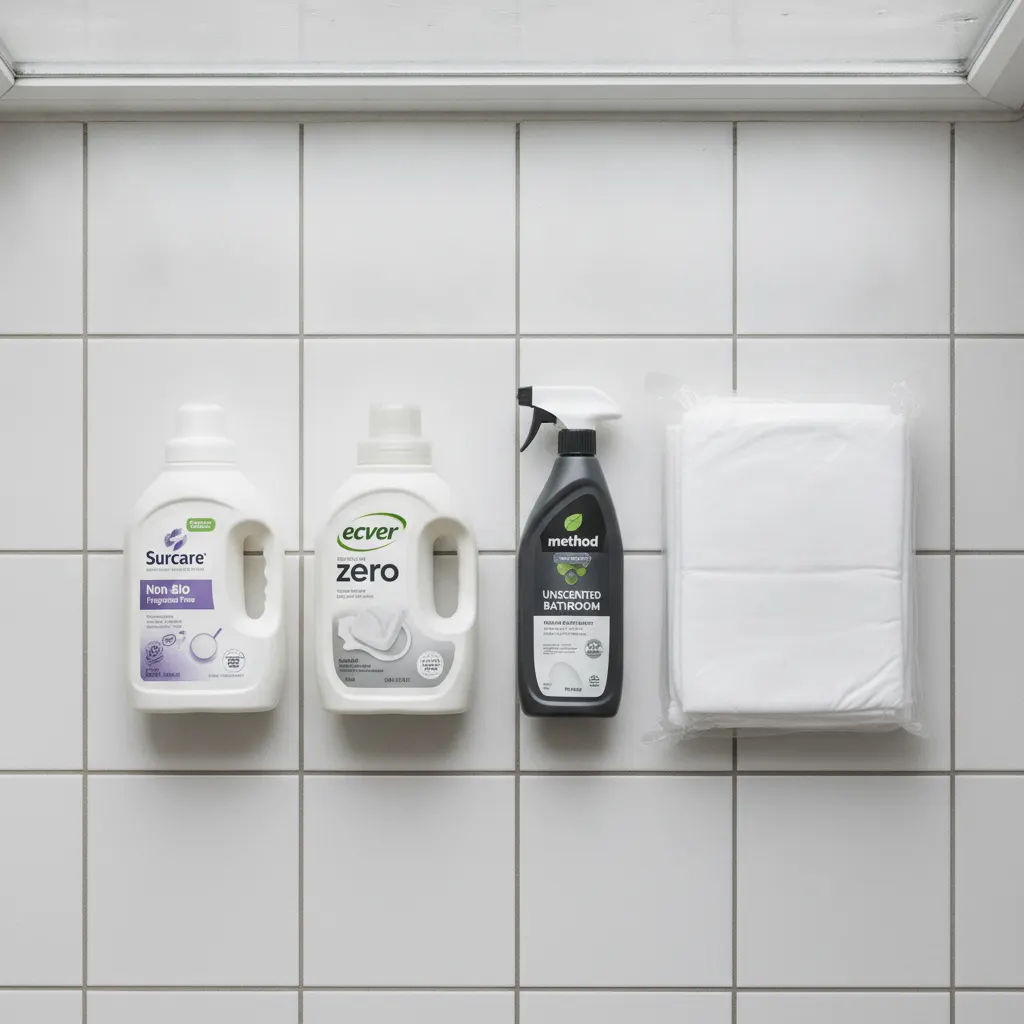
Washing detergent and fabric conditioner on bedding and towels. This is the biggest one. Guests spend 6–8 hours pressed against your linen. If it's laundered in a heavily fragranced detergent, sensitised guests will notice within an hour. Surcare Non-Bio Fragrance Free is the most consistently available option in UK supermarkets. Ecover Zero is another, widely stocked. Both cost about the same as standard non-bio, sometimes slightly more.
Cleaning sprays used on kitchen surfaces and bathrooms. Standard Flash or Dettol contains fragrances. Method Unscented Bathroom and kitchen sprays are the cleaner's version I switched to in my Edinburgh flat. Slightly more expensive, but not dramatically.
Dishwasher tablets. Most contain citrus fragrance additives. Ecover's fragrance-free tablets or Fairy Platinum Unscented work well and are easy to source in bulk from Ocado or Costco. Guests with fragrance sensitivity will notice dishes that have been washed in a heavily fragranced tablet — particularly wine glasses, which retain smell effectively.
Air fresheners: remove them entirely. Not switch to a "natural" version — remove. Reed diffusers, plug-in Febreze units, scented candles, essential oil diffusers — all of these are fragrance sources that sensitised guests will react to, and non-sensitised guests will at least smell. If your property has a persistent underlying smell that you're masking with a diffuser, address the underlying smell (see my post on damp, dehumidifiers, and extractor fans). Don't layer more fragrance on top of a problem smell.
Dust mites: the invisible issue
Dust mite allergy affects a significant chunk of the UK population. NHS guidance identifies house dust mites as one of the most common indoor allergens. The mites themselves are microscopic and live in bedding, mattresses, soft furnishings, and carpets. You can't eliminate them entirely, but you can dramatically reduce their numbers.
Mattress protectors are the first defence. I use fully waterproof, machine-washable mattress protectors on every bed in every property — not just for hygiene but because washing at 60°C kills dust mites. The IKEA Malin mattress protector (currently around £30 for a double) is the most durable budget option I've tested. Wash on every turnover at 60°C. Guests never see the protector because it's under the sheet, but the whole ensemble is clean rather than just looking clean.
Pillows: wash at 60°C every two turnovers in a hot drum cycle. Replace annually — they compress and accumulate allergens and no amount of washing fully restores them. Synthetic hollow-fibre pillows are better for allergy sufferers than feather and down, which can trigger reactions in people with bird-feather allergies (a subset of those with dust mite issues). I switched all five properties to synthetic from feather two years ago. One specific reason: a guest complained of eye irritation in the first few hours of a stay and I traced it back to the duck-down pillows on one bed. Never again.
Duvets: same rule. Wash quarterly at 60°C, replace every two years, go synthetic. Marks & Spencer's synthetic "Soft & Cosy" range is the mid-market option I've used. Not exciting, does the job, survives the washing cycle without clumping.
Hard floors versus carpet
Every property I've set up from scratch since 2022 has had hard floors throughout. Not because I dislike carpet — the Edinburgh flat's original Victorian floorboards are genuinely beautiful — but because hard floors have a significantly lower dust mite and allergen load than carpet. Dust sits on a hard floor; in a carpet it embeds. Vacuuming removes surface dust; it doesn't get the mites out of the carpet pile.
In properties where I've inherited carpet, I use a HEPA-filter vacuum on every turnover and steam clean the carpets every three months. My cleaner has a Dyson V15 which has HEPA filtration — the HEPA certification on the exhaust matters because a non-HEPA vacuum can redistribute fine particles back into the air rather than capturing them. Worth checking what your cleaner is using if allergy-proofing matters to you.
Listing it correctly
If you've made these changes, tell guests. Not in a clinical way — in a normal way. In my Edinburgh flat description I've added: "Fragrance-free detergents throughout. Synthetic hypoallergenic duvets and pillows. HEPA vacuum used on every turnover."
Three lines. Visible in the amenity section and in the description. Since adding it, I've had five bookings in the last year where the guest specifically mentioned allergies in the pre-booking message. All five stayed without incident. Two left five-star reviews mentioning the allergy-friendly setup specifically.
There's also an Airbnb listing tick for "Hypoallergenic" under amenities. It's a minor ranking signal but worth checking. I've ticked it across all properties now.
The cost calculation
Switching to fragrance-free products adds roughly £8–12 per property per month to cleaning costs. Annual cost: about £110 per property. The five-star reviews from the allergy guests have contributed to my Superhost rating maintenance across two properties where I was borderline. A Superhost badge is worth more than £110/year in booking conversion.
Even if you don't care about the allergy-guest market specifically, the fragrance-free switch has a secondary benefit: your property smells clean rather than smelling artificially clean. Guests who are not sensitised still notice the difference between a flat that smells like fabric conditioner and a flat that smells of nothing. The nothing-smell is what you want. Guests associate strong scent in accommodation with the host trying to mask something.
Remove the diffusers. Switch the detergent. Tell people about it. The market for it is bigger than you'd expect.
Ready to streamline your inventory?
Start managing your rental inventory smarter with automated stock tracking.
Start Free Trial