Chopping boards in Airbnbs: plastic vs wood, colour codes, and the three-month replace cycle
Hoststock Team
2 October 2026
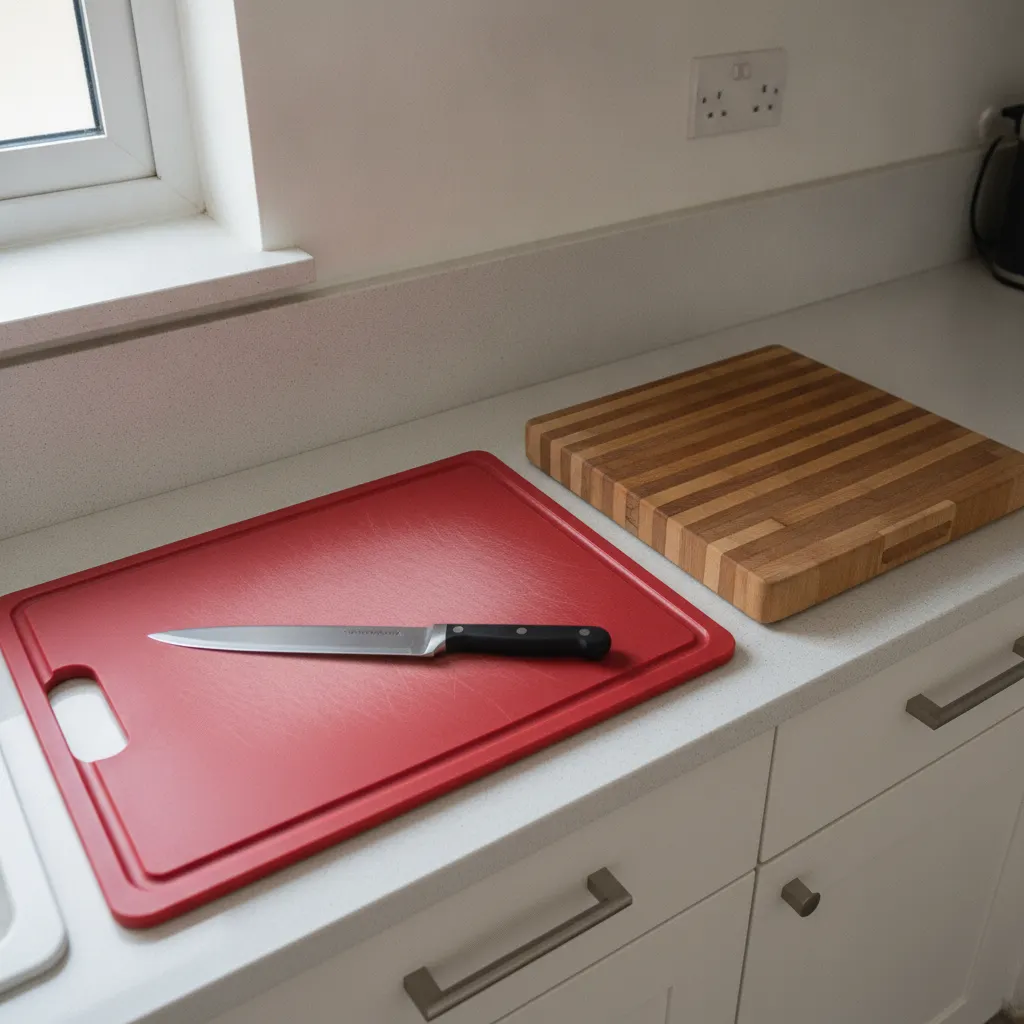
I went through three chopping boards in my first Brighton flat in under a year. Not because they wore out — because I had no system. One board, used for everything, dark stains I couldn't shift, and a review that mentioned "a slightly worn kitchen." The review was about more than the board but the board was part of it. I replaced everything in the kitchen that January.
Now I run two boards per property. A large white plastic board for meat, a mid-size wooden board for bread and vegetables. Both replaceable on Amazon within 24 hours if needed. Both part of a three-month inspection cycle. It's not complicated but you have to decide on it — otherwise it doesn't happen.
Plastic vs wood: what actually works in a rental kitchen
The argument for wood is aesthetics. An end-grain walnut board on the kitchen counter looks the part. Guests photograph it. It appears in their Instagram stories alongside the artisan coffee pods. That's genuinely useful social marketing for your listing.
The argument against wood is hygiene and guest behaviour. In my own kitchen, I wash and dry a wooden board immediately after every use. In a rental kitchen, guests don't. They leave a wet board on the counter overnight with raw chicken residue on it. Wood is porous — bacteria survive in scratches and knife cuts in ways they don't on plastic, which can go through a dishwasher at 65°C. The Food Standards Agency guidance is clear that plastic is easier to maintain hygienically than wood, particularly for raw meat preparation.
My compromise: wooden board for bread, fruit, cheese — things that don't involve raw meat and don't go through the dishwasher. Plastic board for everything else, dishwasher after every turnover.
Colour-coded boards: do you need them?
Commercial kitchens use colour-coded boards as a legal requirement under HACCP food safety management. Red for raw meat, blue for raw fish, green for vegetables, yellow for cooked meat, white for dairy and bakery items. This is professional catering regulation, not domestic law.
In a private rental property, you are not running a food business and HACCP doesn't apply to you. The FSA's advice for domestic settings is simpler: use separate boards for raw meat and ready-to-eat foods, and wash thoroughly in hot water or the dishwasher between uses.
That said, colour-coded boards make the separation obvious to guests who don't read instruction cards. I tried the full commercial set (red and green, from a catering supplies place on Amazon, around £12 for both) in my Lake District cottage after a guest complained that there was only one board. The red-for-meat green-for-veg division was immediately clear to everyone without explanation. It's stayed.
What size boards work for a rental
Big. Bigger than you think. Guests find small boards frustrating — you can't chop a whole chicken breast without the food falling off the edge, which leads to guests using the counter as a cutting surface and you replacing scratched worktops.
My minimum is 35cm × 25cm for the main chopping board. The IKEA 365+ plastic board (currently around £5) is 38cm × 28cm, dishwasher safe, and replaceable without thought. It's not beautiful but it does the job without any drama. I've put it in three out of my five properties. The other two have a slightly nicer option because the properties are higher-end, but the IKEA board outlasts more expensive alternatives in my experience precisely because it's easy to replace without guilt.
For the wooden bread board, the Joseph Joseph range has several options around £20–25 that look good and hold up for twelve to eighteen months before they start looking worn. I replace them when the surface starts to show visible knife cuts and the oil treatment no longer absorbs cleanly.
The three-month replacement cycle
Plastic boards: replace at any point you see deep knife grooves, discolouration that won't come out in the dishwasher, or any cracking at the edge. In my busier properties — the Brighton flats doing 85–90% occupancy — I replace the plastic boards roughly every four months. At £5 for an IKEA 365+, this costs me £15/year per property. That's not a budget line worth optimising.
Wooden boards: oil quarterly (food-safe mineral oil, around £8 for a 500ml bottle that lasts a year). I use a cloth to work it into the surface, leave overnight, wipe off any excess in the morning. A well-oiled board resists moisture absorption and surface bacteria significantly better than a dry one. Replace when oiling no longer restores the surface — usually after 12–18 months with average rental use.
Inspect on every turnover, replace on the three-month cycle regardless of visible wear if the property is high-occupancy. The cost of a replacement board is lower than the cost of a food hygiene complaint in a review.
Cleaning between turnovers
Plastic boards: dishwasher, hot cycle. That's it. If there's visible staining, a paste of bicarbonate of soda and white vinegar left for 15 minutes before the dishwasher cycle will lift most of it. Don't use bleach on plastic boards — it degrades the plastic faster and can leave a residue that affects food taste.
Wooden boards: never the dishwasher. Hot water and washing-up liquid, immediately after use, dried standing upright (not flat). The flat-drying position keeps the board wet for longer and promotes warping. Standing upright dries both surfaces and the board stays flat. If you've left a wooden board lying wet for any length of time and it warps, it's effectively a bin item — a warped board rocks on the counter and is annoying enough to generate a guest comment.
For sanitising between turnovers, a spray of white wine vinegar left for two minutes, then wiped, works fine on both materials for general surface bacteria. For anything involving raw meat, the plastic board goes in the dishwasher and that's the standard.
The kitchen check on turnover
My cleaner runs through a specific kitchen check on every turnover. Boards are part of it: check for deep grooves, check for staining, check that the board is in its designated spot (counter left-side for the wooden one, under the counter in the cupboard for the plastic one, so guests have both available but aren't tripping over them).
She's flagged three boards for replacement in the last year. Each time I've had a replacement there within 48 hours. One of those was a wooden board that had warped after a guest left it in a puddle of water on the counter for a four-night stay. The board cost me £22. The alternative was a guest finding it and mentioning it in a review. Worth the £22.
What I put in the kitchen instructions
A single line: "Red board: raw meat only. Wooden board: bread and cheese. Both dishwasher-safe, but the wooden one prefers hand washing." Guests read it and follow it. Not everyone, but most. The instructions live in the laminated A5 card I put in every kitchen — same card that has the WiFi password and the bin day.
The red board instruction is the most followed. People understand the raw meat rule even if they've never thought about it. The wooden board request is less followed — it still occasionally goes in the dishwasher and comes out slightly warped. At £22, that's an acceptable loss.
Boards are one of those kitchen items that guests judge subconsciously. A clean, intact board signals a kitchen that's looked after. A stained, grooved one — even if everything else is fine — creates doubt. For £20 per year in replacements, it's not worth the doubt.
Ready to streamline your inventory?
Start managing your rental inventory smarter with automated stock tracking.
Start Free Trial