Cookware sets for Airbnb: the 3-piece set I keep reordering and what I'd never buy again
Hoststock Team
18 August 2026
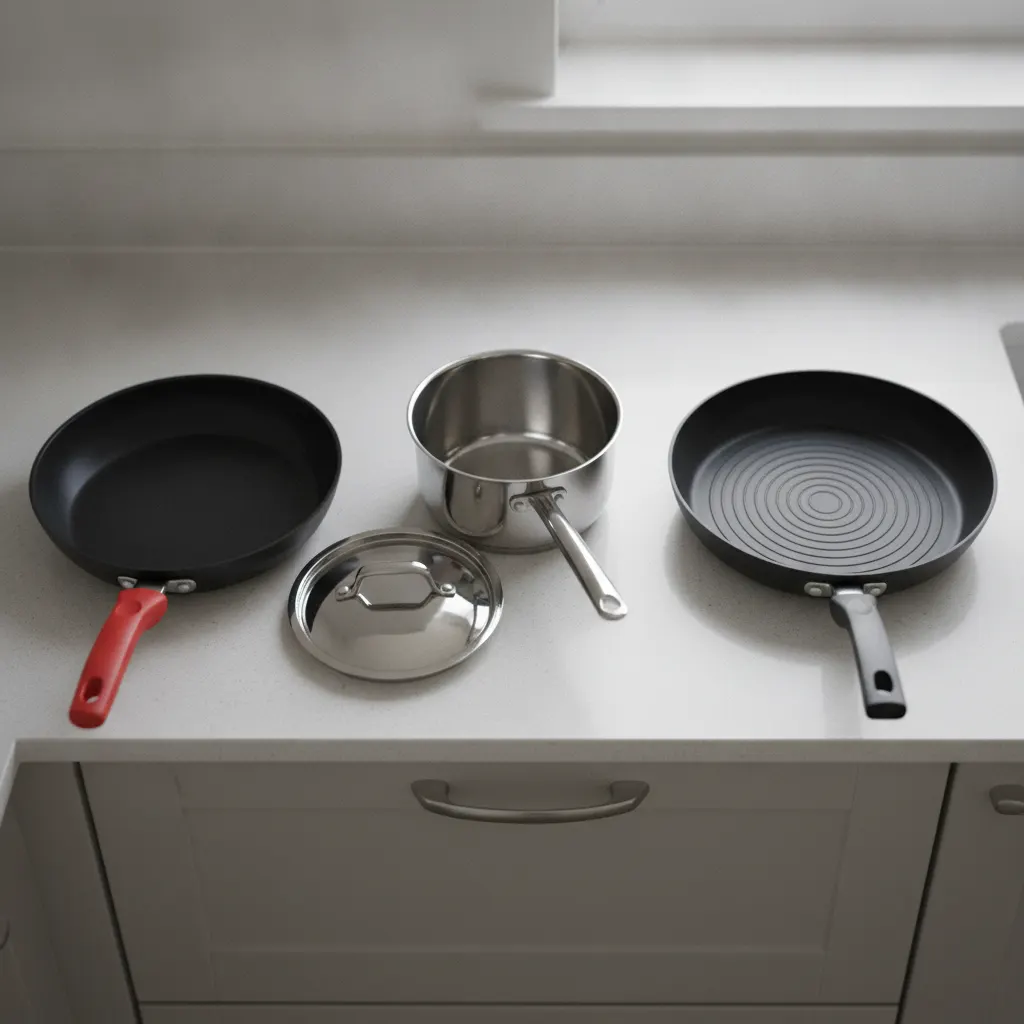
The pan that made me pay attention
It was the third frying pan replacement in six months. Same flat, same hob, different brand each time. The first one I bought from IKEA — a Vardagen that looked solid and cost about £18. It warped within eight weeks. The second was a non-stick from Tesco, which my cleaner reported "smelled funny" after a guest complained. Third was a budget Tefal. That one actually lasted, though I didn't know it would when I bought it.
At that point I started writing down what I was buying and what was happening to it. Not obsessively — just a notes app list. It's become quite long. Nine frying pans, four saucepan sets, two woks, various lids that don't match anything. And across five Airbnbs I now have a fairly clear picture of what survives guest use and what doesn't.
The problem with Airbnb cookware is not the guests
I thought the problem was guests using metal utensils on non-stick. It's part of it. But the bigger issue is heat. Guests heat pans too high, too fast. They put cold pans on a high-heat hob and leave them. They don't do this maliciously — it's just how most people cook at home when they're not paying the electricity bill. A pan that would survive years of careful home use fails in six weeks of short-stay use because it's getting blasted on full heat six mornings a week.
Knowing this changed what I look for. I stopped optimising for non-stick coating quality and started optimising for base thickness and heat distribution. A thick base on an induction-compatible pan spreads heat more evenly and is much less likely to develop the hotspot warping that kills cheap pans.
What I tested and what happened
IKEA Vardagen (£18): Warped on two separate occasions across two properties. Both times on induction hobs. The base is not thick enough for the way guests use hobs. Don't buy this for an Airbnb.
Tefal Ingenio (from £22 for a single pan): This surprised me. The detachable handle concept I thought was gimmicky actually works well in Airbnbs — it means guests can't damage the handle as easily, and you can fit more pans in a smaller cupboard. The non-stick holds up reasonably well. I've had one Ingenio pan across two years and two hundred turnovers at my Edinburgh Newington flat and it's still usable, though I'll replace it this autumn.
Circulon Momentum (around £30-35 per pan): The ribbed non-stick design does seem to be more resilient to metal utensils than flat coatings. I've got a 28cm Circulon at my Brighton flat and it's been through eighteen months without warping or flaking. The downside is it's harder to clean — bits get in the grooves. My cleaner made her feelings clear.
ProCook Professional Steel (around £40 per pan): Stainless steel. Heavier than non-stick equivalents. Requires slightly more skill to use without sticking. And it doesn't care how many times a guest blasts it on maximum heat, because there's no coating to damage. I've got one in the Lake District barn where the guests tend to be more experienced cooks (middle-aged couples, foodies — the demographic that books a rural cottage for the kitchen). Zero problems in nine months.
Zwilling Madura Plus (around £35): Good non-stick, heavy base, handles that stay cool for longer than most. I bought two for my second Edinburgh flat after seeing them recommended on a hosting forum. Both survived the first year intact. The coating is noticeably more resilient than budget non-stick, though I wouldn't say it's indefinitely durable. Plan to replace in eighteen months to two years.
What I actually reorder
For the majority of my properties — the Edinburgh flats, the Brighton flat — I now stock Tefal Ingenio non-stick pans in 24cm and 28cm, plus a ProCook stainless saucepan set. Total cost per property: approximately £90-110 for a full functional kitchen's worth of pans.
The Ingenio pans get replaced every eighteen months to two years, depending on use. The ProCook saucepans I haven't had to replace yet in three years, which tells you something about stainless vs non-stick for durability.
I don't stock woks in most properties. Too specialist, too often damaged, guests either can't use them or use them badly. The one exception is my Lake District barn, which gets longer stays from people who actually cook properly. There I've got a Lodge carbon steel wok that has developed a nice seasoning over eighteen months and requires absolutely no non-stick coating to protect.
Induction vs gas: this matters for pan selection
Three of my five properties have induction hobs. Two have gas. This is a crucial variable because induction is significantly harder on cheap pan bases — the magnetic heating causes much faster warping if the base isn't thick enough.
For induction properties I only buy pans with induction-compatible bases rated at least 3mm thick. This rules out a lot of budget non-stick. For gas properties, the heat distribution is gentler and I can get away with slightly lighter pans without the warping risk. My Brighton flat is gas, which is partly why the Circulon there has lasted so well.
If you're setting up a new property and have a choice, induction is better for energy efficiency and faster to heat — but stock heavier pans, or you'll be replacing them every six months.
The storage question people never think about until a guest complains
I had a three-star review mention that "the pans were difficult to access and stored badly." The guest was right. I'd been stacking pans inside each other without any kind of separator, which was slowly scratching the non-stick of the bottom pan in each stack. I spent £12 on a set of silicone pan protectors from Amazon and the problem went away.
I also switched from a full-height cupboard with pans stacked on the floor to a pull-out base unit with a pan rack at my Edinburgh main flat. This cost about £80 in kitchen fitting time but it means guests can see and access pans without pulling everything out. Obvious in retrospect.
The one thing I'd tell myself three years ago
Don't buy the cheap non-stick on pure cost grounds. A £18 IKEA pan that fails in eight weeks costs you more than a £35 Tefal that lasts two years. The maths is obvious. The reason you buy the cheap one anyway is that it feels like less commitment — you're not admitting the pan is a recurring cost line.
It is a recurring cost line. Accept that, build it into your expenses spreadsheet, and stop buying pans that make your cleaner sigh when she finds them. The ProCook stainless set I mentioned is probably the lowest total-cost-of-ownership option across a multi-property portfolio for saucepans — buy it once, basically never replace it. For frying pans, the non-stick will always eventually fail; the question is how long you get between replacements and whether the coating fails safe (scratches off and goes into guest food) or just stops being non-stick.
The ProCook and Tefal Ingenio combination has been the most durable thing I've found for a standard 1-2 bed flat. Your properties might be different — the ProCook is probably overkill for a studio with a two-ring hob — but the principle holds: thicker base, induction-rated if needed, and a handle that won't wobble after thirty heavy cooking sessions.
Lids, utensils, and the accessories nobody mentions
Lids disappear. I have no idea where they go. I buy pans with lids, and within a year the lids are somewhere else — broken, mismatched, or just gone. I've stopped buying pan sets with lids included and started buying universal glass lids separately in three sizes. Cheaper, and when they break (they do), I'm not replacing a whole set.
Utensils: silicone. Only silicone. I put a note on the inside of the kitchen cupboard: "Non-stick pans — please use the silicone utensils in the drawer, not metal." About 60% of guests follow it. The other 40% don't. This is why you buy pans with a resilient coating rather than relying on guest behaviour.
Colander in each property, one wooden spoon, one fish slice, one set of tongs, a can opener, a potato masher, a box grater. That's it. Anything more specialist than that gets misused or not used. I went through a period of stocking my properties like a proper kitchen and the result was more complaints about equipment not being found, not fewer.
Ready to streamline your inventory?
Start managing your rental inventory smarter with automated stock tracking.
Start Free Trial