Airbnb damage deposit alternatives: what I use now that security deposits are gone
Hoststock Team
7 October 2026
For most of my hosting life I ran a £200 security deposit on Airbnb. Or I thought I did. I assumed it was sitting there as a deterrent, as a buffer, as something between me and a guest who decided to burn holes in my sofa.
Turns out Airbnb removed the ability for most hosts to set security deposits a while back. Their policy now says most hosts cannot collect deposits either through the platform or outside it. What replaced it was AirCover — which offers up to $3 million USD in damage reimbursement and $1 million in liability insurance. On paper this sounds much better than a £200 deposit. In practice it's more complicated.
What AirCover actually covers
AirCover is genuinely decent for large claims. If a guest trashes a room, breaks expensive furniture, or causes significant damage, the $3 million cap is not the binding constraint — the evidence requirements and the dispute process are.
Where AirCover struggles, and where I've had claims partially denied:
- Small damage below around £150 that isn't worth the time to document and dispute
- Items that wear out faster due to guest use but aren't damaged in a single discrete event
- Missing items where there's no clear evidence the guest took them (my post on what guests steal covers this)
- Claims where I didn't have a thorough enough check-in photo log
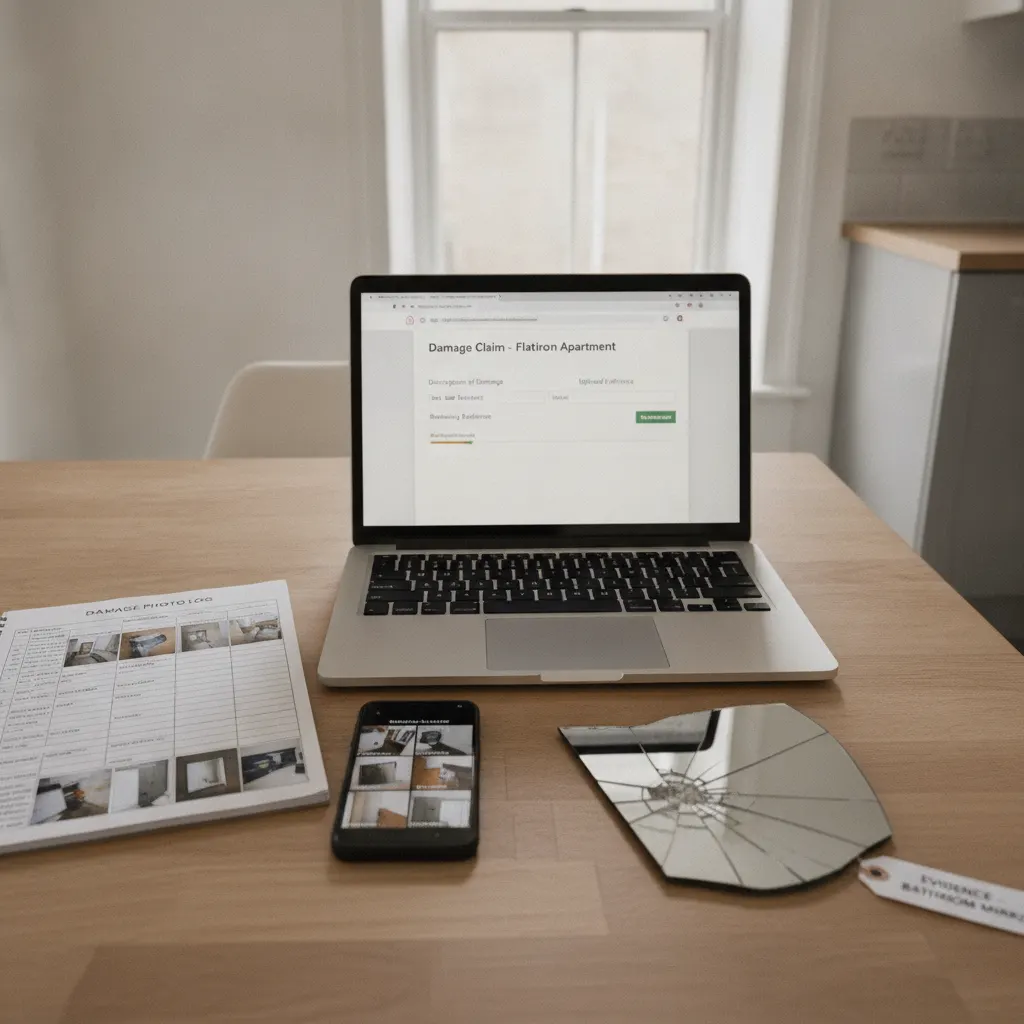
The photo log point is the critical one. AirCover requires you to document the pre-existing condition of your property at check-in and then document the damage at check-out. Without timestamped photos, contested claims can go against you. I've been through this twice.
The three-layer approach I now run
No security deposit doesn't mean no protection. It means you have to build it differently.
Layer one: a serious photo protocol. Every turnover, my cleaner photographs the property at the end of the clean before the next guest arrives. Not a vague wander around with a phone — a specific 40-photo protocol covering every room, every surface, every piece of furniture. The photos are timestamped and uploaded to a shared folder. When a guest checks out, my cleaner does the same walk-through again. Any damage is photographed immediately and logged before anything is cleaned or moved.
This has made my AirCover claims significantly more successful. The third claim I've filed (a smashed wardrobe mirror) paid in eight days with no dispute because the evidence package was clean.
Layer two: Superhog. Superhog is a third-party damage protection provider that works alongside Airbnb and other platforms. Guests complete a brief ID verification process and agree to a damage waiver before arrival. If there's damage, you claim through Superhog rather than Airbnb's Resolution Centre. The process is typically faster and the small-claim threshold is lower.
I've been using Superhog on three of my five properties for about fourteen months. The guest verification process generates some friction — I lose an estimated 5–8% of direct bookings where guests don't complete the check. But for my direct booking channel specifically, it's been worth it. The one mid-sized claim I filed through them (a broken bathroom cabinet, £340 replacement) was settled in eleven working days with minimal back-and-forth.
Superhog isn't free — there's a per-booking fee that currently runs me between £3.50 and £5 depending on the plan. Across a busy property, that's roughly £350–500 a year per listing. Factor that into your calculation.
Layer three: pricing in the expected breakage and loss. I wrote about this in an earlier post — I add roughly £2.40 per night across all my properties to cover the expected annual cost of breakage and missing items. This isn't a deposit, it's a reserve. At 65% occupancy across five properties, that generates around £1,750 a year that covers the sub-£150 stuff that isn't worth a claim and the AirCover grey zone.
For Airbnb bookings specifically
On Airbnb you're primarily relying on AirCover plus your photo evidence. The things that make AirCover work:
- File within 14 days of checkout — the clock starts the moment the guest leaves
- Itemise every piece of damage with photos, replacement costs, and links to replacement products where relevant
- Contact the guest first via the Resolution Centre before escalating to Airbnb — the platform requires you to attempt this
- Don't accept a partial offer you're unhappy with without requesting escalation
The process is designed to favour resolution, but it also strongly favours the host with documentation. Hosts who lose claims almost always lose because they can't prove the damage happened during the guest's stay.
What about off-platform deposit services?
There are services like Swikly that let you collect a security deposit from guests for direct bookings. For Airbnb bookings, Airbnb's terms prohibit collecting additional charges from guests outside the platform (except where Airbnb explicitly permits this, which is a narrow category). Don't try to collect a deposit outside Airbnb for Airbnb bookings — the downside risk if a guest disputes it through Airbnb is worse than the damage you're trying to protect against.
For direct bookings, off-platform deposit tools are legitimate and worth considering. Swikly in particular has a reasonable UK presence among STR operators. The deposit is held in escrow rather than actually charged, which tends to reduce friction with guests while still having a real deterrent effect.
The honest risk assessment
I've been running five properties without a traditional security deposit for about eighteen months now. In that time I've had three damage claims through AirCover (one fully paid, one partially paid, one pending), one through Superhog (paid), and several sub-£100 losses I wrote off against the pricing reserve.
Total damage and loss costs over eighteen months, across five properties, across roughly 450 stays: about £2,800 net of what AirCover and Superhog reimbursed. That averages to just over £6 per stay, or about £186 per property per year.
That's manageable. It's uncomfortable in individual months when something expensive breaks, but across time it's predictable enough to plan around.
The £200 security deposit I thought I had for years was mostly psychological. It didn't actually get drawn on unless something went badly wrong, and even then the Airbnb process to access it was complicated. What I have now — photos, Superhog for direct bookings, AirCover for Airbnb, and a pricing buffer — is genuinely more robust than what I had before, even if it doesn't feel like it.
The one thing I'd tell a new host
Start the photo protocol immediately. Before any other part of this framework. The evidence issue undermines everything else — no matter how good your protection is, you can't claim on damage you can't prove.
Forty photos per turnover sounds like a lot. After the second one it takes twelve minutes. After the tenth it's automatic. That twelve minutes is the best damage insurance money doesn't buy.