Damage photo logs for Airbnb: the system that saved me £340 in an AirCover claim
Hoststock Team
23 August 2026
The claim I nearly lost
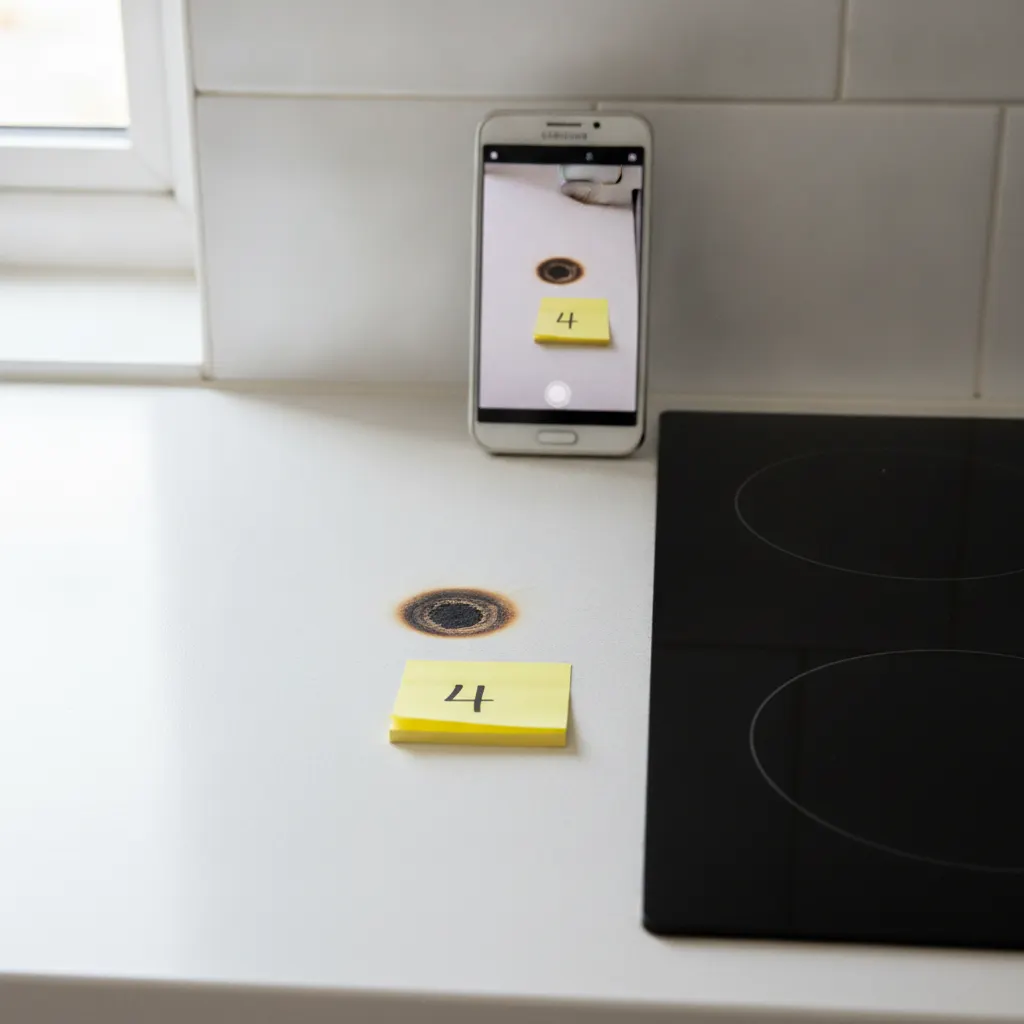
About eighteen months in, a guest put a burn mark on the kitchen worktop in my Brighton flat. Not huge — about the size of a 50p piece, from a pan placed directly on the laminate without a heat pad. Enough to require the entire section of worktop replacing because the laminate was discontinued and you couldn't patch it. The quote came to £340.
I filed an AirCover Host Damage Protection claim. Airbnb came back and asked for proof that the damage wasn't present before the stay. I had the cleaner's message saying the flat was ready, and a listing photo from a year earlier. I did not have a timestamped pre-stay photo of that specific section of worktop. The claim was initially queried — not outright refused, but I was asked to provide more evidence and the resolution dragged on for six weeks before Airbnb eventually paid out a reduced amount.
The problem was clear: I had no systematic way of documenting the property's condition immediately before each booking. I was relying on the cleaner's "it's ready" message, which proved very little in a dispute.
How AirCover claims actually work
Based on my experience filing three claims over four years, here's what the process looks like in practice:
You need to report damage to Airbnb within 72 hours of discovering it. Not 72 hours after checkout — 72 hours from the point you found the damage. In practice this usually means reporting on the day your cleaner goes in, because that's when damage gets discovered. If your cleaner goes in 48 hours after checkout for a same-day check-in reason, and then finds the damage, you've still got time. But you've used most of your window.
You then have up to 60 days from the reservation's checkout date to submit a formal Resolution Centre request — the full claim including repair quotes and evidence. That 60-day window sounds generous, but getting a quote from a tradesperson often takes 2-3 weeks, and by the time you've got the quote and the evidence together, you're sometimes getting close to the deadline if you started late.
What Airbnb needs from you: photos showing the damage, a photo showing the property's condition before the stay (to prove the damage is new), repair quotes, and any communication with the guest. The "before" evidence is the thing most hosts don't have, because they haven't been taking systematic pre-stay photos.
The photo system I run now
After the worktop claim, I put a simple protocol in place. My cleaners take a standard set of photographs after every checkout clean, before any new guest arrives. The photos are uploaded to a shared Google Photos album — one album per property — and the timestamp embedded in the photo file is the check-in authorization timestamp.
The photo set for each property covers:
- Every room, wide shot from doorway
- Kitchen worktops (both sides if L-shaped), close-up
- Hob surface
- Kitchen floor including corner areas near appliances
- Bathroom including bath or shower tray, toilet, floor
- All furniture upholstery — sofas, armchairs, dining chairs
- Bed frames (corners where guests sometimes damage them moving the bed)
- All external-facing walls and windowsills inside
- Any existing damage that was pre-existing and documented (I put small numbered sticker labels on pre-existing scuffs and photograph them with the label visible)
For a one-bed flat this is about 25-30 photos. For a two-bed, around 40. My cleaners do it in about five minutes — it's become part of their checkout routine and they barely think about it now. The whole set goes into the shared album, named by date, and sits there ready to be pulled if a claim arises.
The numbered sticker system for pre-existing damage
This is the thing I'd never have thought of without getting burned by the first claim. Every property has a reference sheet — a printed A4 page — that lists pre-existing damage in each room. Small scuff on the skirting board in bedroom 2: sticker 3. Chip in the kitchen cupboard door near the hinge: sticker 7. Each sticker is a small numbered adhesive label (the kind used for garage sales or office filing) stuck discreetly to or near the damage.
When the pre-stay photos are taken, the cleaners photograph each labeled damage point with the number visible. The label confirms this is documented pre-existing damage, not something new. If a guest tries to claim that damage was there when they arrived, I have a timestamped photo of that damage with a label on it from before the booking started — and I can show the damage was already there and already known.
The label system also protects guests from being held responsible for things that were already damaged. I've had that happen once in the other direction — my second Edinburgh flat had a small crack in a bathroom tile that a previous guest had damaged and I'd not gotten around to fixing. The next guest's checkout photos showed the crack, my cleaner thought it was new, and I nearly filed a claim before I found the earlier photo set with the labeled tile already present. I'd have been filing a fraudulent claim by accident.
What saved me in the third claim
Third AirCover claim, different property: a guest damaged a dining chair — the leg was cracked, clearly from someone sitting on it sideways or leaning it back. Quote for the replacement chair (it was from a matching set, so replacing just one would have left a mismatched set): £185.
I had: a pre-stay photo of that chair, timestamped 14 hours before the guest checked in, showing no visible damage. I had the post-stay cleaner photo showing the crack. I had a message from the cleaner sent the morning of checkout describing the damage. And I had the repair quote from a local furniture supplier.
The claim was reviewed and paid in eleven days. No querying of the evidence, no back-and-forth. The pre-stay photo did the work.
What to do if you don't have a cleaner
Some hosts manage their own turnovers. If that's you, the same system applies — you're just the one taking the photos rather than delegating it. The key is consistency: same set of photos, every single checkout, uploaded immediately. Not "I'll do it when I'm next at the property" or "I'll send the photos if something seems damaged." Every checkout, without exception.
The cleaners who take photos well are the ones who understand why they're doing it. I explained the AirCover claim situation to my Edinburgh cleaner when I set up the system. She now takes the most comprehensive set of photos of any property — she's been on the receiving end of a guest claiming they didn't cause damage that she'd clearly seen them cause, and she has strong feelings about documentation.
The one thing the photos can't fix
Wear and tear. AirCover doesn't cover normal wear and tear — and Airbnb takes that seriously. If a guest puts a minor scuff on a wall that was already slightly marked, or a carpet shows guest footfall that just accelerated existing wear, that's not a claim. The photo system helps you demonstrate that damage is specific and new, not gradual wear — but it doesn't change what's claimable under the policy.
My rule: if a repair or replacement is something you'd have had to do in the next six months regardless of the guest, it's probably wear and tear. If it's something that would have been fine for another two years but is now unusable after one stay, it's a claim. AirCover pays for damage, not for accelerated aging.
The photo log keeps me honest about that distinction too. Looking back at the pre-stay photo of a worktop that a guest has damaged, I can see whether it was already in marginal condition. Sometimes it was, and I accept that and move on. Most of the time it wasn't, and the documentation I have makes the claim straightforward.
Ready to streamline your inventory?
Start managing your rental inventory smarter with automated stock tracking.
Start Free Trial