Dehumidifiers for Airbnb: the damp wall complaint that cost me £47 and what I run in my Edinburgh flat
Hoststock Team
25 August 2026
The £47 lesson
My first damp complaint landed in October 2022. Three-star rating. 'Slight musty smell by the window' — four words in the review that I couldn't remove and couldn't respond to convincingly without sounding defensive. Edinburgh, B-listed Victorian terrace, solid stone walls that don't breathe like modern construction.
I partially refunded that guest — £47, which felt like giving money away at the time. Looking back, it's probably the cheapest lesson I've bought in four years of hosting.
Why Edinburgh flats are damp nightmares
Not all of them. But if you're running an STR in a pre-1970s tenement or terrace in Edinburgh Old Town or Marchmont, chances are you're fighting condensation at some point in the year. Guests cook. They shower. They forget to open a window in November because it's 4°C outside. Moisture builds up in the air, hits the cold north-facing wall, and condenses. Then it grows.
The stone construction is part of it. Solid sandstone walls with no cavity and little or no insulation don't behave like modern cavity-wall builds. I know a host with two properties in Broughton Street who runs a dehumidifier in each through winter and considers it a cost of doing business.
What I tried first
My first instinct was ventilation. I replaced the bathroom extractor fan with a longer-running timer model. About £84. Helped marginally in the bathroom. Did nothing for the bedroom where the complaint happened — the room doesn't have an external vent.
Then I tried a desiccant product. One of those Unibond AERO 360s. Fine for a wardrobe or a cupboard. Not going to do anything meaningful for a 12m² bedroom with three guests cooking most evenings.
Then I bought a proper dehumidifier.
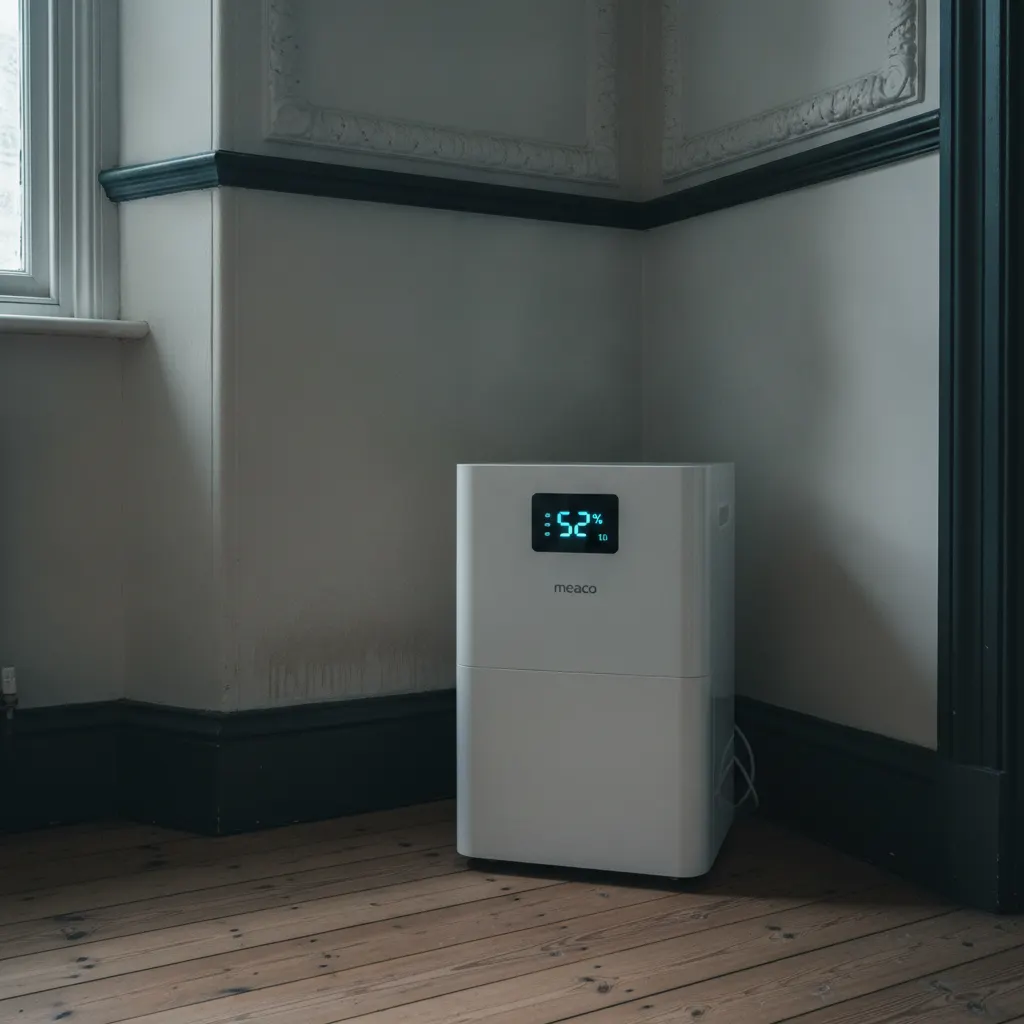
The Meaco MeacoDry ABC 10L
I went with the Meaco MeacoDry ABC 10L after reading through a fair number of hosting communities and finding that Meaco kept coming up as the brand that didn't fall apart after a season. Currently £129.99 directly from Meaco's website. They also appear on Amazon with varying availability.
The 10-litre figure refers to daily moisture extraction capacity — how many litres of water it can pull from the air per day under ideal conditions. For a 2-bed Edinburgh flat that's prone to condensation, it's sized appropriately. Could get away with a smaller unit in some cases, but I'd rather have capacity headroom.
The main things that matter in an STR context: noise and tank size. Neither should be a problem for your guests. The ABC 10L is quiet enough that it can run overnight without complaint — I've never had a guest mention the noise. Tank capacity is 3.5 litres; running overnight for 8 hours in December, it typically extracts about 1.5–2 litres. Fine for a 3–4 night stay without needing to drain it.
Running cost
This is where I usually see vague claims on the internet. A 10L dehumidifier draws somewhere in the region of 190–240W depending on mode and ambient conditions. I run mine at roughly 220W average. At current electricity unit rates, running it for 8 hours overnight costs about 40–45p per night. That's around £12–14/month if you're running it every night through December, January, February.
Not nothing. But compared to a £47 partial refund and a three-star review that's now permanently visible on my listing? It's not a remotely close calculation.
How I set it up for guests
You can't just leave a dehumidifier in the corner of the bedroom and expect guests to manage it. I position mine in the hallway rather than in the bedroom itself. A properly sized unit will draw from the whole flat at that position, especially in an open-plan layout. I run it on a timer so it cycles during off-peak hours — roughly midnight to 6am — which means the tank doesn't fill during the stay and guests don't need to think about it.
For longer stays, I include a note in the guidebook: a photo of the unit, where the tank is, how to empty it. Nobody has managed this incorrectly yet. At every turnover, checking and emptying the tank takes about 30 seconds.
Two winters later
Zero damp-adjacent review mentions since October 2022. The relative humidity in the Edinburgh flat used to sit between 65% and 75% in winter, based on my Mi Home sensor on the windowsill. With the dehumidifier running, it stays between 45% and 55%. That matters because mould and musty odours need sustained humidity above 60–70% to establish. You're not trying to create a desert — you're just keeping the flat below the threshold where problems start.
The Lake District cottage is a different problem
Stone barn conversion, one kilometre from the nearest proper road. A lot of rain, and guests who leave wet walking gear inside and don't think to open a window. For that property I run a larger unit — the Meaco MeacoDry Arete One 20L at £259.99. Bigger extraction capacity, built-in air purifier, 5.5L tank. The larger tank matters more here because changeovers are less frequent and I can't rely on guests to empty it mid-stay. I set it on a 55% humidity target and leave it to cycle automatically.
The 'what if guests break it' argument
I occasionally see hosts say they won't add appliances guests can misuse. Dehumidifiers are genuinely low-risk. No heating element a guest can touch. No sharp edges. The only real failure mode is someone walking into the drainage tube, which hasn't happened to me. And even if it did: a replacement MeacoDry ABC 10L is less than the cost of one disputed partial refund.
If you're running a Victorian-era property in Edinburgh, Glasgow, or any damp-prone UK city and you haven't got a dehumidifier in it yet, this is probably the most cost-effective operational upgrade you're not making.