Airbnb digital guest guidebook: what I cut from 47 pages down to 9
Hoststock Team
3 July 2026
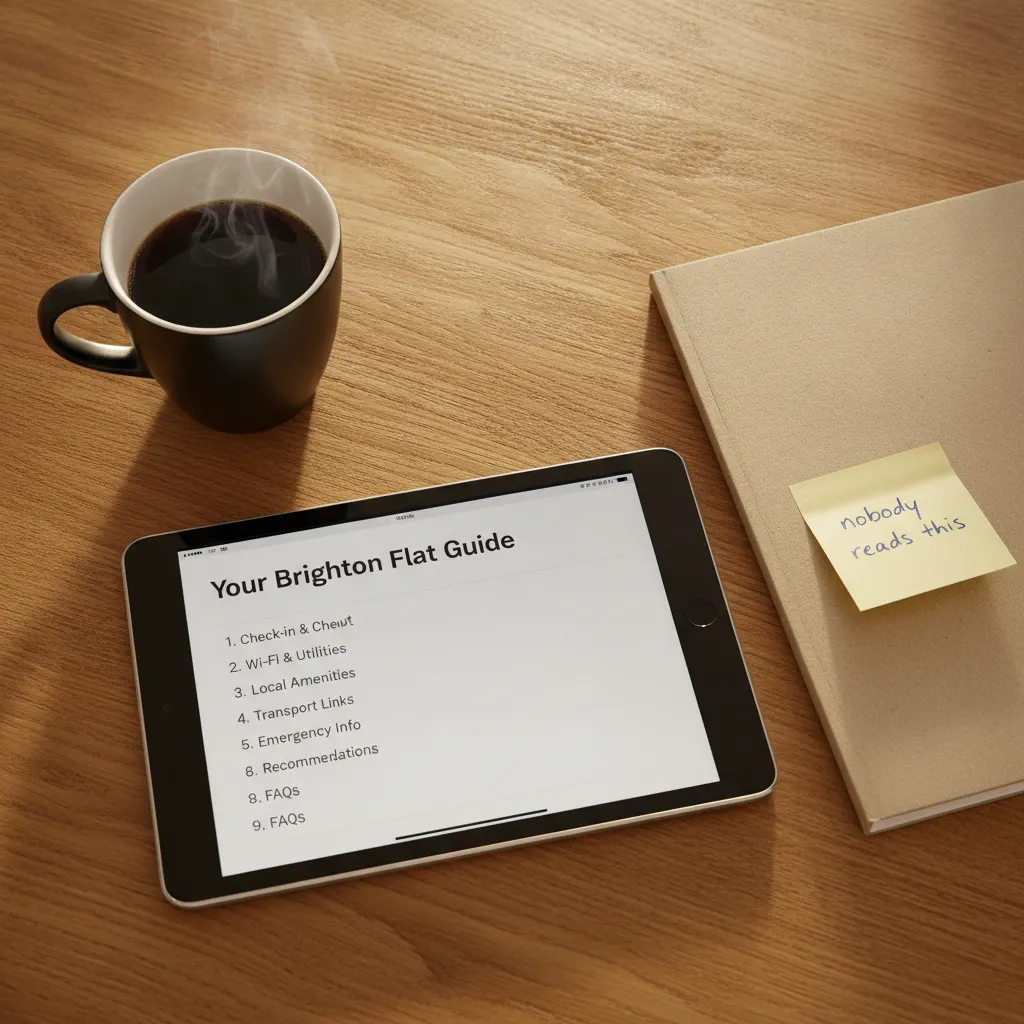
My first guest guidebook was a labour of love. A 47-page PDF, formatted in Canva, with custom icons and a hand-drawn map of the local area I'd commissioned off a graphic design student for £40. It had a section on 'the neighbourhood's history.' It had a 'tips for exploring' section with six walking routes. It had a full page on how to use the dishwasher, with annotated photographs.
I know nobody read it because I had, on average, three questions per booking that were answered in detail somewhere in those 47 pages. The history section — which I was quite proud of, to be honest — generated zero interactions. The dishwasher page generated one guest comment about how thorough I was, followed immediately by a message asking me how to use the dishwasher.
The problem with long guidebooks isn't the information — it's the length. When something is 47 pages, guests see 47 pages and don't start. When something is 9 sections and takes about four minutes to read, guests scan it and retain the bits they need. I've been running the 9-section version for about 18 months across four properties and the 'where is X' messages have dropped off a cliff.
What I cut and why
Everything local that guests can find on Google. Walking routes, restaurant recommendations, market days, the local pub's opening hours — none of this belongs in a guidebook. It goes out of date constantly, guests already have Google Maps, and it adds length without adding operational value. I replaced my local section with three sentences: the name of my favourite local coffee shop, one restaurant I'd genuinely recommend, and a line about parking.
The history of the neighbourhood. Just gone.
Anything longer than six steps. If an appliance instruction takes more than six bullet points to explain, I either need a simpler appliance or I need to be there in person to show you. For anything genuinely complex — the boiler in the cottage, say, or the specific controls on the underfloor heating — I've made a 90-second video and linked it. Guests watch a 90-second video. They don't read a 400-word appliance manual.
The 'house rules' section I'd duplicated from my Airbnb listing. If it's already in the listing, it doesn't need to be in the guidebook too. The guidebook is for things that help the guest, not for things that protect me legally.
The 9 sections that stayed
Every property is different, but these are the sections I run across all four of my properties, adjusted slightly per property.
1. How to get in. Door code, backup code if applicable, what to do if neither works (my number, plus a backup number for my cleaner/keyholder). This is the one section guests read first and most carefully. Keep it short. Mine is four sentences.
2. Wifi. Network name and password, in large enough text that you can read it from across the room. Nothing else. No 'please use responsibly' caveat. Just the password.
3. The five things most guests ask about. For each property, I tracked what questions I was getting most often, and the top five became their own section. At the Brighton flat, these are: how the shower pressure adjustment works, where the extra linen is, how the Nespresso machine capsule drawer opens, whether the outdoor courtyard gate key is the same as the front door key (it is), and what time the bins go out. Different properties, different top fives.
4. Appliances that need a word. The dishwasher, the washing machine if guests can use it, the hob if it's induction (some guests have never used induction; it's worth covering in two sentences), the heating controls. Six bullet points maximum per appliance.
5. Checkout. Six bullet points. Lock the door. Leave the key in the lockbox. Leave towels in the bath. Switch off the hob and lights. That's it. No multi-paragraph checkout essay. Guests who get a long checkout list just feel vaguely oppressed by it.
6. Emergencies. What to do if the boiler goes out (pilot light location, reset button, when to call me). Nearest A&E. Gas escape: leave immediately, call 0800 111 999. This section is short but guests are glad it's there if they ever need it.
7. Local food. Two sentences. My actual favourite place, one practical note (the Sainsbury's Local is five minutes and open till 11pm). That's it.
8. Parking. If applicable. Specific instructions, permit numbers if relevant, any time restrictions. For properties where parking is straightforward, this section doesn't exist.
9. How to reach me. My phone number, response time expectations ('I'll reply within an hour in the daytime, usually faster'), and one line about the local property manager who can help with physical issues when I'm not nearby.
How I deliver it
I've tried several formats. The 47-page PDF was obviously wrong. I then tried a Google Doc link, which was better but felt impersonal and had some formatting issues on mobile. I now use a basic approach: the guidebook is a mobile-formatted web page, hosted on Notion — free, easy to update, and it renders well on a phone, which is what 90% of guests are reading it on.
I send the link about 48 hours before arrival in a pre-arrival message that also includes the door code. The message reads something like: 'Your check-in code is XXXX. Your guidebook is at [link] — it's short, worth a quick read before you arrive.' The casual note that it's short has made a real difference to whether people actually click on it.
I've also heard good things about Hostfully, Touch Stay, and a few other dedicated guidebook platforms. I've not switched because Notion is free and already does what I need. But if you're managing more than about 10 properties, a dedicated platform might be worth the subscription for the management features alone.
How I know they're reading it
A few signals. First, the volume of operational questions has dropped substantially. Before the short guidebook, I was averaging about 3.4 questions per booking that were answered in the guidebook. Now it's closer to 0.8. I haven't formally tracked this — I should — but my rough estimate from memory is at least a 70% reduction.
Second, guests occasionally reference specific things from the guidebook in their messages. 'I saw in the guide that the key for the courtyard gate is the same as the front door — great tip!' That's not a question, it's just confirmation that they read the thing. It happens more than you'd think.
Third, Notion shows me view counts on each page. I check these occasionally. The Brighton guidebook was viewed between 80% and 90% of the time in the 48-hour window after I sent the pre-arrival message. The old 47-page PDF was opened by, my best estimate, about 30% of guests — and of those, most stopped after the first three pages.
One thing I keep updating
The 'five things most guests ask about' section. Every time I get a question that I'd have thought the guidebook covered, I check whether it actually does. If a guest asks something twice in a month, I add it to the top-five section for that property. If I add something, I remove the item that's generated the fewest questions.
It's a living document. The version I have now looks quite different from the version I had 18 months ago — same structure, different specific content for each property. That ongoing maintenance is maybe 15 minutes a month across all four properties. But it's the reason the guidebook still does what it's supposed to do.
The 47-page version took me three days to build and became useless within about six months as things changed. The 9-section version took me about two hours and stays accurate because I actually update it. That trade-off, if nothing else, is worth making.
Ready to streamline your inventory?
Start managing your rental inventory smarter with automated stock tracking.
Start Free Trial