Dishwasher use in Airbnbs: guest instruction cards, wrong tablets, and how I solved the glassware problem
Hoststock Team
26 September 2026
The dishwasher problem nobody talks about
It starts with wine glasses. You buy 12. By month four you have seven. By month eight you have four and two of the remaining four have chips on the rim. You replace them. The cycle repeats.
For two years I assumed this was normal. The natural attrition of breakage, guests being careless, the occasional dropped glass. Then I started looking more closely at how guests actually use dishwashers in my properties, and I realised the glass destruction rate wasn't mostly about careless guests — it was about the dishwasher itself, and specifically about how guests load it.
Wine glasses in a dishwasher on a hot cycle, standing upright in the rack, vibrate against each other and chip at the rim. At the exact point where the glass is thinnest. Standard dishwasher cycle — 65°C, which is what my dishwashers default to — is designed for crockery, not glassware. Glassware ideally runs at 45–50°C on a dedicated glass cycle. Most guests run whatever the default setting is on the machine without looking at the programme options.
This, and three or four other things, make up what I now think of as the dishwasher problem in short-term rentals. Here's what I've learned and what I've actually done to fix it.
The programme problem
Every dishwasher has multiple programmes. Most guests use one: whichever the dial was left on from the last cycle, or whichever label is the most prominent. In most households that's the "normal" or "intensive" cycle — the 65°C option, running for 90 minutes or more.
This is fine for plates, pots, and mugs. It's not ideal for wine glasses, crystal (if you're unlucky enough to have any in a rental), or delicate crockery. It also uses more electricity than necessary for a lightly loaded wash.
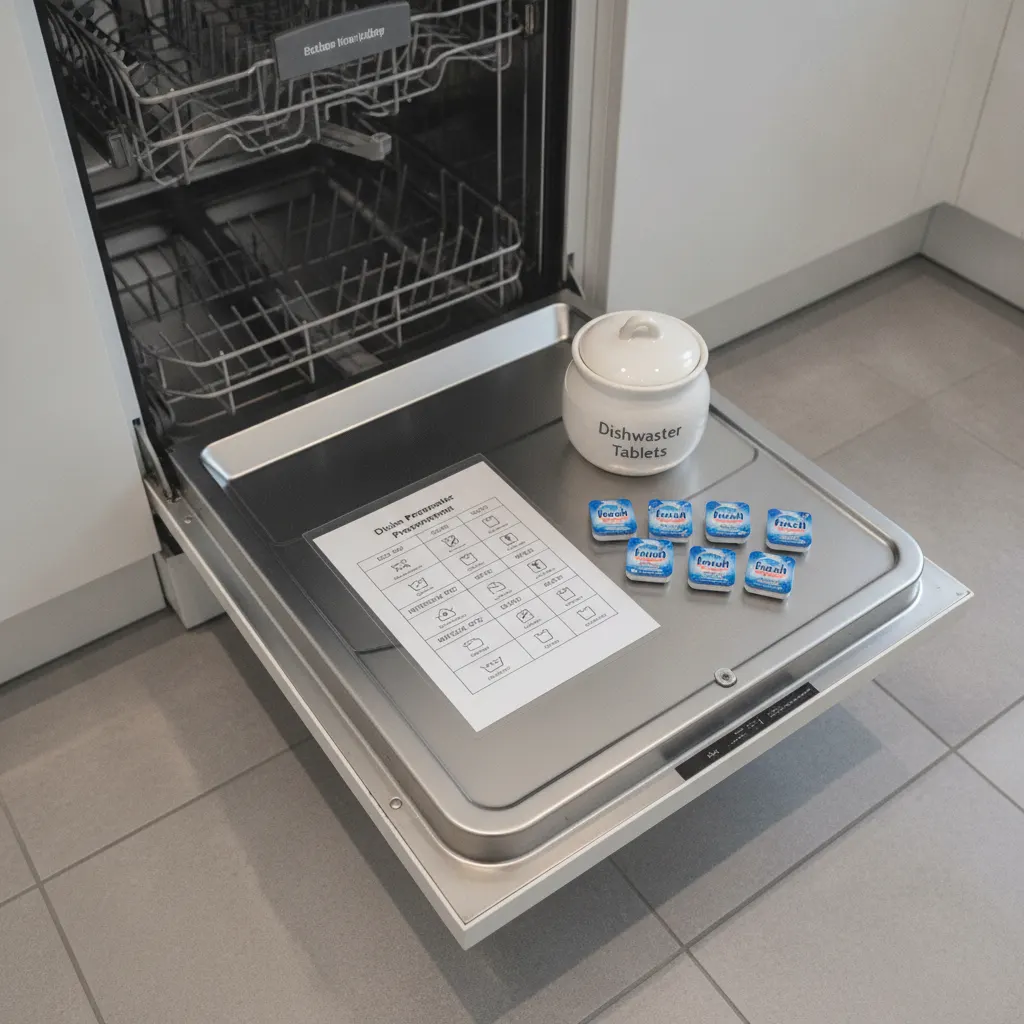
The most useful thing I've done is a laminated programme guide posted on the inside of the dishwasher door at every property. It covers:
- Normal cycle (default, everyday use)
- Glass cycle or delicate cycle (for wine glasses and stemware)
- Eco cycle (longer but cheaper to run — some guests actively want this)
- How to add salt if the indicator light is on
- Which tablet brand is in the cupboard and where to find refills
That last point matters. Guests run out of tablets and use random things — washing-up liquid, laundry pods — in a dishwasher, and this causes suds flooding and machine damage. Stating clearly where the tablets are, and leaving enough for the whole stay, prevents at least some of this.
Which tablets, and how many to leave
For tablets, I use Finish Powerball All-in-1 Max across all my properties. They're not cheap — around 25–30p per tablet at normal retail pricing — but they're reliable, they dissolve fully, and they don't leave film on glassware the way some cheaper alternatives can. Buying in bulk on Amazon Subscribe & Save brings the cost down to around 18–22p per tablet, which across five properties represents a meaningful annual saving.
I leave a starter quantity in a labelled container next to the machine (usually 6–8 tablets for a one-week stay) with a note directing guests to the spare box under the sink if they run out. I do not leave the whole box. Partly because guests occasionally take them (it happens), and partly because an open box of dishwasher tablets under a sink will absorb moisture and deteriorate faster than one in a sealed bag in a dry cupboard.
The other product some hosts forget: dishwasher salt and rinse aid. If your water area is hard (and much of southern England and parts of Edinburgh's water supply tend toward hard — check your local water supplier's data), you need salt in the softener reservoir. Most guests won't know to check the salt indicator light, let alone know what to do about it. I service the salt and rinse aid myself between stays rather than delegating this to guests. Takes two minutes. Saves glassware from limescale clouding that looks like damage to guests arriving for the next stay.
The glassware solution
After the Great Wine Glass Attrition of my first two years, I changed my approach completely. I now use:
Duralex Picardie glasses for everyday use. These are tempered glass tumblers — the French ones used in brasseries across Paris and beyond for decades. They're stackable, dishwasher-safe at high temperatures, chipping-resistant because the tempered glass edge is harder than standard, and when they do break they shatter into small cubes rather than dangerous shards. A set of six from Amazon or a kitchen shop costs around £15–25. I've had the same set in my Brighton flat for 14 months with zero losses. They're not glamorous but they're genuinely indestructible by dishwasher standards.
IKEA SVALKA wine glasses for the occasions guests want stemmed glasses. These are around £2–3 per glass, deliberately cheap, machine washable, and I replace any lost or chipped ones without emotion. I keep eight in each property that regularly has wine-drinking guests (which is all of them). When a set goes down to five or six, I order a fresh eight and return the survivors to backup. The economics of cheap, replaceable wine glasses are so much better than the economics of premium stemware that I can't imagine going back.
I used to have Riedel glasses in my Edinburgh Fringe listing. I thought it added a premium feel. It did, until a guest broke four in one stay and I had to replace them at £25 each. Never again.
Loading instructions: do they work?
I've got a loading diagram on the inside of the door at one of my properties — showing which rack level for glasses, plates facing inward, cutlery basket positioning. It was a bit of effort to make. I honestly don't know if it helps. Guests look at it, then load the dishwasher however they were going to anyway.
What does seem to help: putting the wine glasses in the rack ready-positioned when the guests arrive. The first person to load the dishwasher often sets the pattern for how it gets loaded by everyone else that stay. If the glasses are already in the top rack in the correct position, subsequent loads tend to replicate that arrangement. It's a small thing but it's produced noticeably fewer glass casualties in the two properties where I've tried it.
When guests use the wrong things
Washing-up liquid in a dishwasher produces a foam overflow that can damage the motor and leaves a sticky residue on everything. Laundry detergent does similar. I've had both, once each, across five properties. Both times the issue was discovered by the cleaner at the next turnover — thick suds dried in the machine, all the crockery needing to be rewashed.
The cleaner protocol: if the inside of the dishwasher smells soapy and the crockery comes out with a film, run an empty hot cycle with a dishwasher cleaner (Finish or Fairy both make these — around £3–5 for a bottle or sachet). Then run another empty cycle. Then check again. The residue usually clears in two cycles. Once I noticed a cleaner using a dishwasher cleaning product designed for hand-washing coffee machines — the citric acid-based type — and I had to explain why this was not the same thing. The laminated guide now includes a "what NOT to put in the machine" section.
Long-term machine maintenance
Dishwashers in rental properties run harder than in domestic use. A family of four using the machine once or twice a day over a week of holiday is different from the same machine running two or three times a week in a normal household. The filter and spray arms need descaling and cleaning more frequently.
I clean the filter at every property on a monthly rotation — it takes five minutes, involves pulling it out, rinsing it under a tap, and putting it back. The spray arm holes I check every three months for blockages (food particles, mineral deposits). A monthly descaling run with a commercial dishwasher cleaner — I use Finish Machine Cleaner, around £2–3 per use — keeps the internal components clear and the machine smelling neutral rather than damp.
A dishwasher that smells musty is something guests notice and occasionally mention in reviews. A clean, well-maintained machine they never think about is the goal. It's not exciting maintenance but it's cheap compared to a repair call-out or a machine replacement.
The total annual cost of this regime — tablets, descaler, rinse aid, salt, replacement glasses on the SVALKA economics — runs to around £80–100 per property per year. The old cost, which was premium glassware attrition plus occasional service calls, was considerably more. Sometimes the operational answer isn't dramatic. It's just: buy cheaper glasses and laminate a guide.
Ready to streamline your inventory?
Start managing your rental inventory smarter with automated stock tracking.
Start Free Trial