Duvet covers for Airbnb: thread count myths, what survives commercial washing, and what I buy in batches of 12
Hoststock Team
22 July 2026
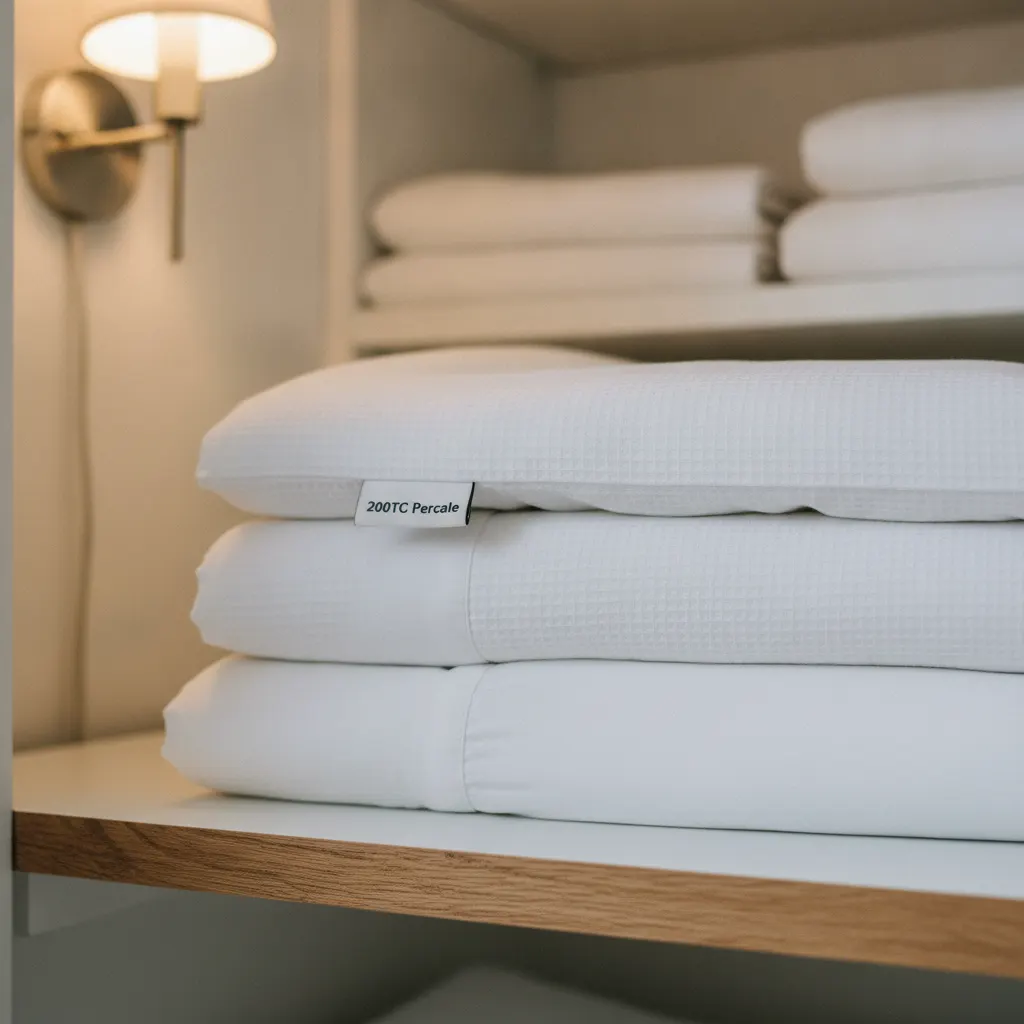
Thread count is marketing. I know that now. I learned it the expensive way — buying 400-thread-count Egyptian cotton duvet covers at £45 each, watching them pill and grey after about twelve hot washes, and replacing the lot six months later with something cheaper that looked identical to guests and lasted longer.
Duvet covers are one of those STR expenses that should be boring but aren't, because the choices are actually complicated once you dig in. Here's what I've figured out across five properties and somewhere north of two hundred full linen turnovers a year.
Thread count: why the number mostly doesn't matter
Thread count refers to the number of threads woven into a square inch of fabric. Sounds meaningful. The problem is that manufacturers inflate it by counting each ply of a multi-ply thread separately — so a three-ply thread counts as three, not one. A 600 thread count that's three-ply is actually 200 threads in the traditional sense. Which is fine, but it's not what the marketing implies.
For STR use, what matters far more is the weave type and the actual weight of the fabric (GSM — grams per square metre). Percale weave (a plain, one-over-one-under weave) is crisp, cool, and — crucially — tends to hold its shape and resist pilling better under repeated commercial washing than sateen weaves. Sateen has a silkier feel that guests often prefer initially, but the surface lustre washes out faster and it pills earlier under high-temperature washing.
I switched to percale about two years ago for all five properties. The initial feel is slightly crisper, which some guests notice. Nobody has ever put it in a review. The durability gap is significant.
GSM: the number that actually matters
For duvet covers in an STR context, I look for roughly 120–140 GSM. Below that and the fabric is thin enough to look cheap on the bed even when it's freshly laundered and pressed. Above 160 GSM and you're in hotel-quality territory — lovely, but at a price point that doesn't make sense when you're washing and replacing at STR frequency.
The IKEA Nattjasmin at around £20–25 for a double is 144 GSM percale and has been one of my most durable buys. It launders well at 60°C, doesn't shrink significantly (buy one size up if you're between sizes), and stays white through roughly 40 washes before it starts to grey noticeably. That's probably a year of STR use at high occupancy before replacement. At £22, the per-wash cost is under 55p. That's the calculation that matters, not the thread count.
What I've tried and stopped buying
John Lewis own-brand percale — the 200-thread-count range at £35–45 for a double. Good quality, holds up well, but the price-per-wash ratio isn't better enough than IKEA to justify the difference when I'm buying in batches of 12. I use these for my one premium property where the nightly rate supports a higher supply budget.
Amazon Basics microfibre — cheap, yes. But microfibre in a hot wash at 60°C degrades quickly, and the texture after about fifteen washes is noticeably different from how it arrived. Guests can feel it. I've had one mention of 'rough sheets' in a review that I traced back to a microfibre cover on its eighteenth wash. Not worth it.
Saat hotel linen — I use Saat for my commercial laundry contract on two properties. Their covers are excellent but priced for a hotel operation with volume contracts. If you're sending linen out professionally and want hotel-grade consistency, worth exploring. For self-laundry at an STR scale, the price doesn't work.
Dunelm's Soft and Cosy — a fine budget option around £12–18. I used it across two properties for about a year. It's fine. The 40°C wash recommendation is a problem — I won't wash STR bedding below 60°C, and at 60°C the Dunelm covers started shrinking and discolouring by wash fifteen. Works if you follow the care instructions; in my laundry workflow, the care instructions don't fit.
The washing temperature question
This matters enormously for STR. A guest who's been ill in your flat, or — and this happens more than hosts like to admit — a child who's had an accident, means bedding that needs to be genuinely sanitised, not just refreshed. That means washing at 60°C minimum, ideally with a hygiene cycle if your machine has one.
Not all cotton covers tolerate 60°C well. The ones that don't are the ones that grey out, shrink, and lose their shape fastest. Before buying in bulk, I run one cover through five 60°C washes and see what happens. If it comes out looking okay, I order the rest. If it's already pilling or distorting after five washes, I know what I'm dealing with.
Pillow cases: buy twice as many as you think you need
Pillow cases get stained faster than duvet covers and need replacing more often. I buy pillow cases in sets of four to match every duvet cover set, and I keep double the quantity in rotation. Two full sets per bed at all times — one in use, one spare. When the spare drops below half-decent condition, the whole set gets demoted to cleaning rags and the next set comes out of storage.
The economic model of STR linen is built on bulk purchasing and rotation, not single-item replacement. Buying four pillow cases when you need two is false economy — you'll be sourcing replacements at inconvenient moments and paying delivery costs. Buy twelve, rotate, replace the set when the set degrades.
My buying system
I standardised on one double and one king duvet cover size across all five properties (the Lake District cottage has two rooms, the Edinburgh flats each have one king). That means I can rotate stock across properties, which significantly reduces waste. A cover that's seen thirty washes in Brighton can spend another ten in Edinburgh where the replacement cycle is slower.
I buy in batches of 12 when a line I trust goes on sale — typically IKEA and John Lewis have predictable sale periods. I store them vacuum-packed. Running out of duvet covers mid-summer, when the washing machine is running twice a day and the spare set is in use, is the kind of problem that's completely avoidable with a bit of planning.
The total linen budget across five properties runs around £400–600 a year for duvet covers, pillow cases, and flat sheets combined. That's under £0.80 per turnover at 65% occupancy. It's not where I save money. It's where I spend just enough to stop guests noticing.
Ready to streamline your inventory?
Start managing your rental inventory smarter with automated stock tracking.
Start Free Trial