Fire safety equipment in UK Airbnbs: the fire extinguisher question I finally answered
Hoststock Team
2 September 2026
The question every new host asks and then ignores
At some point in year one, almost every host I've spoken to asks the same thing: do I need a fire extinguisher? Then they read something vague on a forum, decide it's probably fine, and forget about it until a guest mentions something in passing and the whole anxiety loop starts again.
I did exactly this. For the first fourteen months across my first two flats, I had smoke alarms, CO detectors (because you have to have them since the regulations changed in October 2022), and absolutely nothing else. No fire blanket. No extinguisher. Nothing in the kitchen except the hope that guests would deal with any burning-smell emergencies themselves.
Then I finally sat down and actually read the guidance. And it's both clearer and murkier than I'd hoped.
What the law actually says for UK short-term lets
The smoke alarm and CO detector requirements are clear. Under the Smoke and Carbon Monoxide Alarm (Amendment) Regulations 2022, which came into force in October 2022, private landlords in England must install a working smoke alarm on every floor of their property and a CO detector in any room with a gas, oil, solid fuel or biomass appliance. This applies to residential properties used as short-term lets. If you don't have smoke alarms on every floor and a CO detector next to your boiler, stop reading this and fix that first.
Fire extinguishers: the situation is different. The Regulatory Reform (Fire Safety) Order 2005 applies broadly to non-domestic premises and commercial properties. For private dwellings — which is what most Airbnb flats are — fire extinguisher requirements depend on your property type and local fire authority guidance rather than a single national rule. In most cases, a wholly residential property used as a short-term let is not legally required to contain a fire extinguisher.
That said: I'd encourage you to check with your local fire and rescue authority, because guidance varies and your specific property situation — whether it's in a block, whether it has commercial tenants below, whether it's listed — can all affect the picture. This post is sharing what I've done and why; it's not a substitute for proper fire safety advice.
What I put in every property anyway
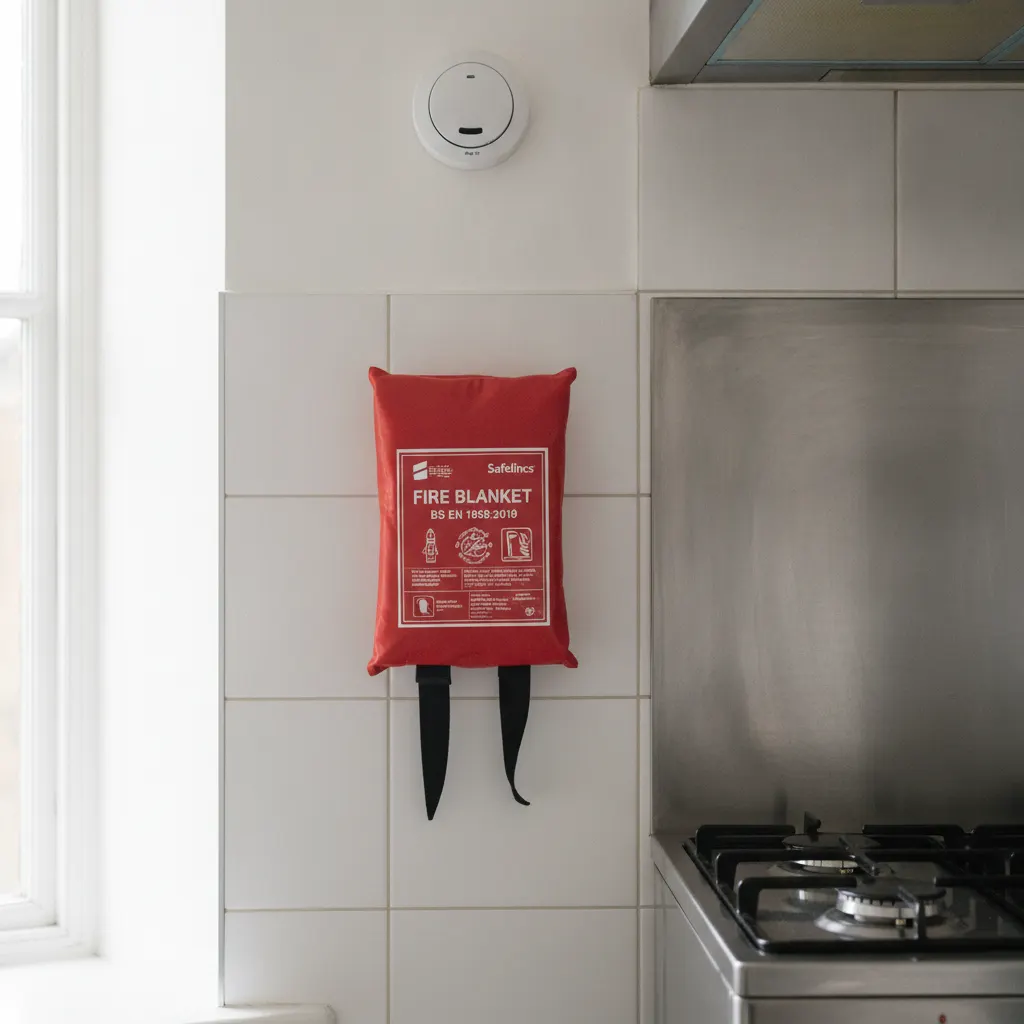
Fire blanket in every kitchen. Full stop. These cost about £8–12 from B&Q or Amazon, they're rated to BS EN 1869:2019, they mount to the wall beside the hob, and they're genuinely the most useful piece of fire safety kit for the type of emergency that's actually likely to happen in an Airbnb kitchen. A chip pan fire. A tea towel catching the gas ring. A guest who's had a few glasses of wine and leaves something on the hob too long.
A fire extinguisher doesn't help with an oil fire — you'd make it worse with the wrong type. A fire blanket smothers it. Guests know (in theory) how to throw a blanket over something. The instruction is on the mounting sign and takes about four words.
That's the bit nobody tells you in the hosting forums, by the way. A dry powder extinguisher in the kitchen covers most fire types but creates an absolute disaster of white powder across every surface that your cleaner will be furious about. CO2 extinguishers are cleaner but less effective on kitchen fires. The fire blanket is the right first line of defence in a domestic kitchen setting — and I say that as someone who had a CO2 extinguisher sitting in a cupboard for two years before I actually thought about what I'd use it for.
What I currently run across five properties
Five kitchens: each has a 1m × 1m fire blanket mounted to the wall beside the cooker. I use the Safelincs ones — made to BS EN 1869:2019, checked during my annual compliance visit.
Four properties also have a 1kg CO2 extinguisher mounted in the hallway or near the front door. Not because I'm legally required to have one — I'm not certain I am — but because I did a fire safety walk-through with a local fire safety consultant last year (cost me £75 for an hour, worth every penny) and he recommended it as good practice for holiday let properties. His view: guests are unfamiliar with the property, they don't know where exits are, and having an extinguisher visible near the exit can matter in the 60 seconds before someone decides whether to try to deal with it or leave.
My Lake District barn is the exception — it has a 2kg ABC dry powder extinguisher in the utility room (recommended by the consultant because of the wood-burning stove situation) and a CO2 in the hallway. More kit, more complexity, more cost (about £40 total for that property's extinguishers), but the risk profile is different for a detached property with a solid fuel appliance.
The fire blanket mounting question
Mount it to the wall beside the cooker, not above it and not inside a cupboard. Beside it and at roughly shoulder height. The reason: if the cooker is on fire, you're not reaching over the fire to get the blanket. You're reaching sideways, which you can do at arm's length without putting yourself in the smoke column.
This sounds obvious until you see how people mount them. I've seen them above the extractor hood (unusable in a fire), inside a kitchen cabinet (invisible to guests), and in a drawer (don't ask). Beside the cooker, shoulder height, clearly visible. Put a small label on the wall: "Fire blanket — pull red tab downward to release." That's all you need.
Guest instructions
I include a one-paragraph fire safety section in the digital guidebook for every property. It covers the smoke alarm locations, what to do if one goes off, the fire blanket location, and the meeting point outside. It's not a full fire safety assessment — I don't have the expertise to write one — but it tells guests where the nearest fire exit is and what the red bag on the kitchen wall is for.
One more thing: check your insurance. Most UK STR insurance policies (Hamilton Fraser, Guardhog, Pikl, Supercover) have specific requirements about smoke alarms and may have recommendations about fire extinguishers. Read your policy schedule before assuming you're covered. Two of the policies I've held over the years had clauses I hadn't noticed until I actually read them properly.
Annual checks
Fire blanket: check the seal annually. If the seal on the release tab has been broken — i.e. someone's deployed it or pulled it accidentally — replace the blanket. They're not refillable.
Extinguisher: most CO2 and dry powder extinguishers should be serviced every year by a competent person. There's usually a sticker on the side showing the last service date. I add it to the same compliance calendar as the gas safety certificate and the EICR — it gets done in January, properties are quiet, costs about £10–15 per extinguisher from a local fire safety company.
Smoke alarms and CO detectors: test monthly. I do it during the monthly maintenance visit. Press the button, confirm the noise, reset. Replace the battery at the first low-battery chirp rather than waiting. One flat had a smoke alarm that chirped at 3am in November and the guest left a two-star review. I drove across Edinburgh at 4am to replace a 9V battery that costs £1.50. Never again — annual battery swap in every alarm, every January, regardless.
Ready to streamline your inventory?
Start managing your rental inventory smarter with automated stock tracking.
Start Free Trial