First aid kits and safety essentials in UK short-term lets: what's legally required vs what I've added
Hoststock Team
29 August 2026
Let's start with what the law actually requires
There is no legal requirement for a first aid kit in a UK short-term let. I want to be direct about this because I see it stated as fact in various hosting guides. The Health and Safety (First-Aid) Regulations 1981 apply to workplaces, not private residences or holiday accommodation. As of 2026, no UK regulation mandates that you provide a first aid kit to guests in self-catering property.
What is legally required is different — and worth getting completely clear on before we talk about what's good practice.
The smoke alarm and CO detector rules
In England, since October 2022, private landlords and short-term let operators must have at least one smoke alarm on every storey of the property, and a carbon monoxide alarm in every room that contains a fixed combustion appliance — gas boilers, gas fires, wood-burning stoves. Open fireplaces count too.
These alarms must be in working order at the start of each tenancy. For a short-term let, that effectively means checking them at every changeover. My cleaner tests every alarm as part of the turnover checklist. Takes about 90 seconds. I also replace batteries annually across all five properties regardless of whether any alarms have triggered — I do it during the annual deep clean in March.
Scotland has additional requirements under its HMO framework that differ from England. If you operate there, check the current Scottish Government guidance directly rather than relying on England-centric sources.
The CO alarm question, specifically
A CO alarm is required in any room with a fixed combustion appliance. 'Fixed combustion appliance' is sometimes interpreted too narrowly by hosts. A gas boiler in a utility cupboard — if there are gaps into the living space — still counts. A gas hob in an open-plan kitchen-living room means a CO alarm in that space.
I use Ei Electronics alarms throughout. The Ei208W specifically — a mains-powered standalone unit with battery backup, rated for 7 years. They run about £25 each from electrical wholesalers. The date of manufacture is printed on the unit so there's no guessing when replacement is due.
For smoke alarms, I fit Ei3016 optical (photoelectric) units near kitchen-adjacent spaces. Optical alarms are less prone to false positives from cooking than ionisation types. I've had three toast-triggered false alarms in my Edinburgh property over four years; each one generated a review mention, none of them positive. Moving the kitchen-area alarm to an optical model and repositioning it away from the toaster zone fixed it.
What guests actually notice
I've been tracking this informally across five properties for four years. Guests notice smoke alarms primarily when they go off unnecessarily. They notice CO alarms almost never — unless something goes wrong, at which point they'd better be there.
A basic first aid kit gets mentioned occasionally. Families with young children are more likely to see and comment on it. I started including a small kit after a guest with two toddlers in the Lake District mentioned in their review that they'd noticed and appreciated it. That was actually a suggestion from my cleaner, who'd spotted it in a similar property she cleaned. She was right.
Fire safety information. A small laminated card showing emergency contacts (999), your number, and — in a rural property — the location of the nearest A&E and GP. Families notice this. City centre guests mostly don't.
What I've added and what it costs
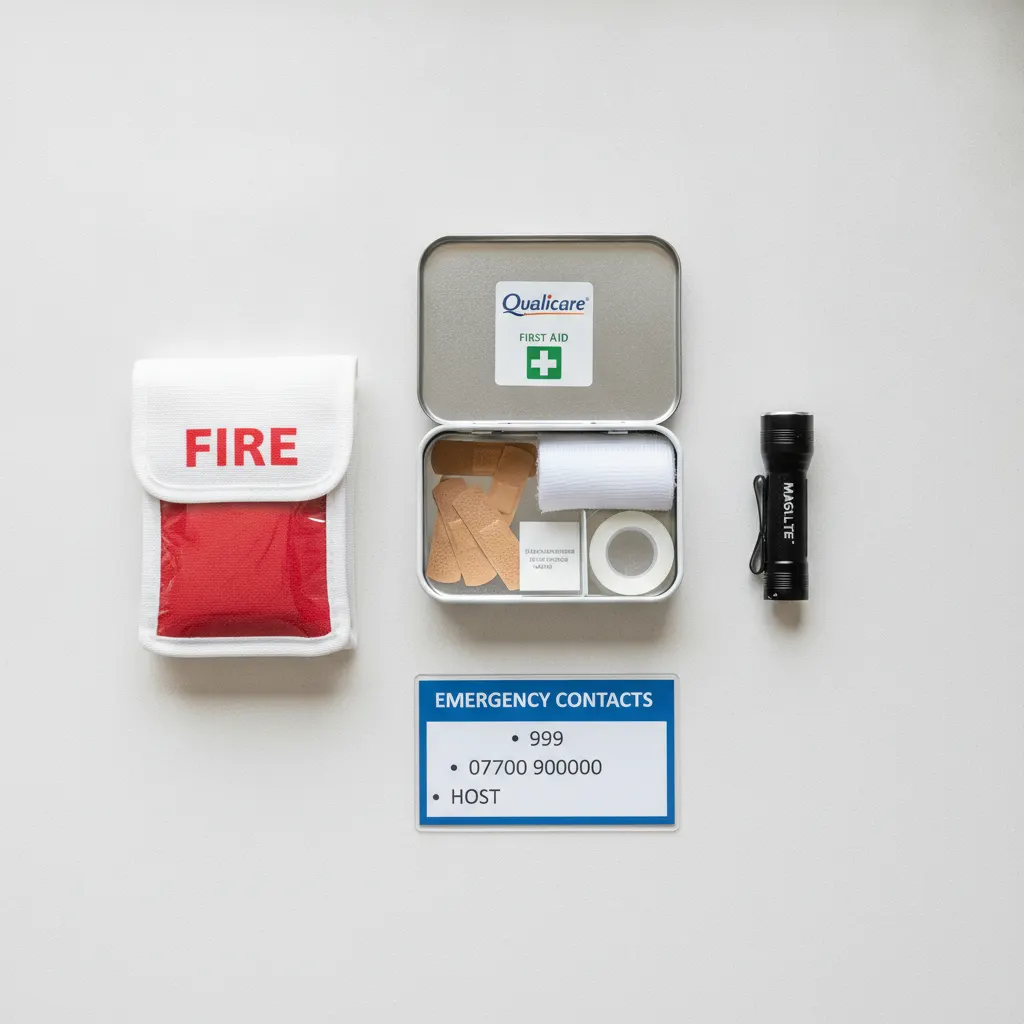
After the toddler review, I put a small first aid kit in every property. Nothing complex. The Qualicare 33-piece travel kit in a metal tin — adhesive dressings in various sizes, sterile gauze, micropore tape, safety pins, scissors, two instant cold packs, and an instruction card. Currently around £6–8 per kit on Amazon. I replace it annually regardless of whether anything's been used, and I write the replacement date on a sticker inside the lid so my cleaner knows when it was last refreshed.
I also keep a fire blanket in every kitchen. These are legally recommended rather than required, but for a kitchen that guests are cooking in without supervision, it's sensible basic provision. I bought mine from a fire safety supplier in Brighton — they come in packs of five, roughly £22 for the set. One in each kitchen, mounted to the inside of a lower cupboard door near the hob.
A torch in the kitchen drawer. One guest every eighteen months or so mentions it positively. Power cuts in Edinburgh Old Town happen occasionally. A small Maglite Mini costs about £12 and lasts years.
Emergency information laminated card: 999, my number, the address of the property written out in full (guests sometimes can't state their address in a panic), and — in the Lake District — the nearest A&E (Penrith, about 22 miles). I laminated mine at a local print shop for £1.20 per card.
Total cost across a 2-bed, starting from scratch
- Smoke alarms: 2 × Ei3016 or equivalent — approx £50
- CO alarm: 1 × Ei208W or equivalent — approx £25
- Fire blanket: £6 (from a pack of five)
- First aid kit: £7
- Torch: £12
- Laminated safety card: £2
- Total: roughly £102
Most of that is the alarms, which you need regardless. Everything else is about £27. Across five properties it adds up to something, but spread over the lifespan of the equipment, it's genuinely not a significant cost.
None of this is box-ticking
A guest who has a minor kitchen incident at 10pm and finds a fire blanket and a first aid kit is going to have a different night — and probably write a different review — than one who doesn't. That's worth more than £27. And the alarms are just the law.
Ready to streamline your inventory?
Start managing your rental inventory smarter with automated stock tracking.
Start Free Trial