Frying pans for Airbnb: three brands tested across five flats, one I keep reordering
Hoststock Team
28 July 2026
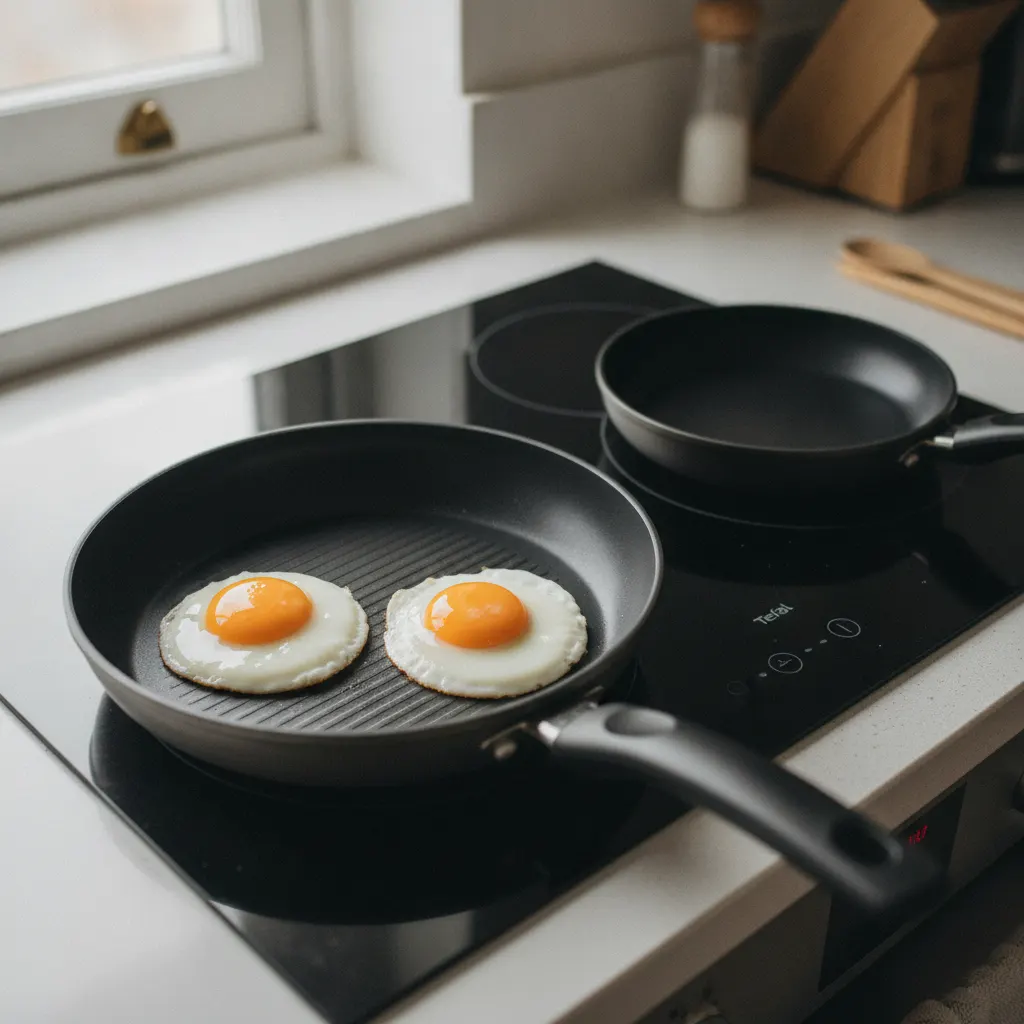
Nine frying pans. That's how many I've bought across five properties in five years. Three warped. Two shed their non-stick coating so badly I had guests message me about it — not aggressively, just that resigned way where they say 'everything was lovely but the frying pan looked a bit tired'. The kind of comment that costs you 0.1 on your review score and makes you stare at the ceiling at 2am. And the one I now reorder without thinking? I only found it after buying all the others first.
This isn't a glamorous topic. But if you're running four or five Airbnbs, you're replacing frying pans at a rate your home kitchen never would. Guests cook. They do it on high heat, with metal utensils, leave the pan soaking in washing-up liquid for sixteen hours before your cleaner shows up at 10am. Non-stick coatings don't survive that. Most pans don't.
Why Airbnb pans die faster than you'd think
At home, I treat my cast iron skillet like a piece of furniture. Dry it by hand, never soap, store it with a cloth between the layers. That care is never going to happen in an Airbnb. Guests don't know — and shouldn't need to know — that you're supposed to treat a pan gently. They cook scrambled eggs on maximum heat and throw it in the dishwasher. Twice.
So you're not really shopping for a pan. You're shopping for something that survives industrial abuse while still looking respectable in your listing photos. That's a harder brief than most people think.
The under-£20 cheerful mistake
My first two Airbnbs got IKEA 365+ pans — the 28cm version, about £15 at the time. Nice looking. Induction-compatible. Decent coating out of the box.
They lasted, on average, eight months before the coating started showing obvious wear. Not flaking — just patchy and uneven. One guest left a note about it in a review. 'Everything was wonderful but the frying pan looked a bit worn.' That's not a three-star review. But it is a signal that something in the property isn't right, and Airbnb's algorithm pays attention to those signals.
So I replaced both, bought the same ones again (I was an optimist in those days), and they lasted about the same time. IKEA 365+ pans are fine for a home kitchen. In an Airbnb they're a six-to-nine month proposition, at best.
The Tefal Comfort phase
Next I tried Tefal Comfort non-stick pans. The 28cm version costs roughly £25-£28. Tefal have a good reputation — Thermo-Spot indicator, sensible heat distribution, a non-stick coating that's at least marketed as durable. And they are better than IKEA for this use case. But not dramatically so.
My Edinburgh flat went through two Tefal Comfort pans in eighteen months. The hob there is a Bosch induction unit, and one of my regulars books three weeks every January for work. He clearly treats the kitchen like his own — which I like, genuinely — but the pan did not.
The coating held up better than the IKEA version. The handles, though — both started getting loose around month fourteen. Not a safety issue, exactly. But a wobbly handle on a hot pan makes guests nervous, and nervous guests leave hedged reviews with vague complaints about 'feeling unsafe'. I've had two of those. Never again.
Meyer Circulon: the brand I didn't expect to like
I found Circulon by accident. My property manager in Edinburgh — she looks after two of my flats up there and has no patience for anything that doesn't work — mentioned she'd been using them in her own portfolio. I bought one 28cm Circulon SteelShield pan for about £35, put it in my Canongate flat in March last year, and tracked it.
Fourteen months later. Still going. The coating on a Circulon pan has a raised Hi-Low groove design — not flat-smooth like most non-stick surfaces — and that makes a real difference for durability. The raised sections bear the brunt of utensil contact. The flat non-stick areas in between stay protected. I won't pretend I understood this before I bought one. But the difference in lifespan is noticeable enough that I've since switched four of my five properties to Circulon.
The fifth — my Lake District cottage — has an Aga. That's a different conversation, and it mostly involves cast iron and a lot of unsolicited opinions from guests who do 'proper cooking on holiday'.
What I actually reorder
The Meyer Circulon SteelShield C-Series 28cm frying pan. Non-stick, induction-compatible, oven-safe to 210°C. Around £35-£40 depending on retailer. Amazon carries it, Robert Dyas stocks it, John Lewis does the range.
Caveat: it's not truly dishwasher-safe. Circulon say it'll survive the machine but it shortens the coating's life. I put a small laminated card in each property — 'please hand-wash the frying pan' — and most guests ignore it entirely. Even dishwasher-abused, the Circulon outlasts everything else I've tried. I'm comfortable with that.
I also run a 20cm pan alongside the 28cm in each property. For eggs, small portions, the single-person guest who books Sunday to Thursday. These are just cheap Tefal — they get lighter use, and I don't mind replacing them annually. The big pan is where the money goes.
Cast iron: let's be honest about this
One guest, in five years and roughly 300 turnovers, has asked if I had a cast iron pan. One. Cast iron is heavy, needs specific maintenance, reacts badly with tomato-based sauces, and goes rusty if a guest leaves it wet. Unless you're running a very specific premium let where guests understand kitchen equipment, cast iron in an Airbnb is asking for a passive-aggressive review about 'the equipment being difficult to use'.
Skip it. Honestly.
Keep a backup pan in the cupboard
I now keep a spare non-stick pan — just a cheap one — in a cupboard in each property. This started after a guest in Brighton messaged me at 11pm on a Saturday to say the frying pan 'didn't work'. It wasn't broken. They'd used a metal fork on the coating at high heat, the surface was visibly damaged, and now they were worried about cooking on it. Not unreasonably.
But 11pm on a Saturday. No spare pan. Nearest shop had closed at 8. That's exactly the kind of operational gap that turns into a three-star review about 'kitchen equipment not being fit for purpose'.
Now every property has a backup pan in the cupboard under the hob. Guests don't know it's there — it's a 10pm safety net, not a feature. The moment I've never needed to use it is the moment I'll know it's working.
Replacement timeline
For the Circulon 28cm pans: I replace at eighteen to twenty-four months across properties doing six or more turnovers a month. For lighter-use properties — the cottage does maybe four turnovers a month at peak season — I'd expect longer. Haven't had one there long enough to know for certain.
For the small secondary pans: annually, regardless of condition. Cheap enough that tracking their lifespan isn't worth the effort.
Pan check is part of my restocking run — hold it up to the window, look at the coating, check the handle wobbles. If it's patchy, it goes. I don't wait for a guest to mention it first.
The honest maths
Cheap non-stick pan: £15. Needs replacing every nine months. Annual cost: £20, plus the risk of a review comment about tired kitchen equipment.
Mid-range Circulon pan: £38. Lasts eighteen months on average. Annual cost: £25, no review comments about the frying pan in any of my properties in the fourteen months since I switched.
That's not a dramatic saving. But the math goes the right way, and more importantly the guest experience goes the right way. A scratched and patchy frying pan is the kind of thing that looks fine to you during a supply check but jumps out at a guest first thing on a Saturday morning when they're making breakfast.
What I'm testing next
I've got a ProCook Professional Ceramic 28cm pan going into my Brighton flat this month. Ceramic non-stick rather than PTFE-based — technically more resistant to high-heat damage, but ceramic coatings tend to lose their non-stick properties faster once they start to go. Two Edinburgh-based hosts in an online group I'm in have recommended it. Three months in, I'll have a proper view. For now, the Circulon is still the default. If the ceramic test goes well, I'll update.
But for anyone starting out or looking to replace a pan that's let you down: buy the Circulon, keep a cheap backup, and put a laminated 'please hand-wash this' card by the hob. Nobody will read it, but it makes you feel better about the dishwasher damage that's coming.
Ready to streamline your inventory?
Start managing your rental inventory smarter with automated stock tracking.
Start Free Trial