Garment steamers for Airbnb: I switched three properties from iron to steamer and tracked what happened
Hoststock Team
15 September 2026
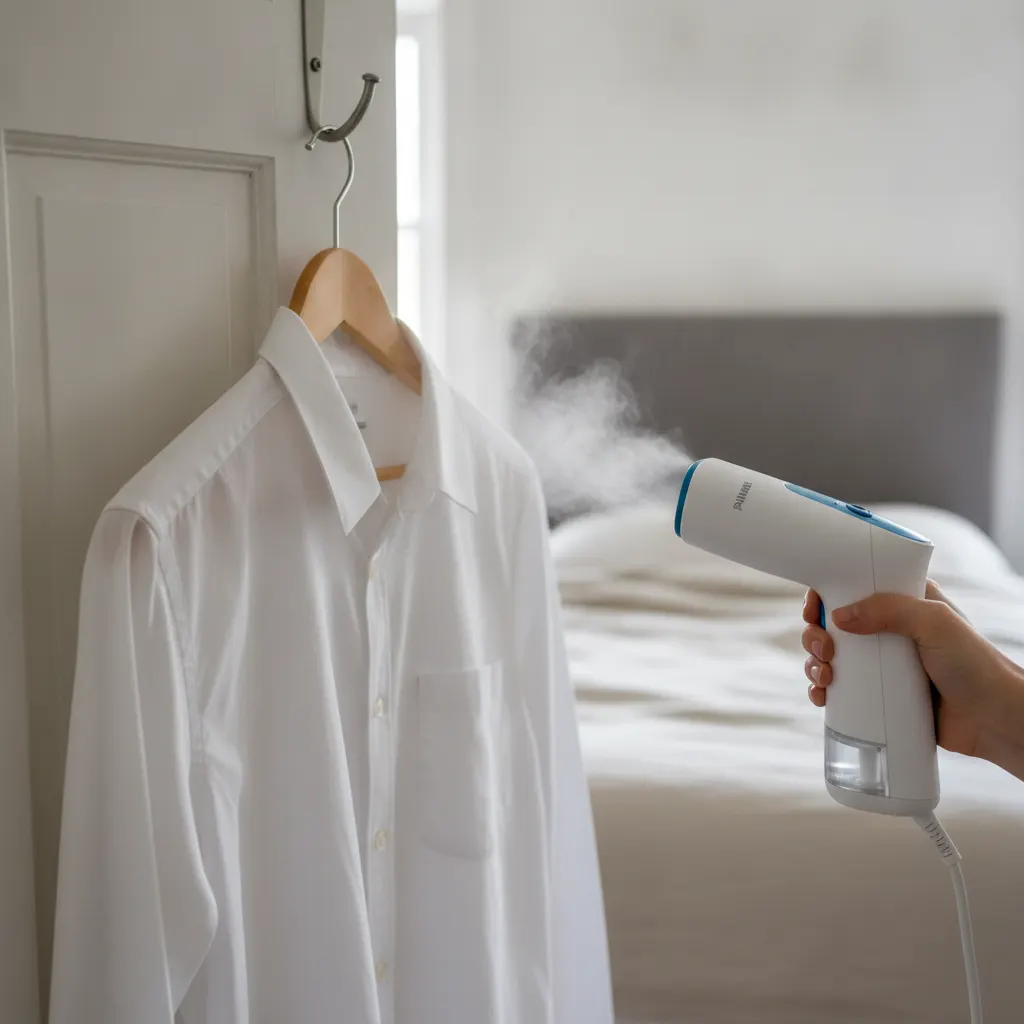
I bought my first garment steamer because a cleaner told me she'd burned a guest's shirt. I'd left an iron at the property. The iron was probably fine — a Tefal Ultraglide, perfectly decent — but she'd used the wrong temperature setting on a synthetic and that was that. Not her fault. My fault for leaving a medium-complexity appliance and not briefing her on it.
So I looked at steamers. And then I got annoyed at myself for not switching sooner, because the case for them in a short-term rental context is honestly pretty clear.
Why steamers make more sense than irons in most STRs
An iron requires a flat surface, a board, and someone who knows what they're doing. The ironing board at my Brighton flat takes forty seconds to unfold and another thirty to find a stable position on the bathroom tiles (I know, I know — it's a small flat). A steamer is basically: fill it with water, turn it on, hold it near the thing you want to de-wrinkle. There's no burn setting. There's no way to scorch a linen shirt if you hold it twelve inches away.
Guests don't use the iron much anyway. In two years of running three properties with irons, I think I saw evidence of actual ironing use maybe once a month across all three. What they do is hang clothes in the bathroom while showering — the steam trick — which tells you what they want is de-wrinkling, not ironing. A steamer does that more intentionally and with less effort.
And for turnovers — getting bedding and cushion covers looking fresh quickly — a steamer is genuinely faster than an iron for anything with pleats or texture.
The models I've tested
I've used three. The Philips STH3020 handheld (around £30 in 2025, give or take), the Tefal Access Steam DT6040 (a vertical steamer, roughly £50), and the Rowenta IS6200 (a garment steamer on a stand, about £80). All tested in live STR conditions, which means: water that's sometimes hard, cleaners with varying levels of familiarity with appliances, guests who leave them plugged in overnight.
The Philips handheld. Compact, lightweight, genuinely does the job for shirts and light fabrics. Heats up in about 25 seconds. The downside is the water tank holds about 100ml, so you're refilling it every few minutes if you're doing a full set of curtains or a heavy throw. For guests using it occasionally: absolutely fine. For a cleaner doing a full turnover: probably annoying.
The Tefal Access Steam. Bigger tank (around 220ml), still compact, the steam output is stronger. This is what I settled on for two of my three properties. It costs more but lasts longer per fill, which matters when a cleaner is trying to get through a 90-minute turnover without stopping to faff around with water.
The Rowenta on the stand. Overkill for most STRs unless you've got a lot of linen hanging storage and you're doing serious volume. I bought it for the Lake District cottage because the bedroom ceiling is high and a steamer on a pole is easier for reaching the bottom of long curtains. Genuinely useful there. Probably not worth £80 for a city flat.
The one property where I kept the iron
My Edinburgh one-bed has a longer-stay pattern — I get a lot of 10–14 night bookings from academics and professionals. Those guests actually use an iron. I know because the ironing board position changes between visits and the iron itself gets moved. So that property still has a Tefal Ultraglide and an ironing board in the wardrobe. The steamer is there too — in the bathroom, on a shelf — but the iron stays.
For shorter-stay properties (mostly weekend breaks, city breaks, 2–4 nights), the iron has gone. Guests don't ask about it. Nobody's complained.
Practical notes for the switch
A few things that are worth knowing before you just order a steamer and put it in a flat:
Leave instructions. 'Fill tank, switch on, hold 10–15cm from fabric, do not press directly onto fabric' — stick that on a card next to the steamer. Sounds obvious, but someone will hold it against a polyester blouse and then message you about a mark. I've got a laminated A5 card for each property.
Use distilled or filtered water if your area has hard water. Brighton particularly. I keep a litre of filtered water in the under-sink cabinet next to the steamer. Hard water calcifies the heating element faster and you'll be descaling or replacing within six months instead of two years.
Store it vertically, tank emptied. A steamer left with water in it grows things. I had to throw one away. I've now got a note on the laminated card: 'Empty tank before storing.'
For cleaners: I briefed each one in person, took two minutes, showed them the fill-and-steam process. None of them have had a problem. Two of them actually prefer it to the iron. One thinks it's 'not a proper iron' and uses it reluctantly. But she uses it, and nothing's been scorched since 2024.
Cost
The Tefal Access Steam is around £45–55 depending on where you buy. Amazon has it in stock consistently. It's cheaper than replacing one scorched guest shirt (typically about £40–80 from AirCover if you're lucky, out of your own pocket if you're not). Pays for itself fast.
I'm not saying iron-free is right for every property. But for anything with high turnover, short stays, and a cleaning team who'd rather not manage a hot flat surface at speed — a steamer is worth a month's trial.
Ready to streamline your inventory?
Start managing your rental inventory smarter with automated stock tracking.
Start Free Trial