Guest temperature complaints in Airbnb: the fan, thermostat, and bedroom setup that ended the messages
Hoststock Team
25 September 2026
The 2am message I never want to receive again
"Hi, sorry to message at this hour — we can't sleep, it's really hot in here. Is there anything we can do?"
2:17am. Brighton flat. August. A family of four from Germany who'd booked a week. I was three hours away in Edinburgh visiting my partner's parents. My cleaner doesn't do 2am emergencies. I told them to open the windows, apologised, and spent the next 45 minutes lying awake calculating how much a portable air conditioning unit weighs and whether I could get one to the flat by courier before the next morning.
I could not. The family survived. Their review mentioned the temperature in passing ("apartment was warm in the August heat") and they gave me four stars for value. Not a disaster, but avoidable.
After that I spent more time on the bedroom temperature problem than I'd like to admit. Here's what I've learned about managing guest temperature complaints across properties in different climates and building types — Brighton seafront flat, Edinburgh Old Town, Lake District cottage — where the thermal dynamics are completely different.
The core problem: different guests, different thresholds
Before I get into the solutions: the maddening thing about temperature complaints is that they run in both directions simultaneously. In the same property, in the same month, you'll get a guest who says it was too warm and a guest who says it was too cold. Usually the "too warm" guests are in summer and the "too cold" guests are in spring or autumn, but not always.
European guests — particularly Germans, Scandinavians, Dutch, and Austrians — tend to have a higher tolerance for cool sleeping temperatures and a lower tolerance for warmth. UK domestic guests vary enormously. American guests are frequently used to aggressive air conditioning and are sometimes startled that UK short-term lets don't have it. International guests from warmer climates often find standard UK room temperatures in March perfectly comfortable.
You cannot set a single temperature that makes everyone happy. What you can do is provide the tools for guests to adjust, and make those tools obvious.
For the too-hot problem: fans
Before committing to air conditioning, try fans. Properly sized fans in the right configuration can make a real difference in the 18–26°C range that represents most of the UK summer. They're cheaper to buy, cheaper to run (the energy cost of running a fan versus even a small portable air conditioner is significant), quieter than most units at meaningful power, and considerably easier to install and maintain.
The type of fan matters a lot. Desk fans are useless for bedrooms — they don't move enough air over the sleeping area. What works:
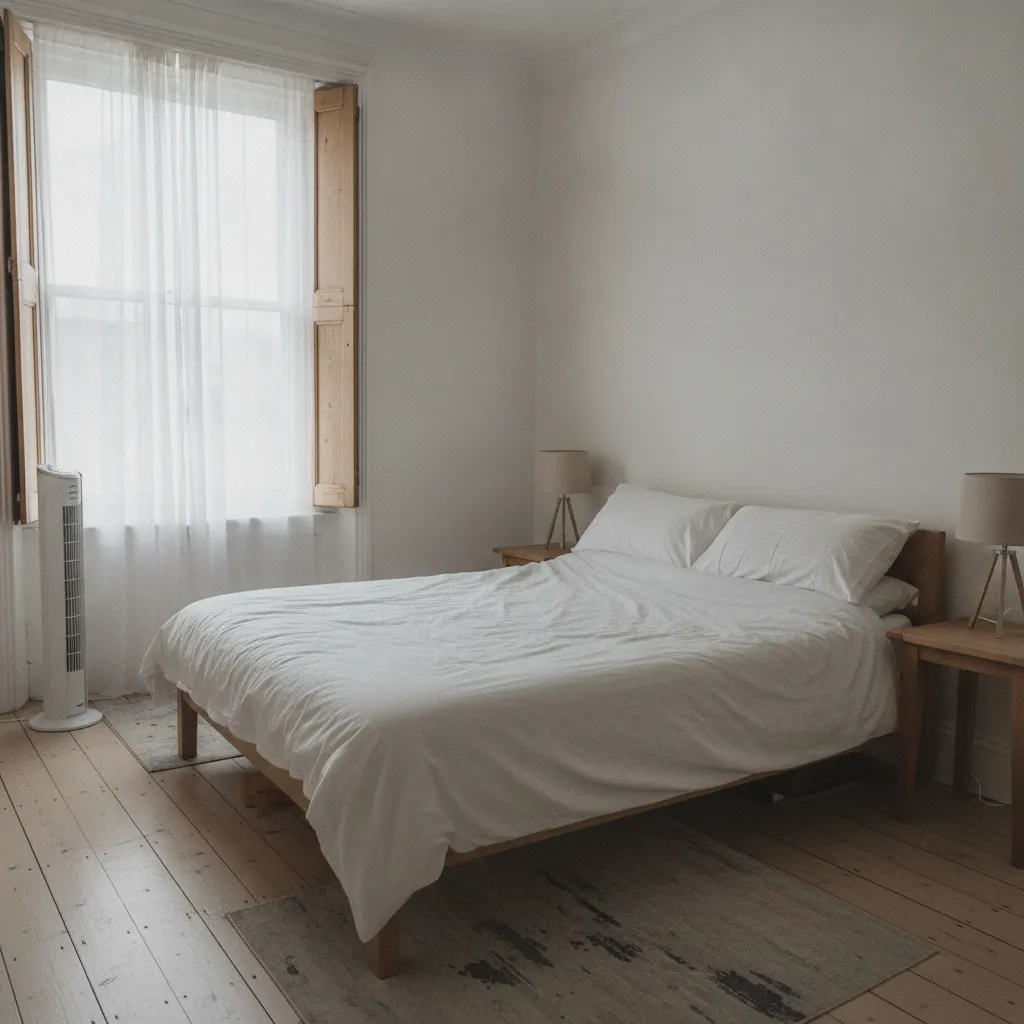
Tower fans are what I've settled on for my Brighton flat bedrooms. They oscillate across a wide arc, move a decent air column, and take up minimal floor space. The Dyson AM series are excellent but at £350–500 per unit they're in a different cost category to most alternatives. I've had good results with the Rowenta VU6670 and similar tower fans in the £80–120 range — they have a sleep mode that reduces noise and dims the display, which is genuinely useful in a darkened bedroom.
Box fans in windows work better in rooms with opposing windows that allow through-flow. A box fan positioned to pull warm air out (facing outward in the window) combined with an open window on the opposite side creates real convection. This is significantly more effective than simply blowing recirculated indoor air around. The limitation is that UK window styles — particularly sash windows — don't always accommodate a box fan neatly. My Brighton seafront flat has sash windows and this didn't work; my Lake District cottage has casements and it works very well.
Installation for tower fans: they just live in the bedroom. No installation required. I include a note in the welcome information (and in the digital guidebook) explaining where the fan is, how to adjust the angle, and what the sleep mode button does. This sounds patronising until you remember that guests are unfamiliar with your specific fan's controls and an unlabelled button in the dark at midnight is frustrating.
For the too-cold problem: heating control
This one should be simpler than it is. You have a thermostat. The guest should be able to set it to what they want. Except in many UK properties — particularly older flats — the heating system isn't that simple. Timer-controlled combi boilers, separate immersion heaters, storage radiators that run on night tariffs, or heating systems that need a specific sequence to function.
I've got one Edinburgh Old Town flat where the heating is controlled by a mechanical timer on the combi boiler, there's a room thermostat in the hallway, and the individual radiators have TRVs. Explaining this to guests in a way that's actually useful requires a clear printed guide. Not a list of technical information — a step-by-step card at eye level in the hallway. "To heat the flat: step 1, check the timer is on (the slider on the white box in the kitchen). Step 2, turn the thermostat in the hallway to the temperature you want. If you're still cold after 30 minutes, call this number."
Smart thermostats help enormously with this. I've put Tado systems in two of my properties. The app gives guests (and me) remote visibility and control, and the interface is significantly clearer than a wall-mounted mechanical thermostat with worn-off labels. More importantly, guests can adjust temperature without understanding the underlying system — they just use the Tado app or the round control unit on the wall. Tado's multi-zone capability has also helped me understand which rooms are actually running cold, which was a useful diagnostic tool. Setup cost is around £120–180 per zone including the thermostat head, and installation is DIY-possible if you're comfortable with the basics.
The thermostat wars problem
A specific issue that hosts in multi-room properties (two or three bedroom flats with parties of four or more) encounter regularly: guests who have different temperature preferences in the same booking. One person wants 20°C in the bedroom, another wants 22°C. If you have separate zone control, this is solvable. In a single-thermostat flat, it isn't.
The practical answer is providing both options: a thermostat the guest can set, and a fan in each bedroom for warm guests who want active cooling while the room thermostat is at a level that keeps the cooler guest comfortable. You can't please everyone at the system level, but you can give everyone individual tools to manage their own space.
I also include a supply of extra blankets in every property — one per bedroom, in the wardrobe. This sounds obvious but it took me 18 months to remember to put it on the inventory list and actually stock it consistently. A guest who's cold at midnight needs a blanket, not a boiler lesson.
Listing photos and description: setting expectations
Part of the temperature complaint problem is expectation management at the point of booking. A listing that doesn't mention air conditioning is implicitly suggesting to some international guests that air conditioning might exist. I now explicitly state in my listing descriptions for the Brighton properties: "No air conditioning — the flat stays comfortable with the sea breeze and the tower fans provided, though it can be warm in peak summer heat."
That single sentence, in the "other things to note" section of the listing, has reduced temperature complaints in summer noticeably. Not eliminated — you'll still get the guest who doesn't read the listing properly — but the guests who genuinely can't cope without air conditioning are now much more likely to not book in the first place. That's better for them and better for you.
For the Lake District cottage, I've had more complaints about damp cold (autumn and winter, particularly October and November) than heat. The fix there was ensuring the heating is timed to come on before guests arrive — not just a set-and-forget timer, but a proper pre-arrival warm. Tado lets me turn the heating on remotely when I confirm the booking is proceeding and know the arrival time. A guest who walks into a warm cottage doesn't mention the temperature. A guest who walks into a 14°C cottage in November absolutely will.
What I'd buy if I were starting fresh
For a one-bedroom or two-bedroom property in a warm-summer UK city (Brighton, London, Bristol): one tower fan per bedroom, positioned near the window, on the floor. Tower fan budget around £100–150 per unit from a reputable brand. Tado or Hive smart thermostat for the heating. Clear instruction card for both in the welcome pack.
For a rural property: focus on heating reliability and pre-arrival warmth. Tado remote control is particularly useful here. Extra blankets in every bedroom. A fan or two in a storage cupboard for the occasional hot week. Written instructions for everything heating-related, printed, laminated, posted.
The actual total cost of getting this right — fans, smart thermostat, instruction cards — is around £300–400 per property. A single five-star review score drop caused by temperature complaints, across 40 stays per year, is worth significantly more than that in lost revenue through positioning. The maths are clear.
And I sleep much better not having a phone buzzing at 2am from a guest who's too warm. That alone is probably worth it.
Ready to streamline your inventory?
Start managing your rental inventory smarter with automated stock tracking.
Start Free Trial