Guest welcome cards for Airbnb: the handwritten note test and what I've settled on across five flats
Hoststock Team
30 August 2026
The handwriting problem
I started writing handwritten welcome notes for every guest in my first year of hosting. I have reasonably neat handwriting. I know Brighton and Edinburgh well enough to personalise the restaurant recommendations. And it felt like the right thing to do.
Then I added a fourth property and kept doing it. Then a fifth. By early 2022, I was spending forty-odd minutes per week writing welcome cards and was increasingly producing what I'd honestly describe as slightly rushed messages, personalised only in the sense that I'd written the guest's name at the top. The 'personal touch' was becoming a task I was completing, not a moment I was creating.
So I ran a test.
The test
Six months across two properties. Three approaches:
- My handwritten note (control)
- A premium printed card with personalised restaurant and attraction picks based on the guest's booking message
- No card at all, just an improved welcome basket with better contents
I tracked review mentions of 'welcome', 'personal touch', and similar language. Also overall star ratings. About 90 turnovers across the two flats. Small sample. Take it as directional rather than statistically solid.
Results: the printed personalised card scored slightly more review mentions than the handwritten note. The no-card approach with the better basket scored similarly on overall stars but fewer specific welcome mentions. Both card approaches beat no-card on 'I felt welcomed' type language.
Why printed beat handwritten, for me
This surprised me. A handwritten note should feel more personal. And for some hosts — particularly those running one or two properties with the time to genuinely write each one — it probably does.
My problem is scale. Twenty notes a month across five properties is not a moment of connection. It's an admin task. And guests can tell the difference between a note from someone who sat down to write it and a slightly-hurried one from someone finishing their Saturday admin before a football run. The printed card is honest about what it is — a welcome from a host who cares about the details — and guests respond to it reasonably well.
What I print and where
I use MOO Postcards — 148 × 105mm, double-sided, matte finish. I designed a simple template in Canva. Front: a clean graphic with the property location and a line that reads 'Welcome — [PROPERTY NAME]'. Back: a personalised text block that I write per booking.
The personalisation on the back takes me about three to four minutes per card — I note something about their stay (arriving Friday, Lake District, probably wanting walking routes), include two or three specific recommendations, and sign off. I batch-print at MOO when I have twelve to fifteen card texts ready. A batch of 50 from MOO currently runs about £28 including delivery. That's 56p per card.
Compare that to fifteen minutes writing a note by hand and the output being significantly less legible. It's not a close trade-off at the volume I'm operating.
What goes in the basket
Probably more important than the card itself, honestly.
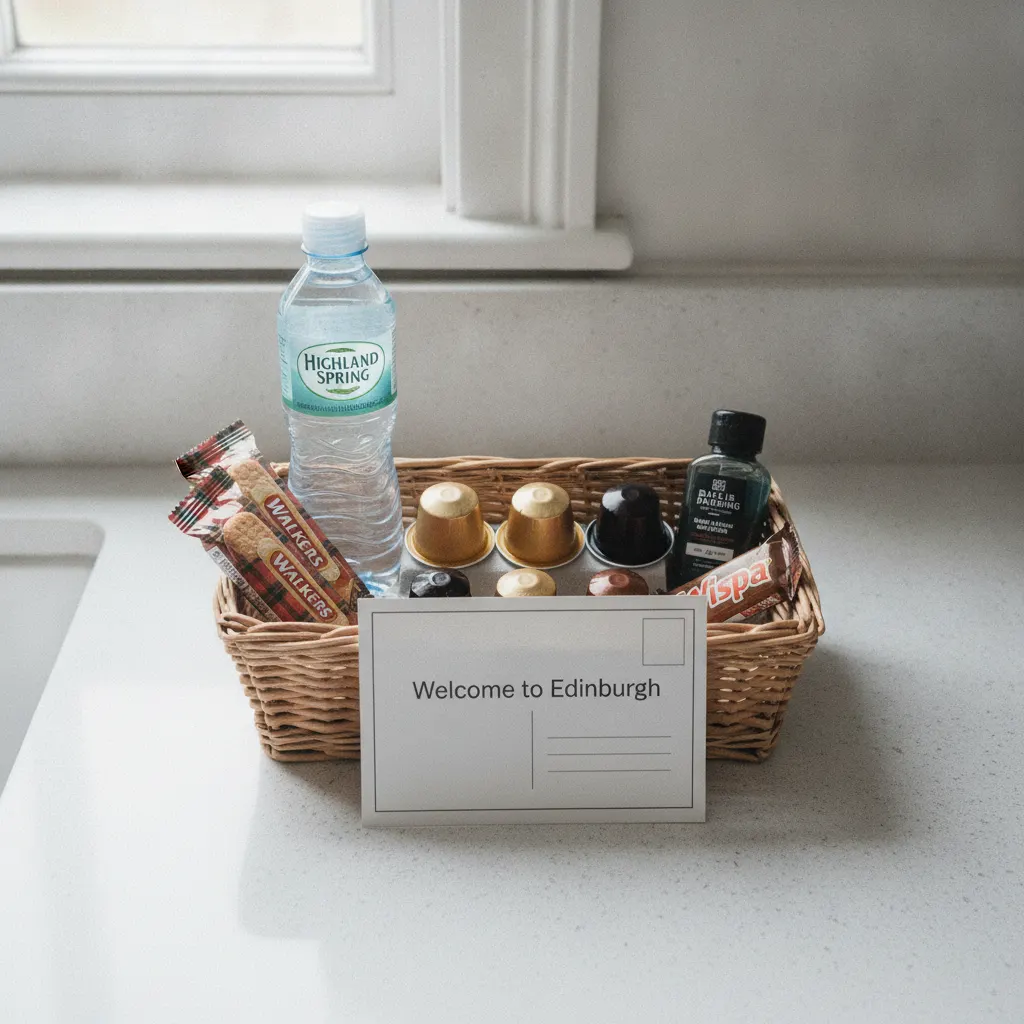
Edinburgh 2-bed standard basket:
- 6 Nespresso Original pods — I vary the range, usually include Vivalto Lungo and Volluto
- Two Walkers shortbread fingers (from a catering pack)
- 500ml Highland Spring still water per guest bedroom (from Amazon Business cases of 24)
- One Baylis & Harding Black Pepper & Ginseng mini per bathroom (about 28p each from a catering wholesaler)
- One Wispa bar
The Wispa bar is slightly absurd and I know it. It gets mentioned in reviews with disproportionate frequency. Something about a single chocolate bar being unexpected seems to land well. I have a guest in Kemptown last March who specifically called it 'an oddly thoughtful detail', which might be the most accurate description of my hosting approach I've ever read.
Total cost for a 2-guest Edinburgh stay: about £3.80–4.20 depending on current pricing.
Brighton basket is similar but I swap the Walkers for a bar from a local chocolatier on the South Lanes, and I add a small card with my three favourite brunch spots on the Lewes Road. The local angle plays better in Brighton — guests there often don't know the city and actively want local knowledge. Edinburgh guests frequently know it better than I do.
What doesn't work
Generic hotel-style notepads with 'Welcome to [PROPERTY NAME]' printed at the top and nothing personalised. I tried these briefly for about three months on a cost-saving basis. Nobody mentioned them in reviews. They just sat on the counter and got ignored.
A welcome message that's primarily about rules. The first version of my welcome card included the key rule reminders — noise after 10pm, no smoking, bin instructions. A guest in Edinburgh described the property as 'a bit clinical' during that period. Reasonable feedback. The card should say 'I'm glad you're here', not 'here is a list of things not to do'.
Time across all five properties
Roughly 25–30 minutes per week on welcome card prep and basket ordering. About half of that is ordering supplies. The Canva text-writing and MOO batch-printing takes maybe 20 minutes per week's worth of cards.
Less time than handwritten notes, better results in reviews, and about £800/year in total basket costs across all five properties. I don't price this into my nightly rate explicitly. I treat it as the most effective marketing I do — cheaper than a Superhost boost, more reliable than anything algorithmic, and something guests actually mention in the reviews that prospective guests actually read.
Ready to streamline your inventory?
Start managing your rental inventory smarter with automated stock tracking.
Start Free Trial