Hair dryers for Airbnb: what guests actually complain about and the model I've reordered four times
Hoststock Team
30 July 2026
Hair dryers are one of those things you buy once, put in a drawer, and then suddenly you're on your third one in eighteen months because guests are using them on maximum heat continuously while their check-out window closes and your cleaner is waiting downstairs. That's the reality of Airbnb appliances. The home use case and the STR use case are completely different, and the cheap hair dryer you bought in an emergency at Boots will not survive both.
I've bought six hair dryers across four properties in three years. Two burned out mid-stay. One got a specific mention in a review — 'the hair dryer was quite weak' — which is the kind of comment that lodges in your brain because you're left wondering how many other guests thought it and didn't bother writing it down. The model I now reorder is the fourth one I tried, and I've put it in four properties. No issues in twelve months.
Here's what I've learned.
Why hair dryers fail in short-term lets
A home user runs a hair dryer for maybe ten minutes a day, three or four times a week, and stores it in a drawer between uses. In an Airbnb, a hair dryer might be used by two guests for fifteen minutes each on a two-night stay, then another two guests the following weekend, then a solo traveller for a week. Over a month at 70% occupancy, a hair dryer in an Airbnb might run for six to eight hours of continuous use across a series of separate sessions — each at the highest heat setting, because guests are always in a hurry.
Most domestic hair dryers are not rated for that kind of duty cycle. The thermal protection cuts in, the motor overheats, the unit dies — usually in a guest's hand at 7am when they have a train to catch.
What I tried first
My first Airbnb got a Remington D3080 from Amazon. About £20. Standard 2000W, dual voltage, compact. Fine for occasional home use. In my Brighton flat it lasted nine months before the motor gave up. I replaced it with an identical model — same mistake, twice — and that one lasted seven months.
Third attempt: a BaByliss 2100W dryer — the Diamond model at the time, about £35. Better motor, better heat management, felt more robust in the hand. It lasted eighteen months in my Edinburgh studio and was still going when I did a full supply refresh — I replaced it preemptively rather than waiting for it to fail on a guest. That's the version of this decision I should have been making from the start.
The model I now buy
For the last twelve months, I've been putting Remington 2200W dryers from the Air range in every new property and any property where a replacement is due. It's 2200W, has five heat and speed settings, ionic conditioning, and — crucially — is available for around £30-£35 on Amazon. Not the cheapest option. Not expensive either.
The reason I switched to this specific model: it runs cool relative to the power output. The ionic conditioning isn't primarily about the guest's hair — it's about heat distribution across the motor. A hair dryer that runs cooler runs longer. Twelve months across four properties, six to eight turnovers a month each, no failures, no guest complaints. That's good enough for me.
I buy them in pairs. One per property, one backup in my supply storage. The moment a unit goes, the replacement is already in the cupboard, and I reorder the backup immediately. I don't want to be sourcing a hair dryer at short notice because a guest has a job interview in three hours.
Power matters — more than brand
The review that mentioned 'quite weak' was on a 1600W dryer I'd put in a property as a temporary measure when a unit died and I didn't have a backup. Guests using a hair dryer in an Airbnb — usually after a shower, usually in a hurry — need a dryer that works quickly. Anything below 1800W feels underpowered. 2000W is a reasonable minimum. 2200W is where I'd start for an STR property.
Don't buy a 1600W travel dryer and call it the 'hair dryer'. Guests know the difference. The ones who care about this care about it enough to mention it.
Hotel-grade dryers: worth it?
Hotel-grade wall-mounted units — the Corby or Valera types you see bolted to bathroom walls — are an option if you want something that's properly rated for high-cycle use. They're more expensive (£60-£120 for a decent unit, plus installation if it's wall-mounted), but they last years rather than months, they're hard to steal, and they signal quality in a way that a drawer dryer doesn't.
I haven't installed one yet. The upfront cost put me off when I was scaling quickly across five properties and watching every capital outlay carefully. But two of my Edinburgh hosts in the same owners' group I'm part of swear by the Valera Superjet — they've had them for three years with no replacements. I'm thinking about retrofitting one in my newest Brighton flat during the winter void period.
If you're setting up a single high-end property and expect good occupancy, the wall-mounted unit is probably the better long-term choice. If you're scaling across multiple properties and need a consistent, low-cost solution you can reorder quickly: drawer dryer at 2000W+, from a brand with decent motor quality.
Where to put it
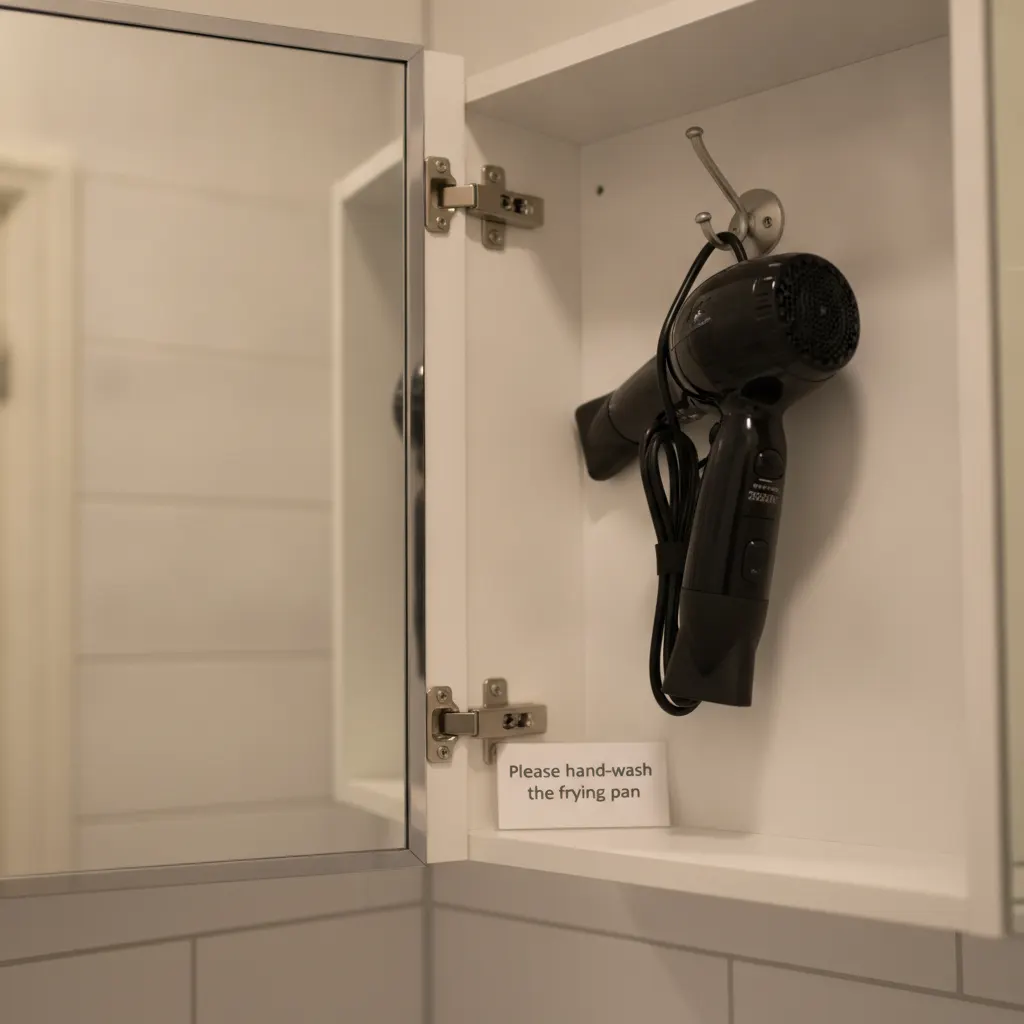
A note on placement, because this has tripped me up. Hair dryers that live in a bathroom drawer are harder to find, get damp, and get left behind less often. Hair dryers on a hook or in an open basket on a shelf get used more often — which is both good (guests appreciate them) and bad (more use, faster wear). I've settled on a dedicated hook inside the bathroom cabinet in three properties, with a small sign. Visible, accessible, dry, slightly less likely to be 'borrowed' for the en suite in error.
My Lake District cottage has a particularly cold bathroom in winter — thick stone walls, north-facing — and I keep a small ceramic bathroom heater in there during November to March rather than worrying about hair dryer placement. But that's a separate thing.
The theft question
Hair dryers do walk occasionally. Not dramatically often — in five years I've had two disappear — but they're light, they're small, and a forgetful guest will pack them by accident without realising. That's why I keep the backup unit in the supply storage rather than in the property itself, and why I buy a consistent model across all properties. One Amazon reorder button covers every property simultaneously.
The two that went missing: one was £20 and I didn't notice for two weeks. One was £35 and I noticed when the guest who'd taken it messaged apologetically from home, offering to post it back. I told her not to bother. She left a very warm five-star review and has booked three times since. Small write-off. Good outcome.
What to actually buy
My current buy: Remington 2200W from the Air range — around £30-£35 on Amazon. Order two for each property you're setting up. Keep one as the active unit, one as backup in your supply store. Replace at the first sign of overheating, reduced airflow, or any noise that wasn't there before. Don't wait for a guest to be standing in the bathroom at 7am with wet hair to find out the motor has gone.
Check the hair dryer every time you do a supply run. It takes twenty seconds — plug it in, turn it on, hold your hand in the airflow, check it gets properly hot within thirty seconds. If it doesn't: replace. The £30 is much cheaper than the three-star review.
Ready to streamline your inventory?
Start managing your rental inventory smarter with automated stock tracking.
Start Free Trial