Airbnb hot tub running costs: the electricity maths for a 4-person spa at my Lake District cottage
Hoststock Team
7 September 2026
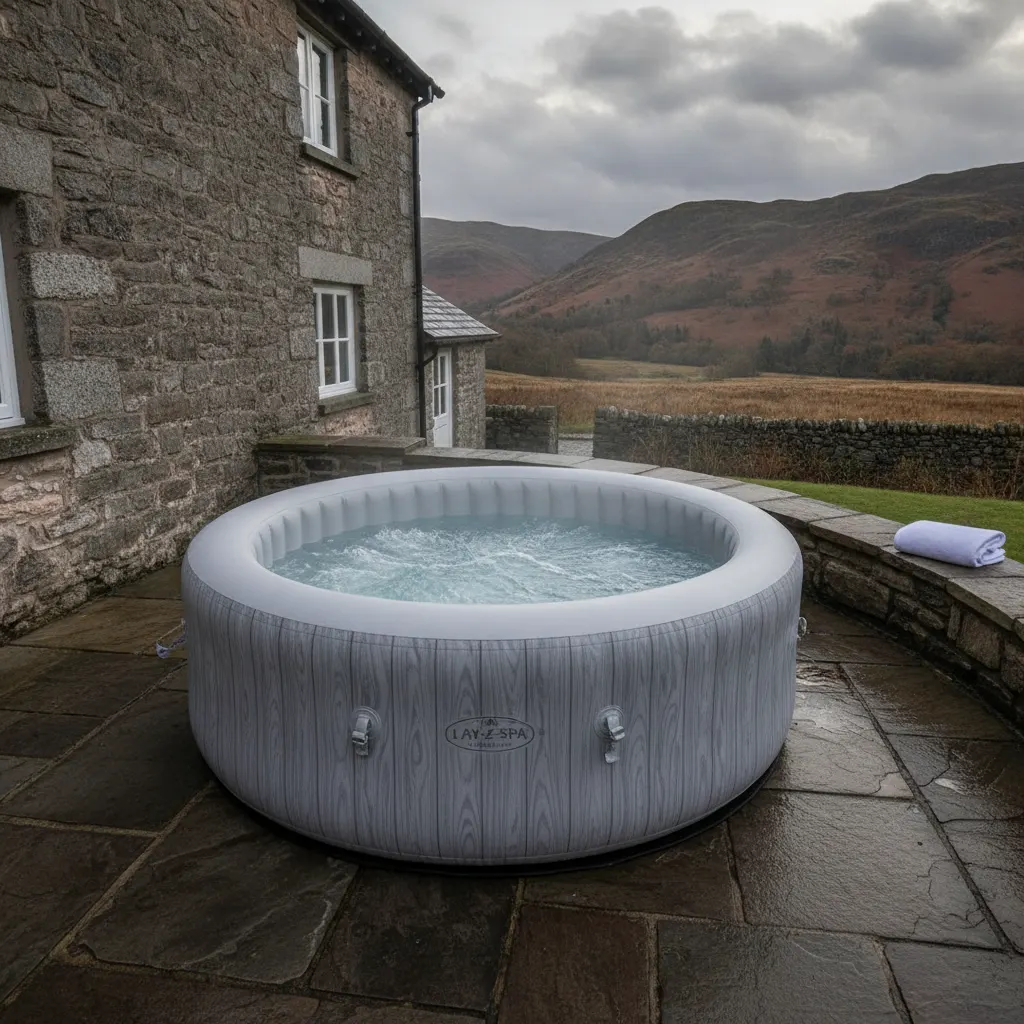
I bought a second-hand Lay-Z-Spa Helsinki for £680 off Facebook Marketplace. This is not a decision I made with a spreadsheet. A guest had asked whether the cottage had a hot tub, I said no, they booked somewhere else, and I spent a fortnight convincing myself it would pay for itself by Easter.
It probably has. But the running costs are not what I expected, and nobody I spoke to at the time could give me a straight answer. So I tracked everything from day one.
What a hot tub actually uses
The Lay-Z-Spa Helsinki is a soft-sided inflatable. Not a luxury unit — a proper one would have better insulation and a more efficient pump. Mine sits outside on the cottage's flagstone patio, fully exposed to whatever the Lake District decides to throw at it.
In summer, with air temps around 18–22°C, it uses roughly 4–6 kWh per day on standby. That's holding temperature at 38°C with the cover on. In winter — January last year, genuinely horrible — I tracked 9–12 kWh on the coldest days. December through February is brutal for electricity consumption. The pump runs almost constantly trying to hold temperature against zero-degree air.
A rigid-sided spa with a proper insulated shell uses maybe a third of that. Worth knowing if you're deciding between inflatable and built-in.
The actual costs
I pay roughly 25p per kWh on my current variable tariff (your rate will differ — check your last bill). At that rate:
- Summer standby: 4–6 kWh × 25p = £1.00–1.50/day
- Winter standby: 9–12 kWh × 25p = £2.25–3.00/day
- Guest heating from cold: add another 6–8 kWh to get from cold to 38°C (roughly £1.50–2.00 per heat-up)
In practice, I leave it at temperature between bookings because heating from cold takes 12–24 hours with the Helsinki. Letting it go cold and reheating it for every guest would be too slow and too expensive per cycle.
In August, with decent occupancy (six bookings that month, 23 nights occupied), the hot tub cost me about £48 in electricity. October was £62. January — two bookings, cold snap, pump running almost flat out for 10 days of vacancy — was £89. That month I nearly turned it off entirely.
What I add to the nightly rate
Before I had the data, I added £8/night as a hot-tub surcharge. After tracking a full year, I've moved it to £12/night in summer and £15 in winter. This still undersells the January cost but I make it back in shoulder season.
Some hosts add a flat hot-tub cleaning fee instead. I tried that for four months — £20 per booking regardless of stay length. Guests pushed back more on the fee line item than they do on a slightly higher nightly rate. I went back to baking it in.
The chemical cost
This is the bit people forget. Bromine or chlorine tablets, pH up, pH down, shock treatment, test strips. For a 930-litre Helsinki, I spend roughly £18–24 per month on chemicals across the guest season. Per booking, on a 3-night stay, that's about £4–6 in chemicals per turn.
I buy Aquasparkle or HTH from Amazon in bulk. Not the branded 'hot tub chemical starter kit' at £65 from Argos. The same ingredients, a quarter of the price.
The cleaning time
This one nearly broke me. I had no idea. A proper hot tub turnover — drain, rinse, refill, rebalance chemistry, test — takes 2–3 hours minimum. The Helsinki drains via gravity through a valve in the base. Slow. Painful. I now drain every third guest booking rather than every one, which means topping up chemicals more aggressively between turns instead.
My cleaner, Nadia, won't touch the hot tub on principle after what happened in November 2024. I won't go into it. She does the cottage; I do the tub. We have an arrangement.
Does it show up in bookings?
Yes. My enquiry rate for the cottage went up noticeably in the 30 days after I added it to the listing. Direct comparisons are hard — I also improved the photos at the same time — but guests specifically mention it in about a third of reviews. 'The hot tub was a highlight' appears nearly verbatim three times. One guest said it was the reason they booked us over the property down the road with an identical layout.
The 4.9 star location score held. The cleanliness score bumped from 4.7 to 4.9 after I sorted the chemical management. I credit Nadia with the cottage and myself with the water clarity.
What I'd do differently
Buy the rigid shell version from the start. Yes, it's £2,500–5,000 versus £600–900 for a decent inflatable. But the electricity saving in winter alone would recover a significant chunk of that cost over three years, and the guest experience is noticeably better. The Helsinki wobbles slightly when you get in. Nobody complains, but it's not a £250/night premium-feel amenity.
Also: fit a timer on the pump so it runs during off-peak hours. My tariff doesn't have Economy 7 but if you have one, you should absolutely run your heat maintenance cycle at night.
And get the cover clips. The Helsinki cover is held on with two straps. High winds in the Lake District in autumn will lift a cover straight off and you'll come back to a tub full of leaves and a shattered chemistry reading. I found this out in October. The clips cost £12 on Amazon.
The bottom line
A year of hot tub running costs — electricity, chemicals, water (a full drain and refill is 930 litres, maybe £1.50 at current water rates) — came to roughly £890 across the full twelve months. Nightly surcharge revenue over the same period: approximately £1,640. Net contribution from the hot tub: around £750 before my own labour.
That's not a windfall. But occupancy also rose about 8% after I added it, and I think that's the real return. Guests who want a hot tub are often prepared to pay more for the right property and stay longer. My average booking length at the cottage moved from 2.9 nights to 3.6 nights over the same period.
I can't isolate the hot tub as the only variable. But I'd add it again.
Ready to streamline your inventory?
Start managing your rental inventory smarter with automated stock tracking.
Start Free Trial