Kettles and toasters for Airbnb: three brands I kept and one I replaced twice in a season
Hoststock Team
20 July 2026
I bought a Swan retro kettle for my Brighton flat because it looked good in photos. It died in four months. The internal element gave out mid-booking, I got a frantic message at 11pm from a couple who couldn't make tea, and I drove forty minutes to drop off a Breville from the Tesco Metro. Not my finest Saturday.
Since then I've been more systematic about it. Across five properties — two flats in Brighton, two in Edinburgh Old Town, one cottage in the Lake District — I've run through eleven kettles and nine toasters over the past four years. Some of those replacements were accidental breakages. Most weren't. Here's what I've learned.
What actually kills kettles in a short-term let
It's not heavy use. Guests don't boil kettles twenty times a day. The thing that kills kettle elements in STRs is limescale — specifically, the hard water in Brighton builds up faster than the national average, and if nobody descales between guests (and they won't, unless you prompt them), you're looking at element failure within twelve to eighteen months regardless of brand.
The second killer is drops. Guests treat kettles roughly. Cordless bases get knocked off worktops. Lids crack. The ones with flimsy lid mechanisms fail first — and that's a design problem, not a durability one. You can have a perfectly good element in a kettle with a broken lid that won't seat properly and suddenly your cleaner is telling you the kettle floods every time.
Toasters are simpler. They die from crumb tray neglect and the occasional piece of toast that stays in too long and warps the heating element. Two-slice versus four-slice matters more than brand for STRs: if you've got a property sleeping six or more, a two-slice toaster on a busy weekend check-in morning is going to get overworked in a way that a residential toaster just isn't designed for.
The brands I've actually kept
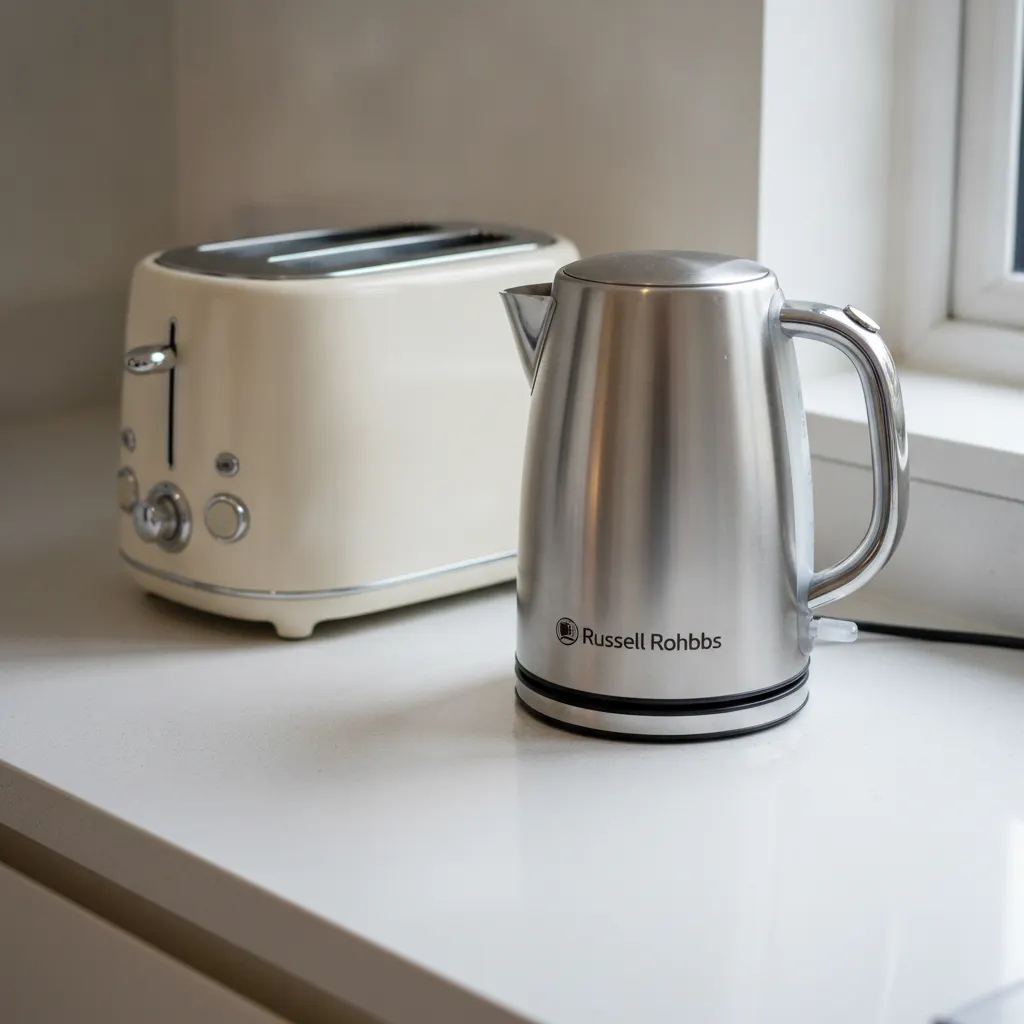
Russell Hobbs Buckingham is what I run in three of my five properties right now. Around £35–40 depending on where you buy it. The element has been solid — I've had units hit two years in Brighton without failure, which I consider a reasonable result given the water. The handle doesn't flex, the lid clicks properly, and the base is weighted enough that it doesn't tip when guests are clumsy. It's not glamorous. It photographs fine. It's there when you need it and it doesn't announce itself by breaking.
For toasters, Morphy Richards has been the most consistent. The Accents range specifically — around £30–35 for a two-slice, £45 for a four-slice. Crumb tray slides out cleanly, which matters because cleaners can clear it in ten seconds without taking the toaster apart. The slots are slightly wider than average, which means thick-cut bread from the artisan bakery around the corner from my Edinburgh flat doesn't get stuck. Six guests, six jams. Nobody's jammed a Morphy Richards yet across three properties.
Dualit I've tried twice. The 2-slice NewGen is around £120. It's built like a tank and the servicing model — replaceable elements, replacement parts available — is genuinely appealing in theory. In practice, when an element fails mid-booking you can't order a replacement element and have it there by morning. And they do fail. Both of mine went within two years. Maybe I got unlucky. But for that money, I expected better.
The one I replaced twice in one season
Smeg. I know. They look brilliant. The pastel colours photograph beautifully. A Smeg kettle on a white marble worktop in a listing photo does real work for you — it probably adds £8 a night in perceived value, which isn't nothing.
But the base connector on the ones I bought (both from John Lewis, both the 1.7-litre model) developed an intermittent fault that made the kettle cut out before reaching boiling point. First one lasted five months. Second lasted seven. The lid on both started sticking by month three. I've seen other hosts report the same on the STR forums, so I don't think I just got two bad units — I think the QC on Smeg small appliances is inconsistent enough that I can't justify the price for an STR context.
I now use the Smeg kettle photo from the first week of listing, and there's a Russell Hobbs in the cupboard under it.
What I buy and where
I don't buy on Amazon for kettles anymore. Delivery speed is fine, but returns are annoying for something this size, and I've had two kettles arrive damaged from third-party sellers. Argos click-and-collect works well — I can get something to a property within a few hours if needed, and the range is predictable.
John Lewis for the odd upgrade purchase when I want something that photographs well. I keep the box and receipt for everything because returns within thirty days, no questions.
I buy in pairs now. One in use, one in a utility room or storage unit. The moment a kettle gives trouble, it gets swapped immediately and the dead one goes in for return or recycling. Zero gap between a working kettle and a property available to book.
The maintenance piece nobody talks about
Descaling. In hard water areas — Brighton, London, anywhere in the South East — descaling every two to three months is the difference between a kettle that lasts two years and one that lasts fourteen months. I leave a sachet of Oust descaler in the kitchen cupboard with a small printed note. Some guests do it. Most don't. The cleaners aren't going to do it in a sixty-minute turnover. So I do a quarterly sweep of kettles across all five properties and descale the ones that need it.
It takes about forty minutes total. It saves me roughly two kettle replacements a year across the portfolio, which is probably £70–80 in hardware and the aggravation of an 11pm message about a kettle that won't boil.
The actual numbers
Across five properties, I'm buying roughly two to three replacement kettles and one to two toasters per year. At the price points I use, that's around £120–180 annually across the portfolio. It sounds like a lot until you price the alternative — a guest complaint about equipment failure is a five-star review risk, and one three-star review on a property that averages 4.9 takes months to dilute.
The math on buying decent mid-range rather than cheap: a £35 Russell Hobbs that lasts twenty-four months beats a £12 Argos own-brand that lasts six, every time. The per-month cost is lower, the failure rate is lower, and the replacement urgency is lower. I don't need to think about it until something actually goes wrong, which is exactly what I want from small appliances.
A note on toasters and sleeping capacity
This is the thing I got wrong in my first three listings. I put a two-slice toaster in my Edinburgh flat that sleeps six. On a busy Saturday check-in where a group of six wants breakfast before a walking tour, the toaster runs for twenty minutes straight and overheats. Two-slice toasters are designed for domestic use — occasional, moderate loads. Not six guests making toast in rotation.
If your property sleeps four or more, buy a four-slice. The Morphy Richards four-slice Accents is around £45–50 and it handles actual load. The cost difference over the life of the appliance is trivial. The review mention of 'slow toaster' is not.
Ready to streamline your inventory?
Start managing your rental inventory smarter with automated stock tracking.
Start Free Trial