Kitchen knives in Airbnb rentals: Victorinox vs IKEA vs Global — which survives a year of guest use
Hoststock Team
22 September 2026
Knives. The thing nobody warns you about.
I've replaced the kitchen knives across my properties four times in three years. Not because I bought cheap ones. Because I bought the wrong ones. There's a difference.
My first set was a Sabatier block — looked great in the listing photos, felt premium, and was destroyed within six months. Not by malicious guests. By the dishwasher. Guests put everything in the dishwasher, even things that say "hand wash only" in three languages on the handle. The high-carbon steel corroded. The wooden handles split. One knife came back from a turnover looking like it had been to the wars.
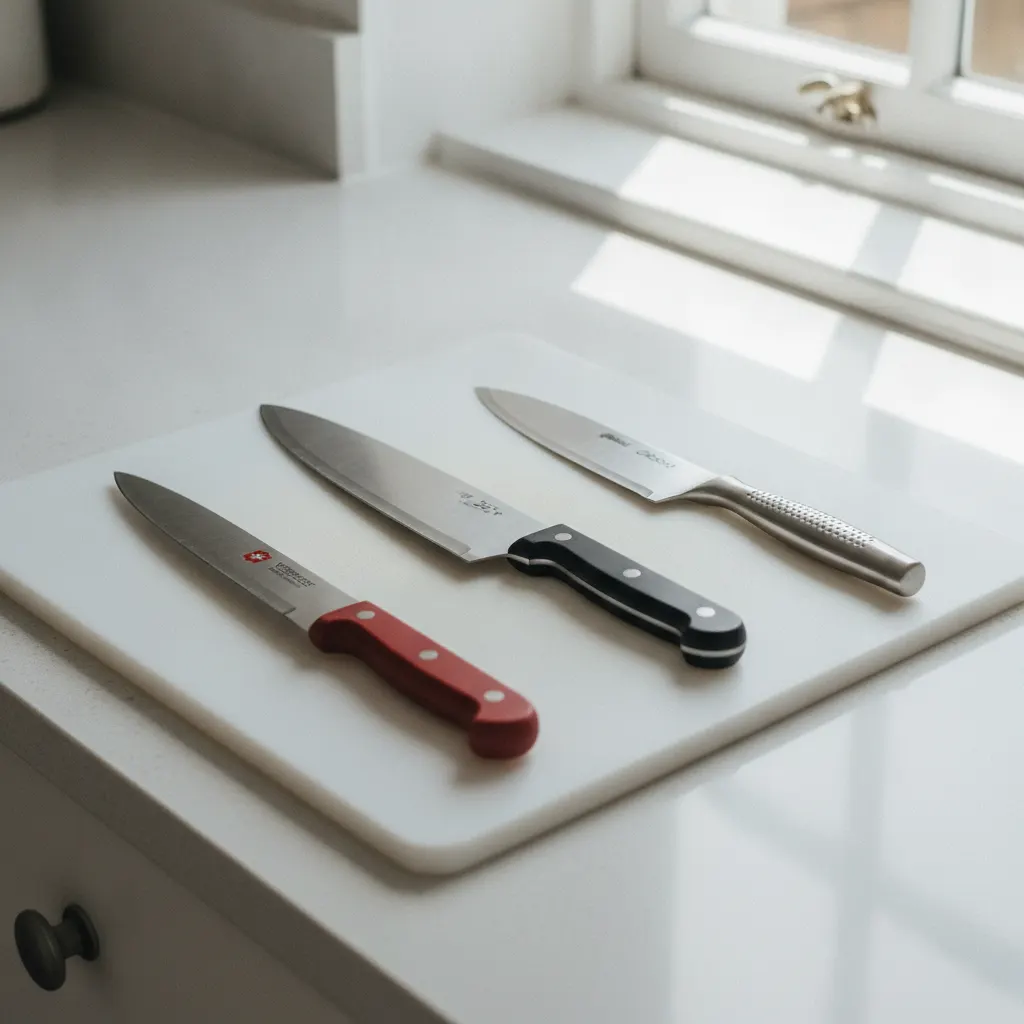
Since then I've tested three ranges across five properties: Victorinox Swiss Classic, IKEA 365+, and a mid-range set from Global I'd had in my own kitchen for years. Here's what I actually know about each from using them in short-term rentals.
What you need from a knife in a rental property
Before I get into the brands: the spec for a rental knife is not the same as the spec for your own kitchen. You're not the one using it. You're not the one washing it. And you're not replacing it only when it's genuinely done — you're replacing it when a guest complains, or when the cleaner tells you it's gone, or when you notice during a check that the blade looks bent in a way that doesn't make physical sense.
A rental knife needs to be: dishwasher-safe (genuinely, not in theory); stainless steel rather than carbon steel; simple enough that guests can't easily snap the tip off by using it as a lever; and cheap enough that replacing individual blades when they disappear doesn't hurt. Because they do disappear. I've lost maybe eight knives across five properties that I cannot account for.
Sharp matters too, but not in the same way. You're not trying to hold a precise edge for a year. You want a knife that arrives sharp and stays serviceable for six months of mixed use, then gets replaced or sharpened. The days of me buying premium knives for rental properties are over.
Victorinox Swiss Classic: the one I keep coming back to
The Victorinox Swiss Classic range is the thing I've settled on for most of my properties. The chef's knives and utility knives in particular. They're made in Switzerland, the blade is high-carbon stainless steel (which means they hold an edge better than standard stainless but without the corrosion risk of pure carbon steel), and they're fully dishwasher-safe.
The handles are the slightly contentious part. That textured polypropylene grip looks a bit institutional — it's the kind of thing you'd see in a commercial kitchen. In a guest property that's meant to look warm and domestic, it can read as slightly clinical. A few of my guests have asked about the knives, and it's always a positive observation — "these are actually decent" — rather than anything negative. So functionally it works.
Pricing in the UK: a four-piece Swiss Classic set (chef's knife, bread knife, paring knife, utility knife) typically runs around £35–45 depending on where you buy. I've found them at John Lewis, Amazon, and occasionally on offer at Lakeland. Individual blades are around £8–15 depending on size. Replacing a lost chef's knife costs less than a cleaning call-out, which is the mental benchmark I use.
They're not exciting. They won't make anyone's Instagram. But I've had sets last 18 months across high-turnover properties without needing replacement — which is about as much as I'd hope for. The Swiss Classic is probably my default recommendation for anyone starting out or scaling up a portfolio.
IKEA 365+: the emergency backup
The IKEA 365+ kitchen knives are very cheap — around £5–8 per knife — and they're fine. Stainless steel, dishwasher-safe, edge holds adequately for a few months of normal use. They're not exciting blades and they won't last as long as the Victorinox, but they're useful in two specific scenarios.
First: the knife has gone missing and you need to replace it before the next guest arrives in 12 hours. Every property owner near a large IKEA knows this scenario. The 365+ is what you grab on the way in.
Second: a property that's particularly hard on equipment. I've got a flat in Edinburgh that has suffered three consecutive groups of students (language school, not long-stay — Airbnb, 4-6 nights each, six guests, busy kitchen). In that property I've gone disposable-ish. Budget knives, replaced more often, lower investment per unit. The maths on a £7 knife that survives six months versus a £40 knife that disappears in two months is fairly clear.
The main weakness is edge retention. The 365+ blade is softer steel and blunts faster. For regular cooking it's fine. For guests who've been enthusiastically quartering butternut squash for eight, you might get a complaint that the knives are blunt. I've never had that complaint with the Victorinox.
Global: premium, and it's not worth it for rentals
Global knives are excellent. They've been in my own kitchen for eight years and they're still going. Japanese stainless steel, excellent edge, ergonomic design, and a price point that reflects all of that — a single Global chef's knife is typically £50–80 in the UK, and a set can easily run to £150–250.
I put a Global set into one of my Edinburgh flats when I first launched it. Nice listing photos, premium feel in person. The set lasted four months before a guest bent the tip off the paring knife, another lost the bread knife, and the chef's knife came back with a chip in the edge that I still don't understand. Total loss on a £180 investment in under a third of a year.
Global knives are not designed for the dishwasher. Technically, the handles are cromova stainless steel and can handle it, but the edge suffers over time in a way that cheaper stainless steel paradoxically doesn't (the softer steel simply doesn't hold a precise edge to lose it). You also need to sharpen them properly, which guests obviously won't do and which I'm not doing between every turnover.
Premium kitchen equipment in rental properties is a sunk cost waiting to happen. Keep the nice stuff for your own kitchen.
The wooden-handle problem
A lot of the knife sets that photograph nicely — the ones with warm natural wood handles, stacked on a magnetic strip against a white splashback — are not dishwasher-safe. I know. I've made this mistake. The wood swells, cracks, and splits. Traditional riveted handle construction allows moisture ingress at the joints, which eventually causes rust spots around the rivets even on stainless blades. This is not a theoretical problem. After one dishwasher cycle you might be fine. After 40 guest groups, each of whom does four loads of washing up, you're looking at a handle that's coming apart.
If you want a magnetic strip setup that photographs well, use synthetic-handled knives. There are decent options — including within the Victorinox range — that have composite or resin handles in dark tones that still look intentional rather than catering-supplier. The "chef's aesthetic" you're going for in the listing photos doesn't actually require wood.
The knife block vs magnetic strip debate
On the storage side: I've switched all my properties from knife blocks to magnetic strips. Blocks are harder to clean (guests don't bother, and mould grows in the slots — I've seen it, it's horrible), they take up counter space, and they break down faster. A magnetic strip mounted on a kitchen wall is easy to wipe down, keeps knives visible and accessible, and lets guests understand the inventory at a glance. If a knife is missing after a turnover, the cleaner can tell immediately.
Budget for a decent magnetic strip — around £20–35 for a solid stainless or acacia-faced version from Amazon or IKEA. A cheap magnetic strip won't hold heavier knives securely and a knife falling off the wall at 2am is the kind of thing that ends up in a review.
Scissors and peelers: the overlooked kit
Kitchen scissors disappear faster than knives, in my experience. I've no idea where they go. Every property now gets a pair of Victorinox kitchen scissors (around £12–15, dishwasher-safe) and I order them in bulk whenever I'm restocking. They're not glamorous but they last and guests actually use them — for packets, herbs, whatever. The cheap ones from supermarkets corrode at the pivot point after about three dishwasher cycles.
A Y-peeler rather than a traditional Lancashire-style peeler: guests find them more intuitive and they're less likely to damage themselves or the product. The OXO Good Grips Y-peeler is around £8–10 and essentially indestructible. I buy three at a time.
When to replace
My rough rule: the chef's knife and utility knife get replaced or professionally sharpened every 12–18 months depending on turnover volume. If a property does more than 60 turnovers a year, I'll check the edge at the 12-month mark. The paring knife and bread knife tend to either disappear or survive indefinitely — I don't think anyone ever uses the bread knife and it's always the paring knife that vanishes.
I keep a spares box at each property (in a locked cupboard, away from guests) with one extra chef's knife and one extra utility knife. When the cleaner reports a missing or damaged knife, the spare goes straight into the kitchen and the main knife order goes on the list for next month. It's not a big spend in the scheme of things — around £40–60 per property per year in knife costs — but it's one of those operational details that if you ignore it, you'll eventually get a three-star review mentioning the knives. And that's avoidable.
The short version: Victorinox Swiss Classic for your main properties, IKEA 365+ as backup, no to premium knives, no to wooden handles, and count your knives at every turnover. You'll thank yourself for it.
Ready to streamline your inventory?
Start managing your rental inventory smarter with automated stock tracking.
Start Free Trial