Laundry detergent for Airbnb linen: what I use after ruining six sets of white bedding
Hoststock Team
28 August 2026
Six sets of white bedding
Not all at once. Over the course of about eighteen months. Three went grey. Two went stiff. One came out of the machine with a faint smell I couldn't place and had to retire. All six went into a bin bag.
I'd been washing at the wrong temperature with the wrong detergent and not thinking about either. Here's what I changed.
Why washing temperature matters for STR linen
White linen in a short-term let needs 60°C to reliably deal with the bacteria and allergens that build up through multiple guest stays. This isn't paranoia — it's the practical standard for hospitality hygiene. Hotels wash their linen at 60–71°C. The same logic applies to high-turnover accommodation where different guests are sleeping in the same sheets every few days.
The problem is that 60°C is also what degrades fibres faster, drives shrinkage, and causes greying if the rest of your laundry process isn't calibrated to it. The right detergent for 60°C washing isn't the same product you'd reach for at 30°C.
What doesn't work
Regular supermarket laundry liquid — Fairy Non-Bio, Surf, the standard Persil liquid — is optimised for 30–40°C cycles. At 60°C you're using more product than necessary and still not getting consistent results, because the formulation isn't engineered for that temperature. The fabric typically looks clean short-term but greys over time.
Colour-protection detergents are an obvious mistake, but I see hosts recommending them sometimes. They include optical brightening agents that interact oddly with bleach and dull over repeated hot washes. Stay away from anything marketed as colour-safe on white linen.
Pods. I used Ariel pods for about six months. The problem is dissolution rate. In cold-fill pre-rinse cycles, pods don't always dissolve fully before the main wash temperature hits. The result is detergent residue on the fabric. Fine for a home machine run occasionally. A real problem when you're doing 4–5 loads a week across a turnover schedule.
What I use now
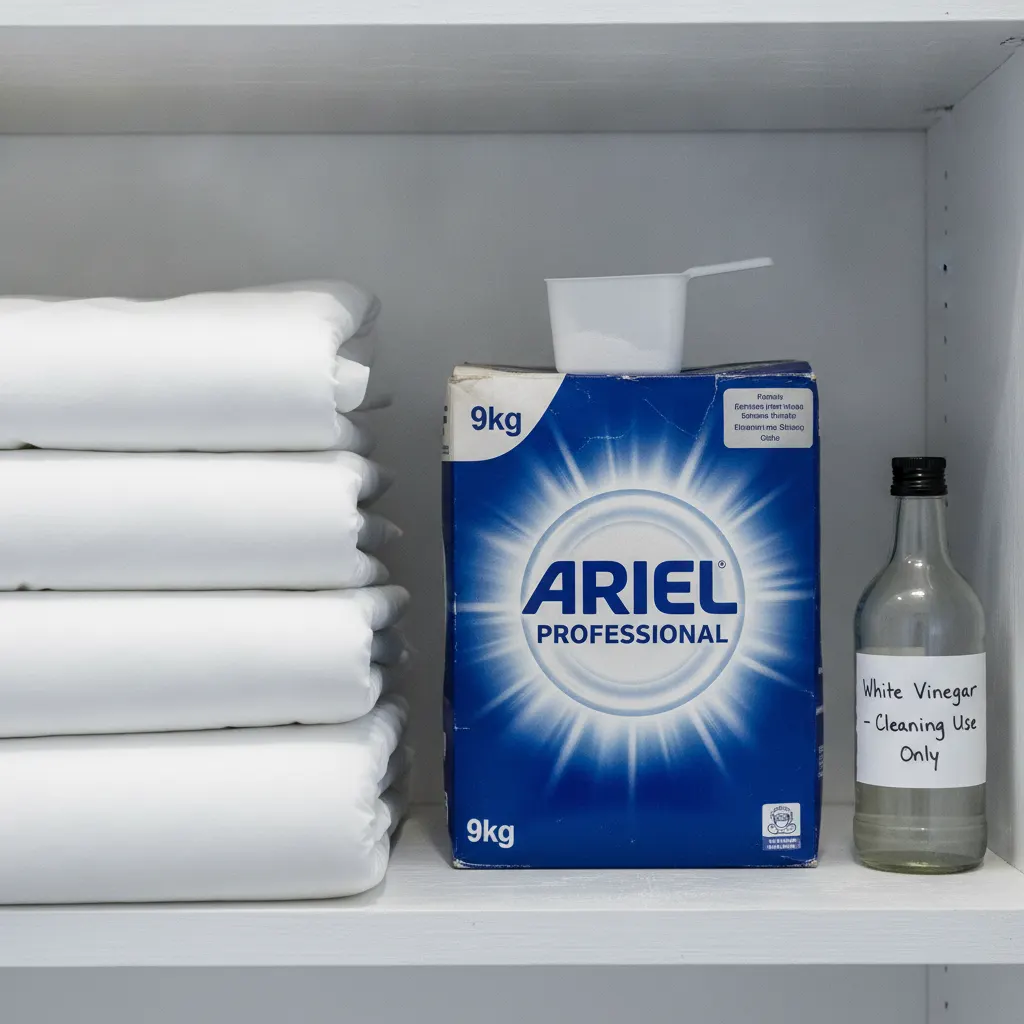
Ariel Professional powder. The Professional range is designed for commercial and high-temperature washing. It comes in a 9kg box — currently available from various trade suppliers and online at around £28–32 depending on where you buy. That box lasts one of my 2-bed properties about four to five months, so the per-wash cost is genuinely low.
Why powder over liquid? Powder is more stable at 60°C. No separation issues, no preservatives that react unexpectedly at high temperature, and it tends to leave less residue on drum seals over time. The Ariel Professional formulation includes sodium percarbonate — an oxygen bleach — which activates meaningfully above 40°C and is doing real work by 60°C on white fabric.
I use it at the recommended dosage for a heavily-soiled load. Don't skimp. The cost saving of using half a scoop isn't worth a rewash.
Fabric softener: just don't, on towels
Fabric softener coats the fibre. On towels, that coating reduces absorbency over time — guests notice this as towels feeling 'not quite right' or not drying them properly. I stopped using softener on towels completely about two years ago and the difference in how long they remain functional is noticeable.
On bedding, I use white vinegar in the softener compartment. About 50ml per wash. It neutralises detergent alkalinity and softens the fabric without coating it. Smells like vinegar when wet — does not smell of anything once dry.
Hard water and descaling
This applies to most hosts in southern England and parts of Scotland. Calcium deposits in the drum and on the heating element reduce your washer's effectiveness at 60°C because the element can't consistently reach temperature once it's scaled. I run a descaling cycle on every in-property machine every three months. One full wash on an empty drum at 90°C with a Calgon tablet. Takes no effort, extends the machine's lifespan, and keeps the 60°C cycle actually running at 60°C.
My Brighton machines are in a notably hard water area. Edinburgh is softer but still benefits from the quarterly cycle.
The hotel laundry shortcut
For my Lake District cottage, I don't wash on-site. I use a commercial hotel laundry service — the sheets come back flat-packed and consistently whiter than anything I get from my own machines. They wash at 71°C with industrial chemistry I can't replicate at a consumer level.
Per-item cost is higher than in-house. But the linen lasts longer. My Lake District duvet covers are now in their third season. The Brighton ones I was washing myself needed replacing at around 18 months.
How to rescue grey-ish linen
If you've already got grey-ish white bedding that isn't structurally damaged — no pilling, no thin patches — there's a recovery option. A sodium hypochlorite soak (diluted to about 1:10 in cold water, 30 minutes) followed by a full 60°C wash with Ariel Professional can bring some whiteness back. I've done this twice on sets heading towards retirement and got another 5–6 months out of them.
Check the care label first. Not suitable for anything marked bleach-sensitive. Rinse the linen thoroughly before putting it through the machine — residual bleach and drum seals don't mix well.
The real fix is getting the process right before the fabric gets to that point. But for linen that's still structurally sound, it's worth trying before binning.
Ready to streamline your inventory?
Start managing your rental inventory smarter with automated stock tracking.
Start Free Trial