Airbnb mattresses: three brands tested across five flats, one I keep reordering, and when I actually replace them
Hoststock Team
22 July 2026
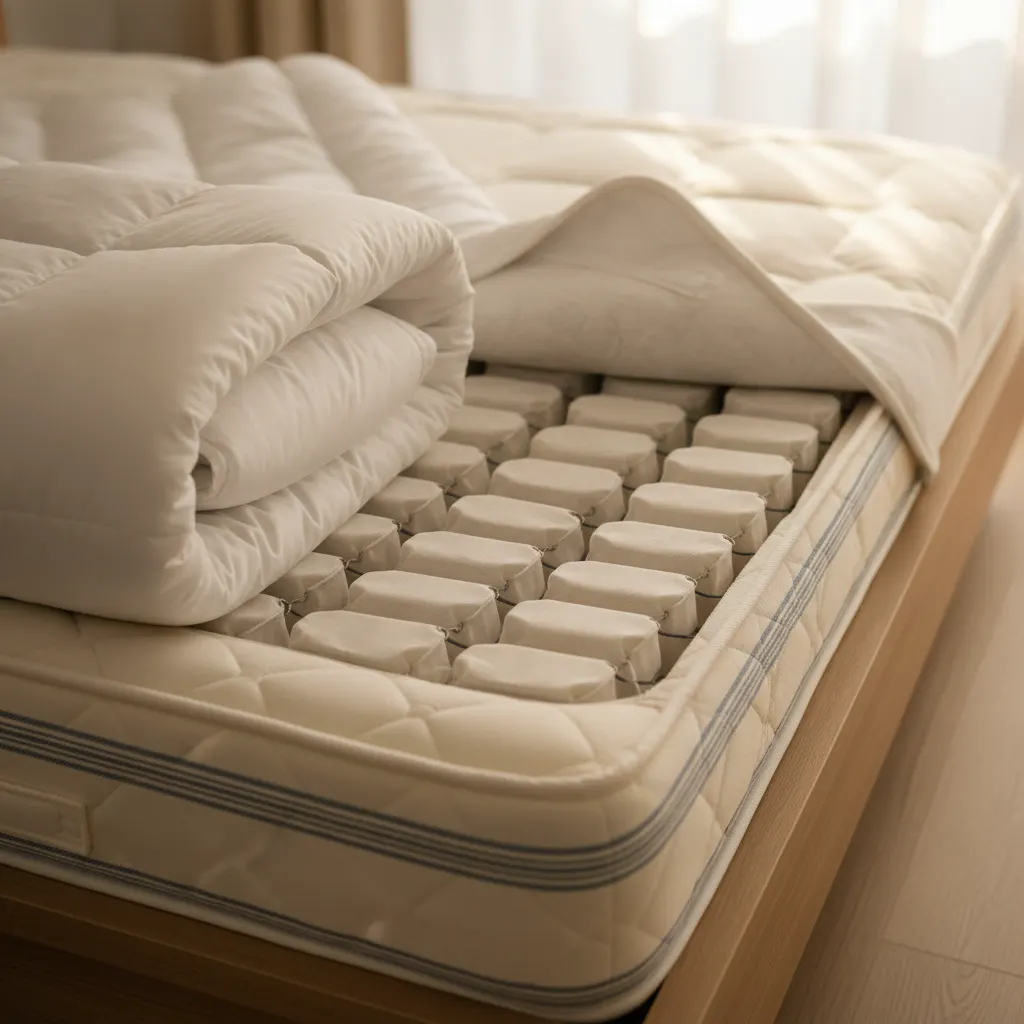
Nobody tells you that buying mattresses for a short-term let is genuinely different from buying a mattress for your own bed. I learned this the expensive way over the first two years, after replacing things I thought would last and keeping things that shouldn't have survived what guests put them through.
Nine mattresses across five properties in four years. That's more mattresses than most people buy in a lifetime. And I've formed opinions.
Why STR mattresses wear faster
In your own home, a mattress gets used by the same person or two, in roughly the same positions, with similar body weight, roughly 365 nights a year. In a short-term let, you might have six adults one week and a single business traveller the next. The weight distribution changes constantly. The mattress gets sat on repeatedly from the edges during packing and unpacking. At 60% occupancy across a full year, that's still 219 nights of use — but the variety of load is much higher than domestic use.
I've also found that STR mattresses get inspected in a way domestic ones don't. Guests look at a mattress before they commit to lying on it. They notice staining, dips, and that particular sag in the middle that happens after a couple of years of heavy use. Domestic mattresses can develop all of that gradually without anyone particularly noticing. Guests notice.
The three brands I've used
Emma Original (or the current equivalent)
I bought three of these. Memory foam, good for domestic sleeping, reasonable price point. In an STR context, two of them developed a noticeable body impression within eighteen months. The third one held up better — I think because it was in my Lake District cottage, which is lower occupancy than the Edinburgh flat. I got two guest comments about mattress comfort from the three Emma beds. Not terrible. Not great. I've since replaced all three.
A pocket spring from Dunelm
I bought one of these as a replacement, partly because it was available for next-day delivery when I needed it quickly. It's still in the Brighton flat two and a half years later. No complaints. No visible sag. I've used it as my benchmark since.
Pocket spring construction holds up better in my experience under variable loads than memory foam does. Memory foam responds to consistent pressure from the same direction. In a short-term let, that pressure is never consistent. A pocket spring mattress doesn't retain those patterns in the same way.
Silentnight from John Lewis
I have two of these now. One in Edinburgh, one in a second Brighton flat. Both have been fine for eighteen months so far — which isn't a long enough track record to say much with confidence, but neither has generated a guest complaint and both look fine on visual inspection. The pocket spring construction seems to hold up, same as the Dunelm one.
Memory foam vs pocket spring for short-term lets
I was sold on memory foam early on because it sounded good in a listing description. Pressure-relieving. Motion-isolating. Guests who co-book with a partner would like it, I thought.
In practice, the issue with memory foam in a short-term let context isn't the feel — it's the longevity. Body impressions develop. And in a guest context, an impression from a previous guest is not a good look. A pocket spring mattress doesn't retain those impressions the same way. The springs respond to pressure and spring back. You get a mattress that looks the same after a year as it did when it arrived.
That said — I've had one memory foam mattress in the Lake District cottage that has been absolutely fine for nearly three years. Lower occupancy, single-occupancy bookings mostly, and I suspect the foam quality was better on that unit. So I wouldn't rule it out entirely. But my default now is pocket spring for anything urban and high-occupancy.
Mattress protectors are doing half the work
If you're replacing mattresses because of staining, you're losing before you've started. A decent mattress protector costs £20-40. A mattress costs £200-600. The maths isn't complicated.
I use waterproof protectors on all five properties now. Fully encasing the mattress, not just the top panel. The ones I've had longest are from Amazon Basics — not glamorous, but they've survived hundreds of washes at 60°C and none of them have leaked. The crinkle noise some cheap waterproof protectors make is a guest complaint I've seen on other hosts' reviews. Worth paying a bit more for a quiet one.
I replace protectors more often than mattresses now. A protector at £30 gets replaced when it starts showing wear — typically around 12-18 months in my higher-occupancy properties. The mattress underneath stays clean and dry and lasts considerably longer as a result.
When I actually replace a mattress
I used to go on a fixed schedule. Every two years, everything gets swapped. Expensive, and I was replacing mattresses that had years of life left in them.
Now I use a combination of three signals.
Visible inspection at turnover. I look at the mattress during my quarterly walk-through of each property. Is there a sag along the middle third? Do the edges compress when I press them? Can I see wear through the fabric on the top panel? Any of those is a replacement trigger.
Guest review mentions. If a guest mentions the bed being uncomfortable — even if the overall review is fine — I go and look at the mattress. Two mentions in six months, I replace it. One mention, I check it.
The sit-on-the-edge test. I sit on each edge and stand back up. A mattress that's near the end of its useful life will either feel soft and unsupported at the edge, or you'll see a permanent depression after you stand. Either one means it's coming out.
By those criteria, I've replaced mattresses anywhere from 14 months to just over three years in. The longest-lived have been pocket spring, in lower-occupancy properties, with a proper waterproof protector fitted from day one.
What I'd do if I was starting now
Pocket spring. Medium firmness — not the firmest option, because some guests find those uncomfortable, but not soft either, because soft wears out fastest. Budget around £250-350 for a double from Silentnight, John Lewis's own brand, or Dunelm's mid-range pocket spring range. Add a decent waterproof protector from day one, not after the first incident. Inspect quarterly rather than assuming a schedule.
And accept that mattresses in an STR context are a maintenance cost, not a one-time purchase. The best mattress for an Airbnb is the one that lasts three years, looks presentable at year two, and doesn't generate a guest complaint. That's a lower bar than you'd set for your own bed. But it's the right bar.
Ready to streamline your inventory?
Start managing your rental inventory smarter with automated stock tracking.
Start Free Trial