Mid-stay guest complaints: the system I use to avoid the 2am escalation and what six years of them taught me
Hoststock Team
26 July 2026
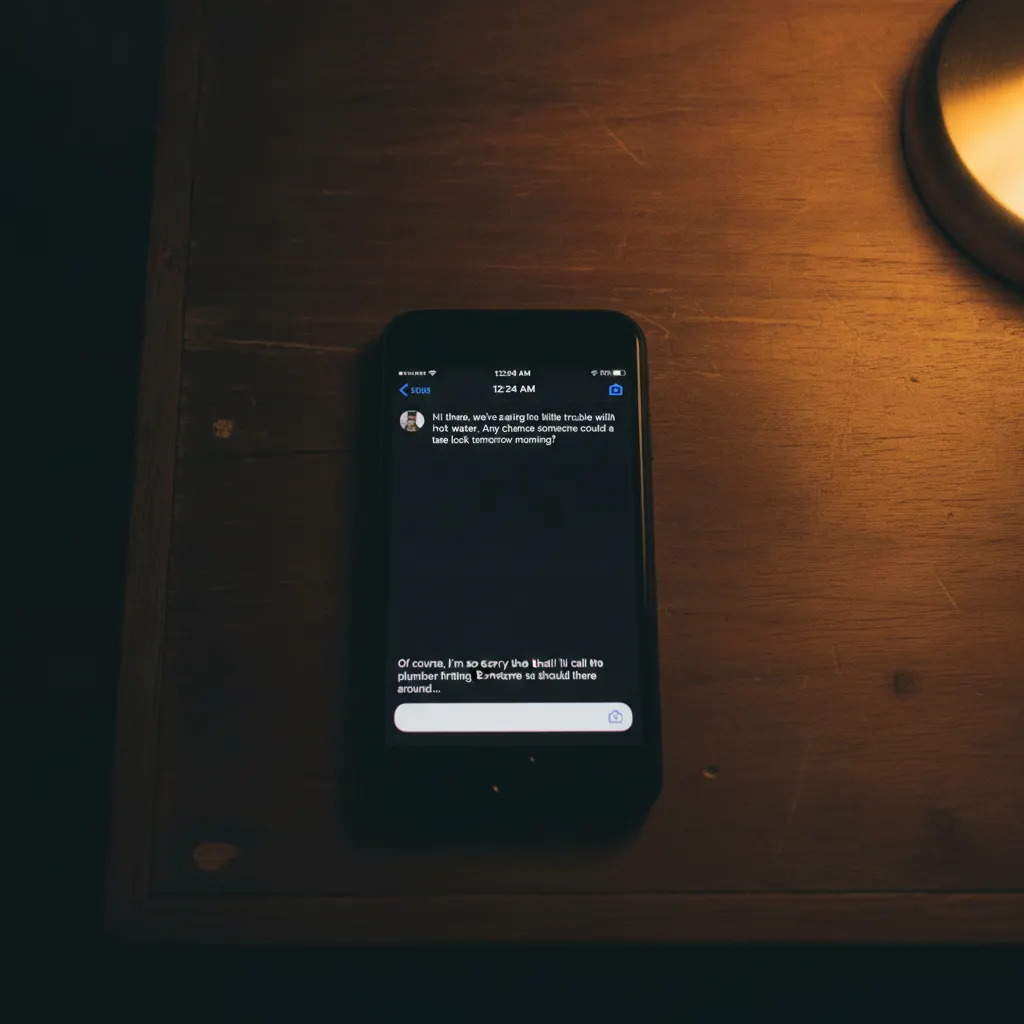
The worst one was Edinburgh. A couple booked a long weekend, sent me a message at 11:40pm on Friday saying the boiler wasn't working and it was October. By the time I saw the message it was 12:15am. I spent forty minutes trying to remote-diagnose a Worcester Bosch boiler through WhatsApp instructions while they sat in a cold flat in their coats, and eventually gave up and called an emergency plumber who charged me £220 for a Sunday callout.
They gave me four stars and mentioned the heating in the review. The review wasn't wrong. But what I learned from that night wasn't about the boiler — it was about the gap between a guest having a problem and me being able to respond to it effectively. I've been tightening that gap ever since.
The three types of mid-stay complaint
Not all mid-stay problems are equal and they don't all need the same response. After six years and 34 complaints I'd break them into three categories:
Equipment failure — boiler, washing machine, dishwasher, TV, oven. Something that was working at check-in and isn't working now. Usually not the guest's fault. Requires active resolution: fix it, send someone, or compensate. The faster you respond to this category, the less likely it is to become a bad review.
Supply issue — ran out of something, something missing, wrong item stocked. Toilet roll, washing up liquid, extra blanket. These look embarrassing in a review ('ran out of basic supplies') but they're fixable mid-stay if you catch them quickly. Pre-arrival supply checks reduce this category significantly — I've written about those separately — but when they get through, the response is usually a quick dispatch of whatever's missing, either by me or a local contact.
Guest preference — the bed is too soft, the duvet is too warm, the flat is too hot/cold, the sofa is uncomfortable. These are the ones that are genuinely difficult because they're subjective and there's often nothing structurally wrong. You can't fix a preference complaint by fixing a thing. But you can manage it with how you respond.
Response times: the only number that matters initially
My rule is a substantive response within two hours, any time, any day. Not an acknowledgement — an actual response that either solves the problem, commits to a specific solution with a timeframe, or asks a clarifying question that moves the situation forward.
'Thanks for letting me know, I'll look into it' is not a substantive response. It's an acknowledgement that does nothing for a guest sitting in a cold flat. 'I've just called a plumber who can be there by 9am — is that okay? In the meantime, there are extra blankets in the wardrobe in the main bedroom' is a substantive response.
Two hours sounds tight at 2am. It is. My phone is on for Airbnb message notifications 24/7 — I muted everything except Airbnb and my emergency contacts years ago. If I'm going to be off-grid (genuinely no signal, rare but it happens at the Lake District property), I set up an auto-reply explaining that and giving the cleaner's number as an emergency contact.
The guests I've lost to bad reviews after mid-stay complaints almost universally waited more than three hours for a first substantive response. The ones I've retained as good reviews, even after genuine problems, got resolved or committed to within the first two hours.
The partial refund question
Eleven of my thirty-four complaints led to partial refunds. This is a decision I make based on: severity (was the guest's stay materially affected?), fault (was it my equipment, my stocking, or genuinely unavoidable?), and guest tone (are they after a refund or after a solution?).
I don't offer refunds as a first response. I offer to fix the problem. If the problem can't be fixed within the stay, then I discuss compensation. The Airbnb resolution centre is for after checkout — mid-stay, everything happens through Airbnb messaging and then the resolution centre if needed.
My rule of thumb: one night's rate as a maximum for a significant issue that persisted for more than 24 hours. A partial refund for the affected period proportionally. I don't go above one night's equivalent unless the issue was catastrophic (it has never been catastrophic). I've never given a full refund mid-stay — if a guest's stay is so badly affected that they want a full refund, the conversation about that happens at checkout through Airbnb, not at 2am.
The partial refund, offered proactively and proportionally, almost always ends the complaint cycle. Eight of my eleven refunds produced reviews that didn't mention the original issue at all. Two mentioned it and noted that I 'sorted it quickly'. One mentioned it in a way that dropped the overall score. Proactive partial refunds convert mid-stay complaints into resolved incidents more often than not.
Equipment failure: the pre-built response kit
For every piece of equipment that can fail, I have a pre-written response I can send in under three minutes. The template covers: what I know about the issue, what I'm doing immediately, what the guest can do in the interim, and the timeframe for resolution.
For boilers specifically — the failure I've had most often — the template includes the boiler make and model, the resetting procedure (most modern boilers have a reset button and will come back on after a pressure drop or lock-out fault), and my plumber's number if the reset doesn't work. Eighty percent of 'boiler not working' complaints are resolved by the guest pressing the reset button after I've told them where it is. That's a two-minute message that saves me an emergency callout.
I keep this template list in my notes app — one entry per appliance. Before every property season, I update the templates with current engineer contacts and any changes to the appliances since last year.
Preference complaints: what I actually say
The bed is too firm. The flat is too loud. The sofa is uncomfortable. These need a response that acknowledges the issue genuinely without promising something you can't deliver.
What I've settled on: 'I'm really sorry that's not working for you. For the [bed/sofa/temperature], I can [offer the specific thing I can actually do — extra mattress topper from the airing cupboard, suggest the white noise machine in the bedside drawer, tell them how to adjust the thermostat to X]. I can't [the thing I genuinely can't do]. I want you to be as comfortable as possible — let me know if that doesn't help and we'll think about what else we can do.'
The specific offer — even a small one — changes the tone of the exchange. A guest who's told you their bed is too firm and gets a response saying 'I'm sorry about that, hope you still enjoy Edinburgh' is going to feel dismissed. A guest who gets the above response, even if the mattress topper doesn't fully solve it, usually feels heard enough not to escalate.
The 2am rule
If a complaint comes in between midnight and 6am, I respond immediately to acknowledge it, assess whether it needs emergency action (no heat, no hot water, security issue = yes; uncomfortable sofa = no), and then deal with it properly at first light if it can wait. 'I've seen this, I'm on it, I'll have a full response and a solution for you by 7am — is there anything urgently dangerous or unsafe?' That message at 12:15am would have served me better in Edinburgh than forty minutes of WhatsApp boiler troubleshooting. I learned that later.
Ready to streamline your inventory?
Start managing your rental inventory smarter with automated stock tracking.
Start Free Trial