Noise monitors for Airbnb: Minut across four properties for twelve months
Hoststock Team
16 June 2026
Eighteen months ago, my Edinburgh Old Town studio hosted what I now refer to as the hen party incident. Eight guests listed on the booking. Twelve people and a portable Bluetooth speaker, according to the neighbour's email to the building manager at 1:30am. The guest checked out the following morning. I refunded a £50 goodwill gesture, received a 4-star review anyway, and spent the following weekend reading Airbnb's community forums about noise monitors.
I fitted Minut in four properties in February 2025. Twelve months in, here's an honest account of what's happened.
What Minut actually is
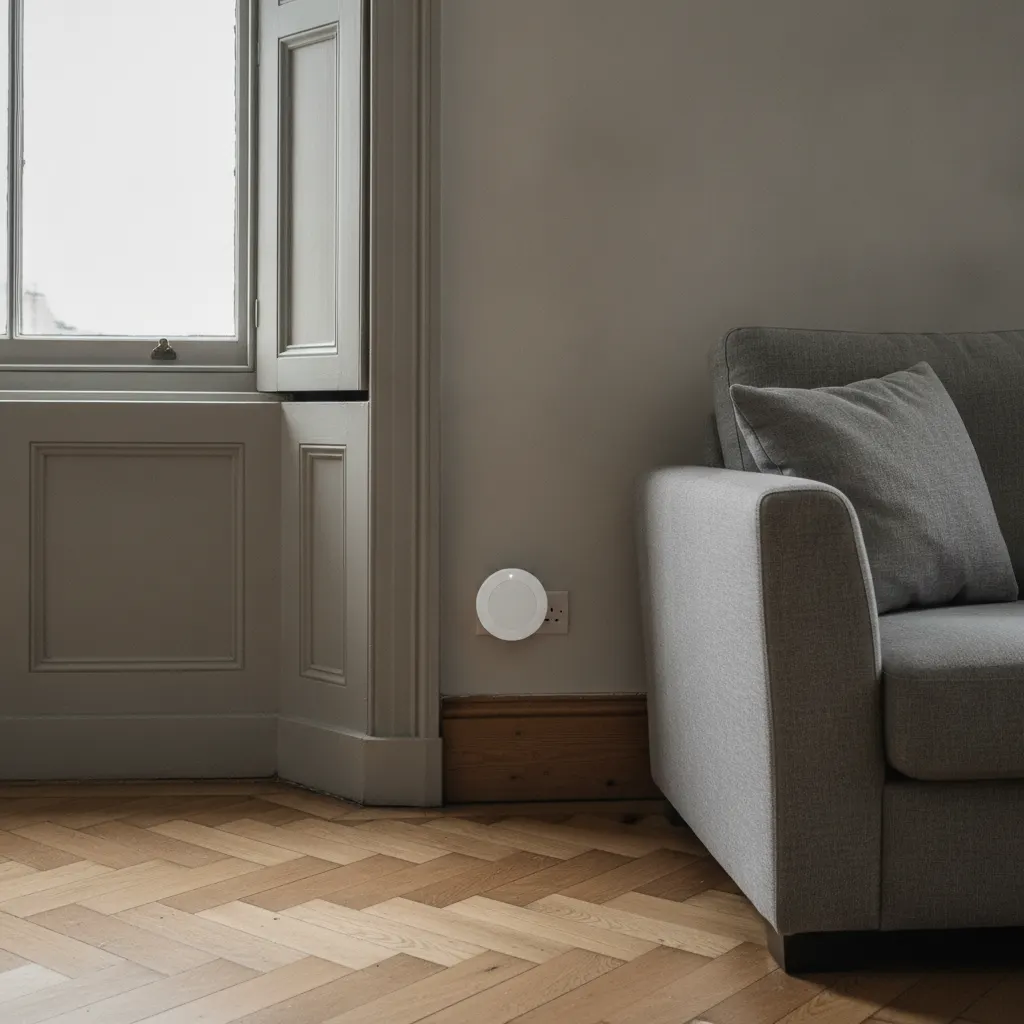
A small white disc — about 70mm across — that plugs into a wall socket. It monitors decibels continuously. If ambient noise exceeds a threshold you've set, it alerts your phone and (optionally) sends a message to the guests. It doesn't record audio. It tracks sound levels and the acoustic signature that corresponds to a crowd. It also monitors temperature, humidity, and motion — though in practice I mostly use the noise function.
Subscription on the Standard plan: around $10/month per property, roughly £8 at mid-2025 rates. Device cost is separate — I paid around £85 per unit. So the setup per property is approximately £85–90 upfront and around £96/year ongoing. Not nothing.
Six months of data: what the alerts actually were
Across four properties, Minut triggered 23 noise alerts over the first six months. I broke them down:
- 8 genuine noise issues — groups louder than the threshold, usually after midnight. In three of those eight, I messaged the guests and noise dropped within twenty minutes. Two cases required a call. Three had already stopped by the time I saw the alert.
- 9 false positives — a TV playing loud at 11pm, a thunderstorm, and three incidents in the Brighton flat where a neighbouring property's music came through a shared party wall and set it off.
- 6 borderline — noise at 10pm or 11pm that I chose not to act on, because the guests had paid for a three-night weekend and were clearly just having dinner at volume.
The false positive rate annoyed me in the early weeks. I adjusted the threshold on the Brighton flat from 70dB to 75dB and it dropped to roughly one false alert per month. Getting the calibration right takes a few weeks.
What it prevents — and what it doesn't
Honest version: Minut doesn't stop parties. It gives you information faster. What you do with that information is still entirely up to you, and the window between "alert on phone" and "actual damage to neighbour relationships" can be thirty seconds or two hours, depending on when you're awake.
At 2am, I'm not always quick. I saw two alerts this year — both from the Lake District cottage — that I didn't notice until 7am. By then the complaint from an adjacent property had already been made.
Where it genuinely helps: the post-stay dispute. Before Minut, if a neighbour reported a problem two days after checkout, I had nothing. Now I have timestamped decibel readings showing exactly when noise peaked and when it stopped. That's protected me twice from guests who tried to dispute a partial refund following a reported complaint. I had the data. They didn't.
The auto-message feature: I turned it off
Minut has a function that sends guests a notification when noise exceeds your threshold. I ran it for three months, then disabled it.
The automated message is blunt. Something along the lines of "noise levels at your property have exceeded the acceptable limit." That reads like a legal threat when it arrives on someone's phone at 10:30pm and they're watching a film at moderate volume. Two guests asked why they were being "accused of having a party" when they clearly weren't. One left a 4-star review specifically mentioning it.
I now send manual messages when Minut triggers. Takes thirty seconds. I can calibrate the tone to the situation — "Hey, just a heads up, our noise monitor's showing some activity — hope you're having a great evening, just wanted to give you a nudge as we've got neighbours close by" gets a different response than a policy notice.
Is £8 a month worth it?
Across four properties I'm paying about £32/month, or £384/year. Against that:
Three neighbour complaints avoided (roughly). One 5-star review I'm confident I wouldn't have had without the alert that let me intervene early in Edinburgh. One refund dispute resolved in my favour because I had timestamped decibel data.
Assigning a precise pound figure to those is imprecise. But the neighbour in my Edinburgh building sits on the management committee. Keeping that relationship intact is worth considerably more than £384/year to me.
Single-property hosts running a rural cottage: marginal, in my view. The false positive calibration frustration is higher in quieter properties. Multi-property urban hosts where one bad incident can sour a building relationship for years — yes, it earns its cost.
Comparing it to the alternatives
NoiseAware is the other name you'll see. More common in the US market — UK distribution and pricing aren't as clean, and most UK hosts I know who've tried both have landed on Minut for the simpler subscription model and better UK support.
Some hosts use basic security cameras in communal areas. I tried this in the Edinburgh hallway before Minut and it caused more problems than it solved. Airbnb's camera disclosure policies are strict, and the line between a compliant hallway camera and one guests find uncomfortable is finer than you'd think. Minut sits cleanly outside that grey area — no audio recording, no video.
Setting up Minut for the first time
Plug in. Download the app. Name the property, set the time zone. Threshold calibration takes about ten minutes on-site: stand in the room, play music or talk at varying volumes, watch where the dB reading lands. The app defaults to 70dB. I find 72–75dB better for properties with hard floors and high ceilings (they echo), and 68–70dB works for carpeted rooms.
Set your quiet hours — I use 10:30pm to 7:30am — decide whether the auto-message is on or off, and you're done in twenty minutes.
Three of my cleaners have asked to be added as secondary contacts on the app. Suits me — it means there's a second pair of eyes on overnight alerts in properties where I'm not nearby.
One thing I didn't expect
The humidity monitoring. I expected to mostly ignore it. Last March, the Minut in my Lake District cottage showed humidity above 75% for three consecutive days while the property sat empty. I drove over and found a slow leak under the kitchen sink — undetectable from outside, heading for the subfloor. Repair cost: £140. Leaving it another month would probably have been £800-plus.
I didn't buy Minut for leak detection. But that paid for three years of subscriptions in a single afternoon.
One change I've made that I'd recommend
I now mention Minut in my house rules. Not prominently — a single line: "This property has a noise monitoring device installed in the communal area. It does not record audio or video. It tracks ambient sound levels and will alert the host if agreed noise thresholds are exceeded."
Guests who'd push things tend to behave better when they know there's accountability. I haven't had a noise complaint since I added that line. Correlation, not causation — but I'll take it.
Ready to streamline your inventory?
Start managing your rental inventory smarter with automated stock tracking.
Start Free Trial