Outdoor and security lighting for UK Airbnbs: what I've installed, what guests mention in reviews, and why smart plugs changed everything
Hoststock Team
25 July 2026
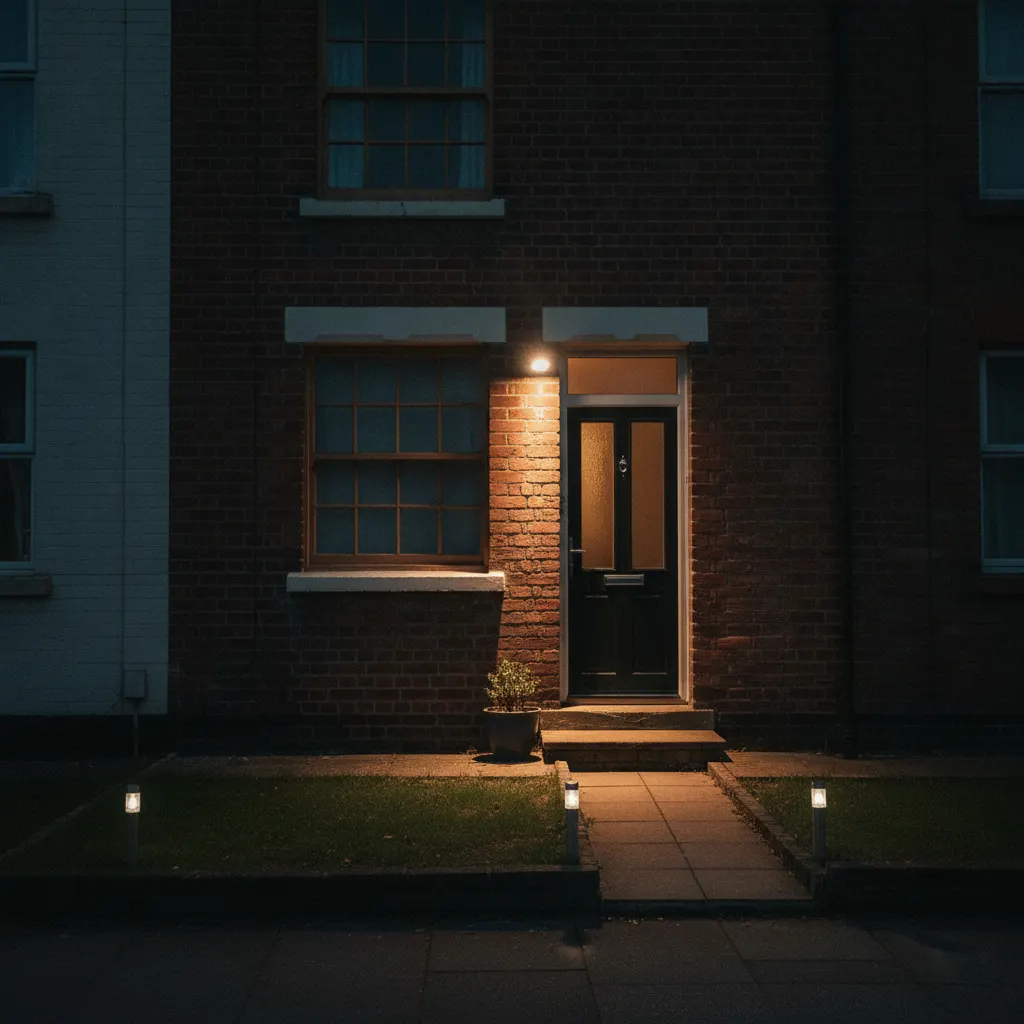
Lighting is one of those things that only becomes visible when it's wrong. Nobody leaves a review saying 'the exterior lighting was adequate'. They do leave reviews saying 'arrived late and couldn't find the front door', or 'light above the patio kept triggering at 2am and woke us up', or — and I've had this one — 'the security light is so bright it lights up the entire bedroom through the curtains'.
I've had all three complaints across five properties over four years. Here's what I've changed and what I'd do from scratch now.
The PIR problem
Passive infrared motion sensors on security lights are brilliant for a residential home. For an STR, they're a liability if you don't configure them correctly. The two failure modes I've encountered:
First: sensitivity set too high. The light triggers on cats, foxes, anything moving past. In a garden that backs onto a lane — which both my Brighton properties do — this means the light is firing all night. Guests staying in summer with the windows open get woken up repeatedly. First review mention I got: 'lovely property but the garden light kept going off all night'. I turned the sensitivity down. Problem went away.
Second: duration set too long. PIR security lights have an adjustable on-time, typically 1–8 minutes. Most come set at the maximum. In an STR context, 8 minutes of a 600-lumen floodlight aimed at a patio every time a guest steps out for a cigarette is too much. I set mine to 90 seconds. Enough to see what you're doing, not enough to turn the garden into a crime scene for a Saturday evening.
Both of these are adjustable on almost any PIR floodlight. They're usually small dials on the sensor head, accessible without tools. If you've had noise or light complaints related to your security lighting, check the sensitivity and duration settings before replacing the fitting.
What I use for exterior security lighting
The Ring Floodlight Cam has been on two of my properties for about eighteen months. Around £200 installed. It gives me motion alerts, a camera feed, and a floodlight — all on one fitting. The motion alerts are worth more than the camera footage for STR use: I can see when guests arrive, which is useful for long stays where I'm not in direct contact mid-booking, and I get a notification if someone's moving around outside at 3am in a way that looks odd.
I don't monitor this actively. I don't have time. But the log is there if I ever need it for a dispute — to show a guest checked in at a certain time, or to demonstrate a vehicle was parked in a loading bay they claim they weren't told about. Twice in eighteen months I've pulled the footage for exactly that reason.
The main downside to the Ring: it needs power (hardwired, not battery) and it needs Wi-Fi. If the Wi-Fi drops, you lose the camera functionality but the light still works. The hardwiring means it needs an electrician to fit — add £80–150 to the cost. Not ideal for a quick upgrade but fine if you're doing it as part of a wider property update.
For the other two properties with exterior spaces, I use simpler Philips WiZ outdoor floodlights. About £35 each. Not smart in a sophisticated sense — they connect to the WiZ app via Wi-Fi and I can set schedules. I have them set to come on at dusk and off at midnight, then on again at 5am. No motion triggering, no camera. Just a reliable light that guests can expect to be on when it's dark.
Smart plugs for indoor lighting
This is the change that generated the review mentions. I put smart plugs on two lamps in the main bedroom and one in the hallway of my Edinburgh flat. They run on a schedule: on at sunset (the app pulls local sunrise/sunset times, so it adjusts seasonally), off at 11pm. When guests arrive in the evening, the flat is already lit. It looks welcoming. It reads as attentive hosting even though I've done nothing.
The smart plugs I use are TP-Link Tapo P110 — around £12–15 each. They work with the Tapo app and can also be set up through Amazon Alexa or Google Home if you use those ecosystems. The P110 model specifically has power monitoring, which lets me see energy usage. I can tell when a guest is home by whether the lamps have drawn power in the evening, which is occasionally useful context.
The four review mentions came from guests who noted the flat 'felt warm when we arrived' or 'the lights were already on which was a lovely touch'. One of them mentioned it in the context of giving a five-star review for the overall experience. I've no idea if the lights specifically drove the five stars. But they cost £14 each and they don't require any ongoing effort, so I'll take it.
The path lighting question
The Lake District cottage has a long path from the road to the front door. In winter, that path is dark enough to be a genuine trip hazard for guests arriving after 4pm, which in January is basically everyone. Solar path lights were my first attempt. They don't generate enough charge in a UK winter to last through the evening — six hours of daylight in November isn't enough. They failed.
I wired low-voltage path lights connected to a timer. It was a job for an electrician — around £350 for the full run of eight lights plus timer. They've been in for two years with no issues. Guests mention the 'nice path lighting' occasionally. Nobody has fallen over. That feels like a success for £350.
For properties where wiring path lights isn't practical, battery-powered motion-sensor path lights from brands like Luceco or Lyco are a reasonable compromise. Expect to change batteries every 3–4 months in winter. Set a reminder; otherwise a guest arrives in January and three of the eight lights are dead.
The two things I'd do from scratch on every property
First: a smart plug on a welcome lamp near the front door or in the hallway, set to come on at sunset every day. Takes twenty minutes to set up, costs £14, and gives every arriving guest the impression that someone thoughtful runs this place.
Second: a PIR floodlight over the front door or main entrance — adjusted to 60-second duration and medium sensitivity. For a guest arriving at 11pm with heavy bags, a light that comes on automatically when they hit the path is the kind of detail that reduces friction without requiring any active hosting. They're not thinking about it. They're just not fumbling with keys in the dark. That's the whole point.
Ready to streamline your inventory?
Start managing your rental inventory smarter with automated stock tracking.
Start Free Trial