Asking guests for Airbnb reviews: the message timing that moved my 5-star rate by 13 points
Hoststock Team
19 August 2026
The checkout message that wasn't working
For my first two years hosting I had a review request tucked into my checkout instructions. Something like: "We'd love it if you could leave us a review — it really helps! We'll leave you one too." Standard enough. I didn't think much about it. My review rate was okay, my average score was fine, but my 5-star percentage was stuck around 71% across four properties and I couldn't work out why.
71% sounds alright until you look at what Airbnb actually wants to give you Superhost status — a 4.8 average maintained across all listings. At 71% five-star, my averages were wobbling between 4.7 and 4.8 depending on the month. It wasn't consistent. And the more I looked at my data, the more I suspected the issue wasn't the property — it was the timing and framing of when I was asking guests to reflect on their stay.
What Airbnb's review system actually does
Both guests and hosts have 14 days after checkout to leave a review. Airbnb doesn't tell you when the other side has submitted — you just know the review appears (or doesn't appear) after both have written one, or after the 14-day window closes.
Critically, Airbnb allows hosts to ask guests for reviews. The platform's community policy explicitly says this is fine — you just can't offer anything in exchange for a positive review or apply any kind of pressure. Asking politely is completely above board. I checked this before I started experimenting because I didn't want to get a policy violation flag for something I was doing with good intentions.
The experiment: three different timings
I ran an informal test across four properties over eight months. Not a controlled trial — I don't have the booking volume for that — but enough data points to form a strong view.
Timing 1: Checkout message (day 0)
This is what I was doing originally. Review request in the same message as "please strip the bed" and "leave the key under the flowerpot." My hypothesis, looking back: guests are in checkout mode. They're loading bags, they might be running late, they're thinking about getting home. Asking for a review in that moment is competing with twelve other things in their head. My response rate from this message was roughly 58%.
Timing 2: Day 1 follow-up
I tried sending a separate message the day after checkout: "Hope you got home safely — it was great having you at the flat!" with a brief mention that they could leave a review if they had a moment. This felt more natural — the guest is home, unpacked, back to normal life. Response rate jumped to about 67%. But my 5-star percentage didn't move much. I think the timing was still too close.
Timing 3: Day 3
Three days after checkout is now what I do. By day 3, the guest has had time to decompress, remember the good parts of the trip, and isn't thinking about the minor things that annoyed them — the awkward door lock, the light that flickered once, whatever small irritant was fresh on checkout day. Review rate: around 72%. And this is where my 5-star percentage moved. From 71% to 84% over the eight months I ran this approach. That's thirteen points, which across four Superhost listings is the difference between a consistent 4.8+ and a stressful monthly average check.
The message that works
Short. That's the main thing. No preamble. No "I hope you had a wonderful time and enjoyed exploring everything our beautiful city has to offer." I hate writing that stuff and guests can tell it's generic.
The message I send — slightly adapted per property — is roughly this:
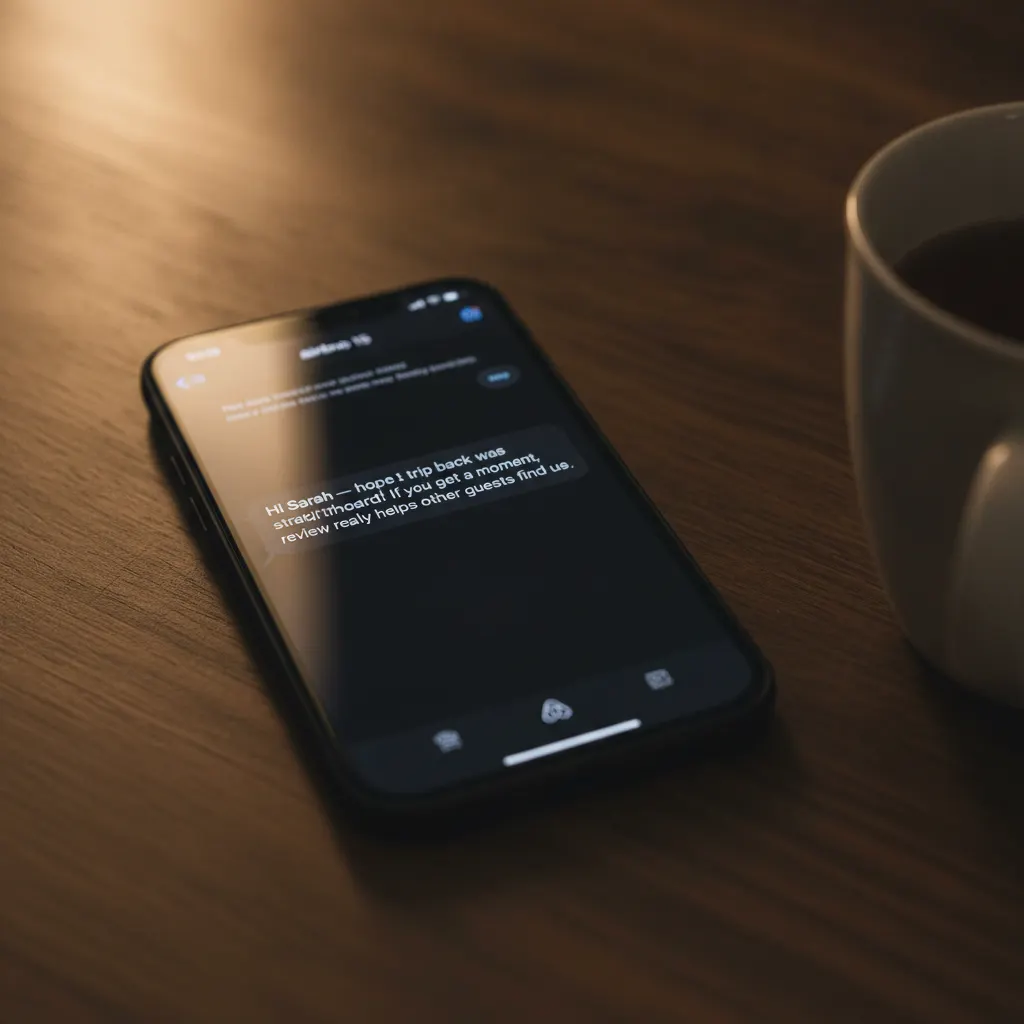
Hi [first name] — hope the trip back was straightforward. We had a great time hosting you at the flat. If you have a moment over the next few days, a review really helps other guests find us — and we'll write you one too. Either way, hope to see you again if you're back in Edinburgh!
Forty-seven words. Sent on day 3. First-name only. Mentions the specific city (not "our listing" or "the property"). That last bit matters — personalisation in the subject line of an Airbnb message is limited, so specificity in the body text is how you signal you're not sending a template blast.
I do actually write personalised review responses immediately after a guest checks out, so that when the guest's review goes live, my response is already there within hours. I think this shows guests I'm engaged. Whether it affects their star rating I genuinely don't know.
What doesn't work
I've seen other hosts on community forums recommend asking twice — once at checkout, once a few days later. This felt too pushy to me and I didn't try it across all properties, but I ran it at one flat for two months. My instinct was right: two asks produced marginally higher review rates but notably more 4-star reviews in the mix. My guess is that a second message feels like pressure, and guests who feel pressured into reviewing don't review generously. Anecdotal, but I wasn't willing to keep testing it.
Also doesn't work: the vague "if you enjoyed your stay" framing. Guests who had a 4-star experience had a 4-star experience — you're not going to magic that into a 5-star with a message. What you're trying to do is make it easier for the 5-star guests to actually sit down and leave the review they meant to leave but haven't got around to.
The review I actually care about
Score is one thing. Content is another. Most of my 5-star reviews are perfectly nice and perfectly generic — "clean, comfortable, great location." These are good for the algorithm and fine for the listing. But occasionally a guest writes something specific: mentions the welcome pack, mentions that the Edinburgh flat's windows look out over the rooftops, mentions that check-in was genuinely easy. These reviews are gold because they answer the next guest's specific question before they ask it.
I've started including one sentence in my day-3 message to try to prompt specificity: "If there was one thing about the flat that stood out for you, that's always the most useful bit to mention." I've only been doing this for three months so I don't have a large enough sample. But my recent reviews have been noticeably more detailed and I'd rather have a detailed 5-star review than a generic one every time.
My review-leaving process
I write the guest review immediately after checkout, before I've heard from my cleaner. I do this for two reasons. First, guests are more likely to leave a review after you leave one (Airbnb notifies them). Second, I want my review to reflect the booking as a whole, not be influenced by whatever the cleaner finds.
The rule I have for guest reviews: if the stay was fine, write the review the same day. If there was a problem, wait 48 hours. Writing an annoyed review of a guest who caused a minor issue on checkout day is almost always regrettable by day three.
The one thing I still can't control
Some guests just don't leave reviews. I have a 72% review rate at best, which means roughly a quarter of my bookings leave no record at all. That's guests who might have had a genuinely great time but simply can't be bothered. I've made peace with this. Chasing beyond one message crosses a line I don't want to cross.
What I can control: timing, tone, and making the stay good enough that the guests who do bother feel motivated to say something specific and positive. The review request message is a nudge, not a guarantee. The guarantee part is the hosting itself.
Thirteen percentage points in 5-star reviews is real, though. It changed my Superhost scorecard from something I checked nervously every quarter to something that just sits steady. That's worth 47 words and three days of patience per booking.
Ready to streamline your inventory?
Start managing your rental inventory smarter with automated stock tracking.
Start Free Trial