Spare key management for Airbnb: the four-key system across five properties and the 10pm lockout that changed everything
Hoststock Team
3 August 2026
The lockout happened at 10:07pm on a Thursday in November. My guests — a couple, first Airbnb trip, clearly nervous — messaged to say they were locked out of my Brighton flat. They'd left their key inside when they went for dinner. The flat has a Yale-type latch lock that locks automatically on pull. They'd pulled the door shut without thinking.
I didn't have a spare key in the property. My cleaner had a key, but she lives in Worthing and was not going to drive to Brighton at 10pm on a Thursday, and I couldn't ask her to. My nearest neighbour who had a key was in Edinburgh for the week. The locksmith I eventually found charged £120 for a callout at that hour, took 40 minutes to arrive, and the guests — understandably exhausted and now £120 out of pocket (I reimbursed them immediately) — left a four-star review noting the property had 'some operational issues'.
That's the four-star review that made me build a proper key system. Here's what I run now.
The four-key principle
For each property: four keys in existence. That's the minimum for a robust system.
Key one: the guest key. Handed over on arrival, returned at checkout, or held in a key safe using a code that changes every booking. This is the key guests use for the duration of their stay.
Key two: the cleaner key. Held permanently by the cleaner or cleaning team for that property. Not a key that gets handed back and forth — it lives with the person doing the turnovers. Losing this key is a meaningful event: I have to rekey the lock (or change the smart lock code, where applicable) and redistribute.
Key three: the property manager or backup person key. This is the 10pm lockout key. Someone physically nearby who can get to the property within 30-45 minutes in an emergency. For my Brighton properties, this is a property manager I work with who is based in Hove. For Edinburgh, it's my local contact — the cleaner's husband, who I pay a small monthly retainer to be available for exactly this kind of thing. For the Lake District cottage, it's the neighbour across the lane, who has agreed to hold a key in exchange for a modest annual 'thank you'.
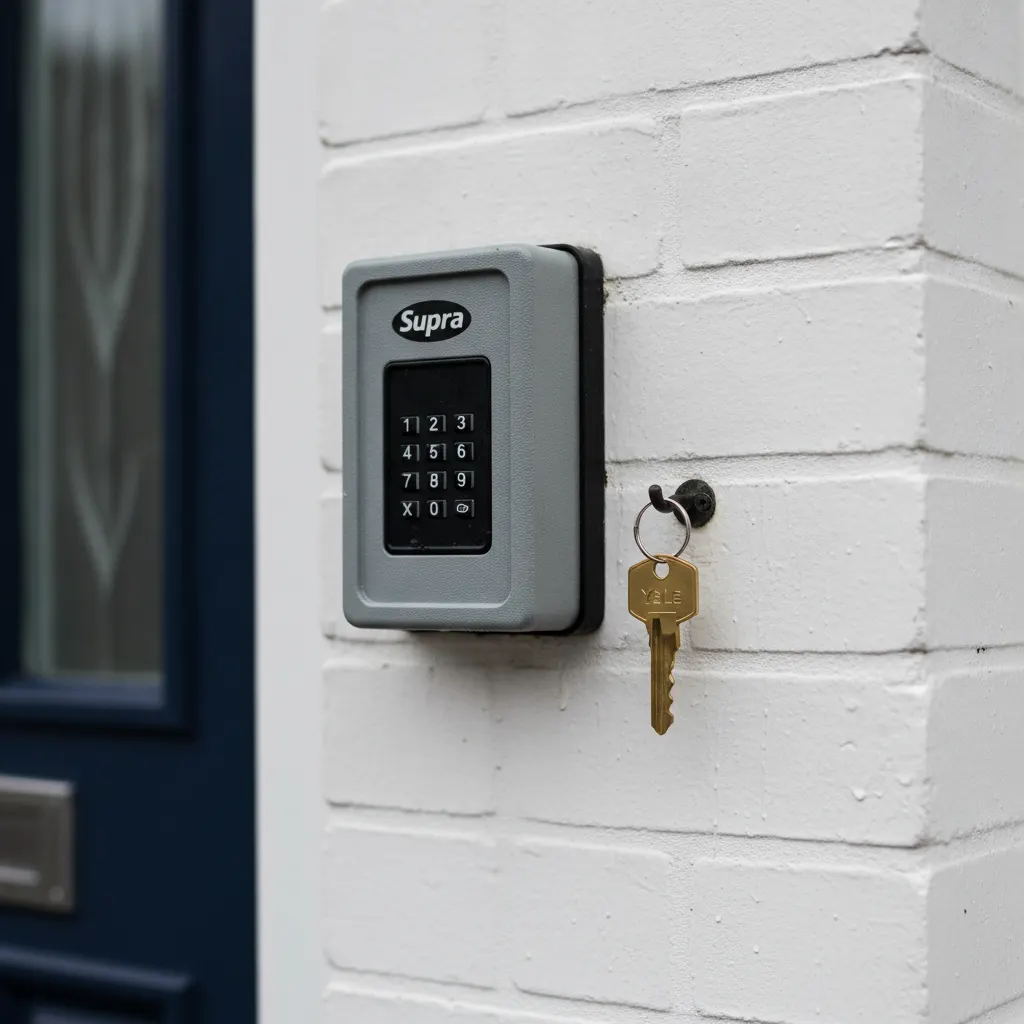
Key four: the spare emergency key. Kept in a lockbox fixed to the property — either a combination key safe or a combination padlock box — outside the main entrance or in a communal area. This is the absolute last resort. The code for this box is known to me and to the guest (shared on check-in day, not in the booking confirmation). It solves the 'locked out, no one nearby, 10pm' scenario without involving a locksmith.
The key safe question
Key safes are the infrastructure that makes the whole thing work. I use two models across my properties.
For external wall mounting — porch, gate, communal entrance — I use the Supra C500 key safe. It's a professional-grade wall-mounted box with a 10-digit pushbutton code, holds up to four keys, and is rated to a professional security standard. At about £80-£90, it's more than a basic key safe from a DIY shop, but it's properly tamper-resistant and the mechanism doesn't seize in cold weather, which matters for Edinburgh and the Lake District in January.
For properties where external mounting isn't possible — some leasehold flats with communal entrance restrictions don't allow external fixtures — I use a MasterLock 5401D portable combination padlock box. About £25. It attaches to a fixed point (a drainpipe, a gate post, a bicycle stand) with the shackle, and holds up to three keys. Less secure than the Supra, but significantly better than having no spare key access at all.
The combination code for these safes changes every six months on a schedule I keep in a note. Not after every guest — that would be operationally exhausting — but twice a year as a minimum. I used to change the code of the key safe more often, and then I realised I was spending more time resetting codes than on anything else to do with the property, so six months is the compromise between security and sanity.
What happened to smart locks
Three of my five properties have Yale Linus or Nuki smart locks installed. The smart lock changes everything about primary access — I don't hand a physical key to most guests anymore, I send them a time-limited code that works only for the duration of their booking. But smart locks don't replace the spare key system. They sit alongside it.
Reason: smart locks fail. The battery dies, the Bluetooth connection drops, the motor jams in cold weather, a guest's phone runs out of battery and they can't open the app. These things happen rarely — maybe twice in eighteen months across three smart-locked properties — but when they happen, they happen at inconvenient times. The physical key safe with a spare key is still there, still works, and doesn't need a Bluetooth connection.
I had a Nuki lock battery die at 9pm on a winter Saturday in Edinburgh. Guest couldn't get in. Smart lock was showing 'unresponsive' in the app because the battery was too low to communicate. Physical key safe on the communal entrance gate: solved the problem in six minutes. Without the physical spare, that's a locksmith callout or a very unhappy guest.
Key distribution record
I keep a simple key log for each property — a one-page note in each property's folder. It lists: how many keys exist, who holds each one, when they were last confirmed to be holding it. That last part matters because keys get lost. Cleaners move on and forget to return them. Property managers change. A key that was with your cleaner two years ago might be in a drawer in a house you've never visited.
I do a key audit once a year — usually in January when things are quiet — where I ask every keyholder to confirm they still have the key. The two who can't confirm get their key 'deactivated' by having the lock rekeyed or the smart lock code changed. Small hassle. Prevents a significant problem.
The code that guests get
For properties with a key safe: guests get the code in the check-in message, sent via Airbnb on the day of check-in — not in the booking confirmation weeks earlier. The code is always described as 'emergency access only — if you lock yourself out and can't reach me'. Three guests have used it in fifteen months across all properties. All three thanked me for having it. None of them had to pay a locksmith.
The code is never in the listing description. Never in any document that pre-dates check-in. It's a day-of-arrival piece of information that expires when the smart lock code changes at checkout.
The locksmith bill was £120. The key safe was £85. The maths is obvious.
I delayed building the key system because it felt like operational overhead — buying key safes, tracking who had which key, maintaining the audit. In practice it took about two hours to set up across five properties, costs me about an hour a year to maintain, and has prevented three locksmith callouts (at roughly £100-£150 each) in fifteen months. That's an easy return on the time invested.
The four-key principle isn't complicated. One for guests, one for the cleaner, one for a nearby emergency contact, one in the key safe on the property. Know where all four are. Check annually. The lockout at 10pm on a Thursday happened once. It's not going to happen again.
Ready to streamline your inventory?
Start managing your rental inventory smarter with automated stock tracking.
Start Free Trial