Stain removal in Airbnb turnovers: the products I keep in every cleaning kit
Hoststock Team
23 September 2026
The stain that cost me a five-star review
It was red wine. On a white duvet cover. Discovered 40 minutes before the next guest was due to check in.
My cleaner — who is brilliant and has been running my Brighton flats for two years — had missed it in the rush. A 60-minute turnover with a late checkout doesn't leave much margin for drama. She found it, messaged me in a panic, and I drove over with a bottle of Vanish and cold water in the vague hope we could sort it before 3pm. We couldn't. The guest arrived to a spare duvet cover from the airing cupboard that wasn't quite the same shade of white as the rest of the set, and they noticed, and it was in the review.
The fix was not buying better stain removers. It was building a proper stain treatment process into the turnover before things go in the wash — and keeping a kit at every property that anyone can use without calling me first. Here's the kit I've landed on and how I use it.
The basic principle: treat before you wash
The mistake I kept making was relying on the washing machine to deal with stains. It doesn't. Especially not at 60°C on a quick cycle — and that's the wash you need to use for Airbnb linen, because anything lower won't kill the bacteria. Hot water sets protein stains (blood, food, bodily fluids) before the detergent can lift them. Enzymatic pre-treatment is what breaks those stains down first.
The other thing hot washing does is make red wine stains permanent. Red wine needs cold water, fast, before it goes anywhere near heat. This is basic science but it's easy to forget in a time-pressured turnover. I now have a laminated A5 instruction sheet in the utility room of every property explaining this, because I cannot always be there to supervise.
The core kit
Every cleaning station at every property has these five things. They're all cheap, widely available, and they work:
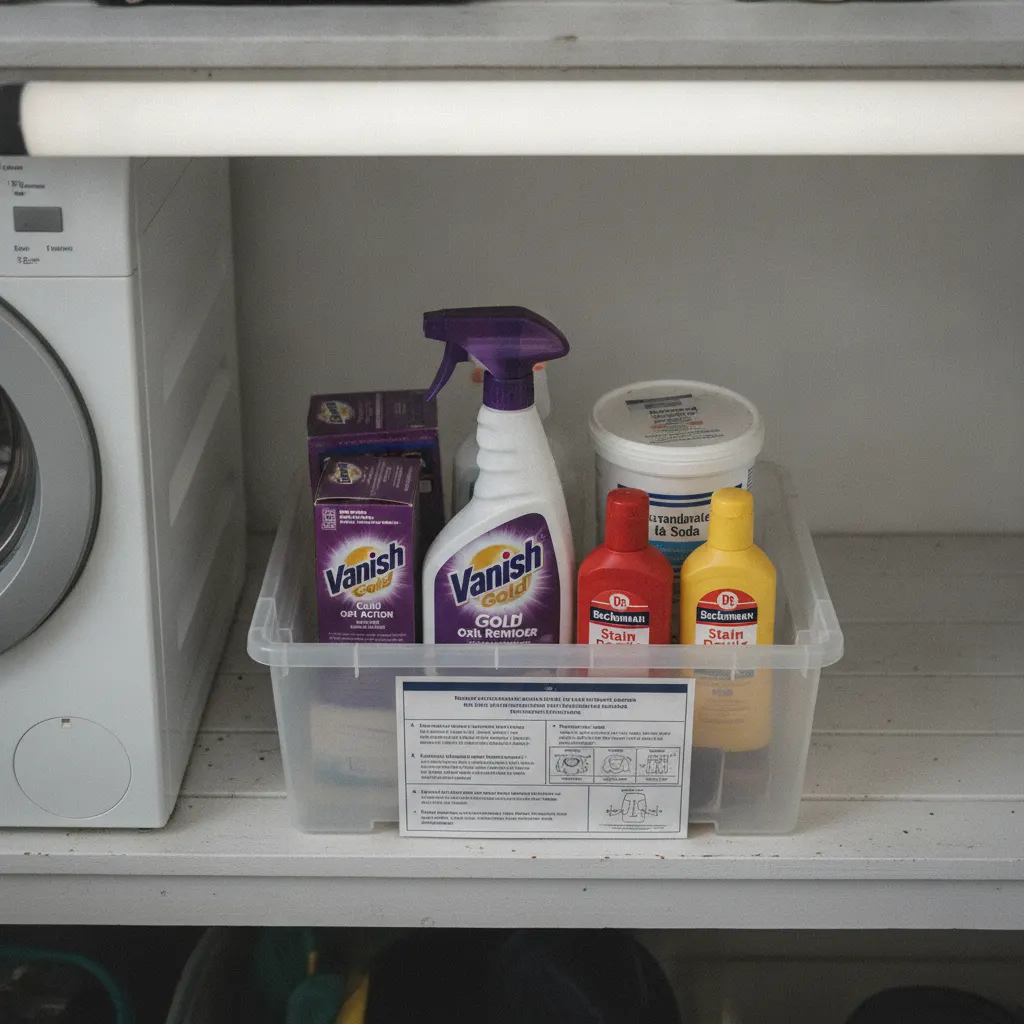
1. Vanish Oxi Action spray (white fabrics)
This is my main pre-treatment for the duvet covers and pillowcases. It's a hydrogen peroxide formula — you spray directly onto the stain, leave for five minutes, then wash as normal. It's genuinely effective on food stains, light bodily fluids, and coffee. Not a miracle for red wine, but it helps. The spray version is better for spot-treating linen than the powder, which is more useful in the wash cycle itself. Cost is around £3–4 for a bottle, which lasts several properties' worth of turnovers. I buy in packs of four from Amazon.
2. Vanish Gold Oxi Action powder (for the wash)
Goes in with the laundry detergent in the drum. Boosts the wash performance on stubborn general soiling — the kind of grey tiredness that builds up on pillowcases over time even when there's no obvious individual stain. I use about one scoop per duvet cover wash. It's more expensive than regular detergent but meaningfully extends the life of white linen — I've tracked this across three properties and the towels and pillowcases on Vanish powder cycles stay noticeably whiter over 12 months. A 1.35kg box is around £7–9 and lasts a while if you're not chucking in handfuls.
3. Dr. Beckmann Stain Devils for specific stains
The Stain Devils range is the thing to know about for problem stains. They're small bottles (around £2–3 each) formulated for specific types of staining: grease and oil, make-up, fruit and wine, blood and protein. They work better than general-purpose treatments precisely because they're targeted. I keep a small selection at each property — the fruit/wine one and the grease one get used regularly. The make-up one saves towels constantly (mascara on the white guest hand towels is an every-third-booking occurrence in my experience).
One bottle lasts ages because you use a small amount. The only thing to watch: don't mix them with bleach and don't apply to dry-clean-only fabrics. Read the labels. The cleaner needs to know these aren't all-purpose — they're specific.
4. Bicarbonate of soda
For odour absorption during soaking. If something has been sitting for a while before you get to it — because the previous guest left the dirty linen balled up in a corner and the cleaner's on a back-to-back and didn't notice — a cold soak with bicarb loosens the stain and neutralises the smell. Cost: pennies. I buy 1kg bags and decant into a labelled tub at each property.
5. Cold water (obviously, but stated for clarity)
The immediate response tool for fresh stains is cold water. Not warm. Not hot. Cold, applied immediately, blotted (not rubbed — rubbing spreads the stain and pushes it deeper into the fibres). I've had cleaners who've confused blotting with rubbing and I've had to explain this more than once. The laminated instruction sheet covers this.
The red wine protocol
Because red wine is the most common serious linen-stainer in my properties, here's the exact process I've written up for my cleaners:
- Cold water immediately, pour gently over the stain, do not rub.
- Blot with a clean white cloth or paper towel from outside the stain in, pressing firmly.
- Apply Dr. Beckmann Stain Devils (Fruit & Wine variant) per the bottle instructions.
- Leave for 10 minutes.
- Cold rinse again.
- Add Vanish Oxi Action spray if stain persists.
- Wash at 40°C with Vanish Gold powder in the drum.
Washing at 40°C rather than 60°C for wine-stained items is a deliberate departure from my usual linen protocol. Set the stain, and you're washing a rag. The biology issue (bacteria) is less relevant on a duvet cover with no bodily fluid contact than on pillowcases, so the temperature compromise is acceptable.
If the stain doesn't clear after step 7, I quarantine the item rather than use it for guests. A stained duvet cover that's been soaked and washed twice is sometimes recoverable with a second Vanish treatment 24 hours later when dry. If it's still there after that, it goes in the bin. The economics of fighting a £12 duvet cover stain for three hours of cleaner time don't make sense.
Towels: the mascara problem
Black mascara on white hand towels is the thing I've spent more time on than I expected. The Stain Devils make-up variant helps. But the real fix is having extra hand towels in rotation so the mascara-damaged ones can cycle through a longer pre-treatment without blocking the clean supply for incoming guests.
I run a par level of three sets of hand towels per bathroom per property. That means one set in use, one in the cupboard, one in the wash/treatment cycle. This gives me room to soak and treat without rushing. Before I got to three sets per bathroom, I was constantly rushing towels through the wash to meet turnover deadlines, which meant stains weren't getting treated properly and the towels were degrading faster.
The other mascara fix: consider placing a small makeup-remover wipe dispenser or a dark-coloured "makeup cloth" in the bathroom explicitly labelled for makeup removal. A few guests who use it will stop using the white towels. Not all of them, but some. The cloth costs pennies and it costs you one less laundering fight per month.
What to do about the mattress protector
Mattress protectors take the biggest hits and need a separate treatment approach. The ones I use are waterproof on the back (Terry cloth on top, polyurethane backing) — they're designed to be machine washable but the backing limits temperature to 60°C maximum and rules out tumble-drying at high heat.
For staining on the mattress protector surface: Vanish spray before washing, 60°C wash (maximum), air dry or tumble-dry low. Don't fold and store a damp mattress protector — the waterproof backing doesn't breathe well and you'll get mildew on the inside of the fold. Something I learned the unpleasant way with a new property that had a damp utility room.
Protectors showing permanent staining after treatment: replace them. They're typically £10–20 per single, £15–30 per double from somewhere like Dunelm or Amazon. I keep one spare per property. The cleaner swaps it in, the stained one gets a proper home treatment on the next visit, and if it clears it goes back into rotation.
Organising the kit so it actually gets used
None of this works if the products are under the sink in a random plastic bag with eight other things. Every property has a clearly labelled plastic crate (A4 label on the front, laminated) containing: the stain kit, a cleaning reference card, spare labels for shelves, and nothing else. The crate lives on the utility room shelf at eye height, next to the washing machine. The cleaner opens it, reads the stain, picks the product, follows the instruction.
This sounds obvious. It took me 18 months and several ruined duvet covers to actually do it properly. The setup cost per property was maybe £25 for the kit contents and about 20 minutes to laminate the card. Time well spent.
One last thing: photograph any significant stain before and after treatment, and if it needs to go via an AirCover claim, you need those photos with timestamps. My cleaners know to send me a WhatsApp photo of any stain before they treat it. Takes five seconds and has saved me several arguments about who was responsible for what.
Ready to streamline your inventory?
Start managing your rental inventory smarter with automated stock tracking.
Start Free Trial