Throw blankets and cushion covers for short-term lets: which fabrics last, which shrink in the wash
Hoststock Team
24 September 2026
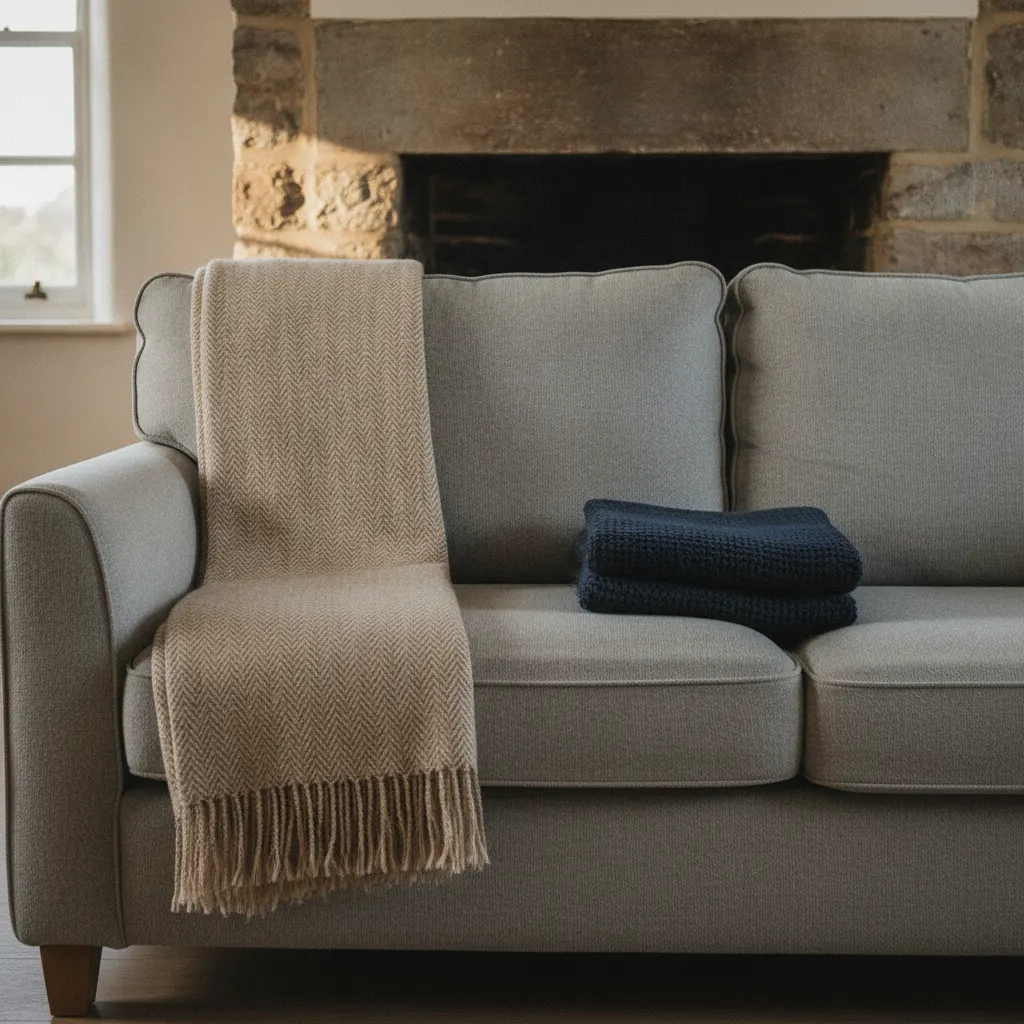
The throw blanket I bought for my Airbnb cottage disappeared in a washing machine
Not literally disappeared. It came out of the washing machine at 60°C having entered it as a 130x170cm woven throw and exited as something the shape and size of a tea cosy. The label had said machine washable. It had not specified at what temperature. And I hadn't checked. This was year one.
Soft furnishings are one of those areas where most Airbnb hosts initially buy for appearance — what looks good in the listing photos — and then discover slowly that different fabrics behave very differently in a high-turnover context. Throw blankets pile up in a corner of every property, guests cocoon themselves in them, they come out needing washing after every stay, and most of the ones designed for domestic lounge use will not survive that cycle for long.
Cushion covers are a related problem. They look great in the photos, go grey after six washes, and the insert keeps migrating through the opening no matter what type of fastening you buy. After about 18 months of trial, error, and mild resentment, here's what I've landed on.
Why the standard approach fails
Most people buy throws from home décor shops — Anthropologie, Oliver Bonas, H&M Home, Zara Home. These are designed for occasional washing in a domestic household. Washing three or four times a year at 30°C. In a short-term rental with 40 stays per year, a throw might be washed 40–50 times in 12 months. At those volumes, the materials that look beautiful on day one start to show their weaknesses by month three.
Knitted or loose-weave throws: excellent looking, terrible in practice. The individual loops catch on things — jewellery, suitcase zips, velcro, watches — and pull. After 10 wash cycles at any meaningful temperature, a knitted throw starts to look matted and slightly tragic. Guests still use them, because they're available, but they're not adding anything positive to the guest experience by month six.
100% cotton throws: much better, but the weight matters a lot. Light cotton weaves (500–600g total weight) can survive 60°C washing and come out looking reasonable for 12–18 months. Heavy blanket-weight cotton (1kg+) takes forever to dry, which is a practical problem if you're doing back-to-back turnovers and don't have a tumble dryer with enough capacity.
Polyester fleece: indestructible and hideous. Washes at any temperature, dries in 20 minutes, and makes your property look like a budget travel lodge. Some hosts use them as functional spares in the wardrobe rather than display items, which I think is the right call. One fleece throw folded on a shelf in case a guest gets cold in the night is practical. A fleece throw draped across the bed for photos is a choice I disagree with.
The fabrics that have worked
After testing various options across my Brighton and Lake District properties, two fabrics have stood out as reliably suitable for short-term rental use:
Cotton-acrylic blend (typically 60/40 or 70/30 cotton-acrylic): this is the sweet spot. Cotton gives the natural feel and appearance; the acrylic content gives stability, reduces shrinkage, and makes the throw more resilient to repeated washing. These are the workhorses of the hospitality textiles industry for good reason. They wash at 40°C reliably, dry reasonably fast, and hold their shape. Most of the own-brand throws you'll find at John Lewis or M&S in the £30–50 range tend to be in this territory, though the blend ratios vary and aren't always prominently labelled.
Woven recycled polyester (not standard polyester fleece, but the heavier woven variant): brands like Hay or IKEA's VITMOSSA line make woven throws in heavier polyester that look substantially better than fleece and wash just as easily. Machine washable at 60°C, tumble-dry safe on medium heat, no shrinkage. They don't have the tactile warmth of natural fibres but they're genuinely resilient and look decent in photographs. IKEA's VITMOSSA throw (around £10–15 when on offer) has been in two of my properties for 14 months without meaningful deterioration. It's not aspirational interior design, but it does the job.
Care label literacy (the thing you actually need to do before you buy)
Every throw purchase decision should start with the care label, not the visual appearance. The questions to answer before buying are:
- Machine washable at 40°C? (Minimum acceptable for rental use)
- Machine washable at 60°C? (Preferred — you need this for anything in direct contact with sleeping guests)
- Tumble-dry safe? (Critical for high-turnover properties without long drying windows)
- What happens to size after washing? (Anything without documented shrinkage resistance is a gamble)
Sounds obvious. I didn't do this properly for the first year. The beautiful woven merino wool throw I bought for the Lake District cottage — £85, photographed beautifully — survives dry cleaning only. I use it in my own house now. The cottage got a cotton-acrylic replacement.
Cushion covers: the fastening problem
The primary failure mode for cushion covers is the fastening. Zip fasteners tend to fail before the cover fabric. Hidden poppers come undone and the insert migrates to a lump in one corner. Envelope-back covers (no fastening, just overlapping fabric at the back) are the most durable and the easiest to remove, but they're not great with heavy or oversized inserts because the insert works its way out during use.
My current preference is zip-closure covers made from a polyester-cotton canvas (around 60/40 poly-cotton). They're the kind of thing IKEA does well — the GURLI range and similar. Durable, machine washable at 60°C, the zip closures last 20+ wash cycles without failure, and the fabric doesn't pill or bobble visibly for at least 12 months of heavy use.
I've moved away from linen covers for rental properties even though they look brilliant in photos. Linen requires lower-temperature washing (typically 30–40°C maximum to prevent significant shrinkage), it creases immediately, and guest guests are not ironing cushion covers before they get on the sofa. Creased linen in photos submitted by guests as review evidence is a thing that has happened to me. It wasn't worth the look.
How to buy covers and inserts together sensibly
The most common cushion disaster I've seen in STRs is mismatched cover-to-insert sizing. A 45x45cm cover with a 45x45cm insert will look flat and slightly depressed because the insert needs to be slightly larger than the cover to look plump. The standard advice — and it's good advice — is to buy 50x50cm inserts for 45x45cm covers, or 60x60cm inserts for 50x50cm covers. This is so universal that IKEA now sells paired cover-and-insert sizes on the same shelf. Use it as a starting point.
Inserts for STRs: hollow-fibre polyester fills every time. Not feather, not down. Feather and down inserts require covers with proper down-proof linings or you'll get quills working through the fabric. They're also harder to wash frequently and take longer to dry. Hollow fibre, machine wash 60°C, done. The IKEA FJÄDRAR is the one I've used most — it's cheap (around £5–8 for a standard size), resilient to washing, and recovers its shape after drying.
The look vs durability compromise
I want to be honest: the throws and cushions that look best in listing photos are usually not the ones best suited to short-term rental use. Natural fabrics — wool, linen, raw cotton — look warmer and more considered. Synthetic-blend fabrics that last look more functional. This is a real tension that every host in this business navigates.
My approach is to buy for durability as the primary criterion, then filter for aesthetics within that. So: cotton-acrylic blend or woven polyester for the throw, within those constraints find the best-looking colour and texture option available. In the UK you can do quite well at John Lewis, at IKEA, and at Dunelm, which has expanded its throw range and often has decent options at the £25–40 price point that meet the durability requirements.
What I don't do any more is buy the beautiful thing and then try to protect it with washing instructions to guests. Guests don't read washing instructions. They bung everything in at whatever temperature and get on with their holiday. Build that assumption into your purchasing decisions from the start and you'll spend less time being cross about it later.
Replacing on a schedule
I've moved to replacing throws annually regardless of condition. The cost is around £25–40 per throw; doing this once a year means the throws in my listing photos always look fresh, and I'm not making judgment calls mid-year about whether something is "good enough." Cushion covers on a similar cycle — annual replacement, because for the difference in cost it's not worth the marginal degradation in guest experience from covers that have been washed 40 times.
Inserts: every two years, replaced completely. They compress over time and don't recover fully even after washing. A flat, thin cushion insert signals "cheapness" to guests in a way that's hard to articulate but easy to see.
The total soft furnishing cost per property per year on this regime — two sofas' worth of cushions plus one throw per main seating area — runs to around £80–120. Not nothing, but a fraction of a single review score drop caused by worn-looking textiles. And the listing photos always show something that looks like the property actually looks, which is a small but real confidence factor for potential guests.
Ready to streamline your inventory?
Start managing your rental inventory smarter with automated stock tracking.
Start Free Trial