Tumble dryers for Airbnb turnovers: heat pump vs condenser across three properties
Hoststock Team
10 August 2026
I started with a vented dryer in the Edinburgh flat. My cleaner pointed out, quite reasonably, that there was no wall to vent it through. So that was a short experiment.
Five Airbnb properties. Four in Brighton and Edinburgh. One converted barn in the Peak District. None of the flats have external wall access in the utility area, which ruled out vented from the start. What I've been working with since 2022 is a mix of condenser and heat pump dryers — and I now have a firm opinion about which goes where.
This is that opinion. Along with the machines I've actually bought, what's gone wrong, and what I'd do differently if I were setting up a sixth property tomorrow.
Condenser vs heat pump — the bit that actually matters
Condenser dryers pull moisture out of your laundry and collect it in a reservoir you empty after each cycle. Heat pump dryers recycle warm air to dry the load — they use less electricity but take longer. That's the core difference.
Energy rating-wise, heat pump dryers sit at A++ or A+++ in most mid-to-upper tier models. Condenser dryers tend to run at B or C. Whether that matters in practice depends almost entirely on your turnover volume.
A single cycle on a condenser dryer costs roughly 40–50p at current electricity rates, depending on your tariff and the machine. A heat pump cycle runs closer to 20–25p. Twenty-odd pence a cycle doesn't sound like much. But at six cycles a day across a busy August — which is roughly where my Edinburgh two-bed sits during the Fringe — you're talking about a difference of around £1.20–£1.50 per day. £42–£52 over August alone. Over a full year with decent occupancy, that gap can reach £150–£200 per machine.
The catch: heat pump dryers cost more to buy. Budget £150–£250 more upfront for a heat pump vs an equivalent condenser. So the payback on the electricity saving isn't immediate. You need volume, and you need enough years of use to break even before something goes wrong.
Which type for which property
Here's how I've landed on it after three years of switching things around.
High-volume city flat, daily turnovers in summer: heat pump every time. My Edinburgh Marchmont two-bed does four to five laundry loads per turnover — two sets of bedding, bath towels, hand towels, bath mats. During festival season that's basically a daily cycle. The running cost difference earns back the purchase price premium in roughly two years at that volume. The Miele heat pump I put in there two years ago has been solid. The lint filter compartment is easier to access than the Bosch I had before, and the drum seal hasn't cracked.
Moderate-volume 1-bed, two or three turnovers per week: condenser. The running cost gap across a 1-bed with one set of linen per turnover is around £1–£1.50 per week. That's £70–£80 a year. The condenser costs £150 less to buy. Year two you're marginally ahead on the heat pump, but barely. And the condenser is simpler to repair if something goes wrong. I've got a Bosch WTH85200GB in my Brighton one-bed. Around 600 cycles in over two and a half years, one loose lint filter clip at month eighteen — fixed with a screwdriver — and nothing else. I'd buy it again.
Rural property sleeping six: 10kg condenser. Not because I'm against heat pump, but because the volume argument changes shape when you're doing king, double, and two sets of twin bedding in one turnover. I went 9kg there first. Big mistake. Second summer I replaced it with a Hotpoint 10kg condenser. The extra capacity eliminated three-load evenings that were running into midnight.
Drum size: 8, 9, or 10kg?
For a standard two-bed sleeping up to four guests: 9kg. Almost always. Here's my reasoning.
8kg feels like enough until you have a king duvet that needs emergency washing at midnight before a morning changeover. Then it isn't. I've overloaded an 8kg dryer twice and pulled out damp bedding. I now have 9kg as my floor for any two-bed or larger property.
10kg is worth it once you're sleeping six or more, or if you have significant textile volume — extra throw blankets, pool towels, bathrobes. In the Peak District barn I was fighting the 9kg all through summer 2023. In went the 10kg in September and I haven't had a late-night laundry panic since.
For a 1-bed sleeping two, 8kg is genuinely fine. The load per turnover is manageable and the machine is physically smaller, which matters if you're squeezing it under a worktop.
What breaks first
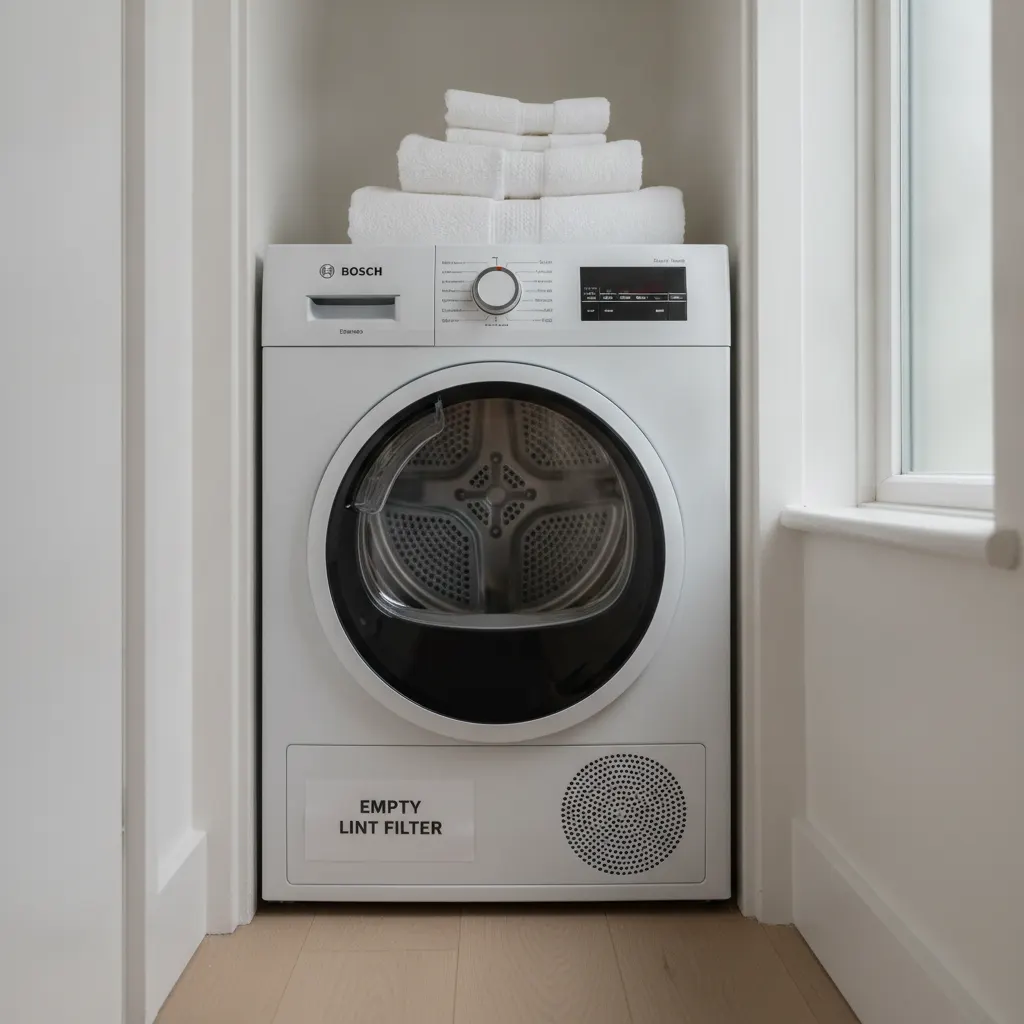
Lint filters — not because they're fragile, but because they get forgotten. I laminated a card that says EMPTY THE LINT FILTER BEFORE EACH LOAD and stuck it on the front of every machine. Not because my cleaners are careless. Because a two-hour turnover involves 40 tasks and it's the invisible one that gets skipped.
Condenser pumps are next. The pump moves water from the drying process into the reservoir, and it can gum up with softener residue over time. I had one replaced at month 30 on a condenser — the call-out and parts came to around £85. Annoying but not catastrophic. On the Miele heat pump I run an empty drum-clean cycle roughly every 40 cycles, which takes about 70 minutes. I think that helps. Haven't needed a pump replacement yet.
Drum seals third. The rubber gasket around the door takes a beating with high-volume use. Replacing it yourself is fiddly — you'll spend an evening watching a YouTube repair video with your arm inside a tumble dryer. A white goods engineer will charge somewhere between £60 and £120 depending on the machine. My Bosch Serie 6 seal cracked at month 20. Didn't stop it working, just made it run a bit less efficiently. I eventually had it sorted during an off-season week.
Washer-dryers: don't
I inherited one in the barn. A Hotpoint washer-dryer combo. It took two hours to wash and then another two to dry, and the dry-only capacity was half the wash capacity, which meant splitting every load and running an extra drying cycle. It cost me about 90 minutes more than a separate setup per turnover, and the combined drum took an absolute pasting. The machine died in month 22 of my ownership.
Replace with separate machines. Yes, it costs more to buy. Yes, it takes up more floor space. The time and reliability tradeoff is worth it at any decent turnover volume.
The cheap Amazon mistake
I bought a no-brand condenser from an Amazon reseller in 2022. £215, mid-range listing, decent reviews. The condensate pump failed at month nine. Machine was in warranty, but the replacement took three weeks to process. Three weeks. In August.
I rented a launderette four streets away for that stretch and paid my Edinburgh cleaner an extra £30 per turnover for the additional travel time and wait. Total cost of saving £100 on the original machine: roughly £280 over three weeks.
Buy from a brand you'd recognise in a Harvey Norman or John Lewis. Bosch, Miele, Hotpoint, Beko. Not because they're perfect — Beko has mixed reviews depending on the model and I've had mixed results myself — but because their service networks are real, their spare parts exist, and if something goes wrong in peak season you have a better chance of a quick resolution.
The machines I'd buy today
High-volume two-bed, city location: Miele TCJ680WP 9kg heat pump. Around £900–£1,000. Worth the outlay at daily-turnover volume. Self-cleaning condenser, solid door seal, sensible lint compartment access.
Moderate-volume 1-bed: Bosch Serie 6 WTH85200GB 8kg condenser. Around £350–£400. Reliable, compact, easy to service. Does what it needs to do without complaint.
Rural/large property: Bosch Serie 4 WTW84T00GB 10kg heat pump or the equivalent Hotpoint 10kg condenser if budget is tighter. Both cope with large linen loads. The Bosch is quieter, which matters if you have guests in earshot of the utility area.
One last note: get the machine fitted properly. Don't pay a friend £20 to connect it and balance it on an uneven floor. A badly levelled dryer vibrates, walks, and wears faster. Most white goods retailers will install for a flat fee and take the old machine away at the same time. It's worth the £50.
Ready to streamline your inventory?
Start managing your rental inventory smarter with automated stock tracking.
Start Free Trial