USB charging sockets in Airbnb bedrooms: I retrofitted four flats and here's what happened
Hoststock Team
14 August 2026
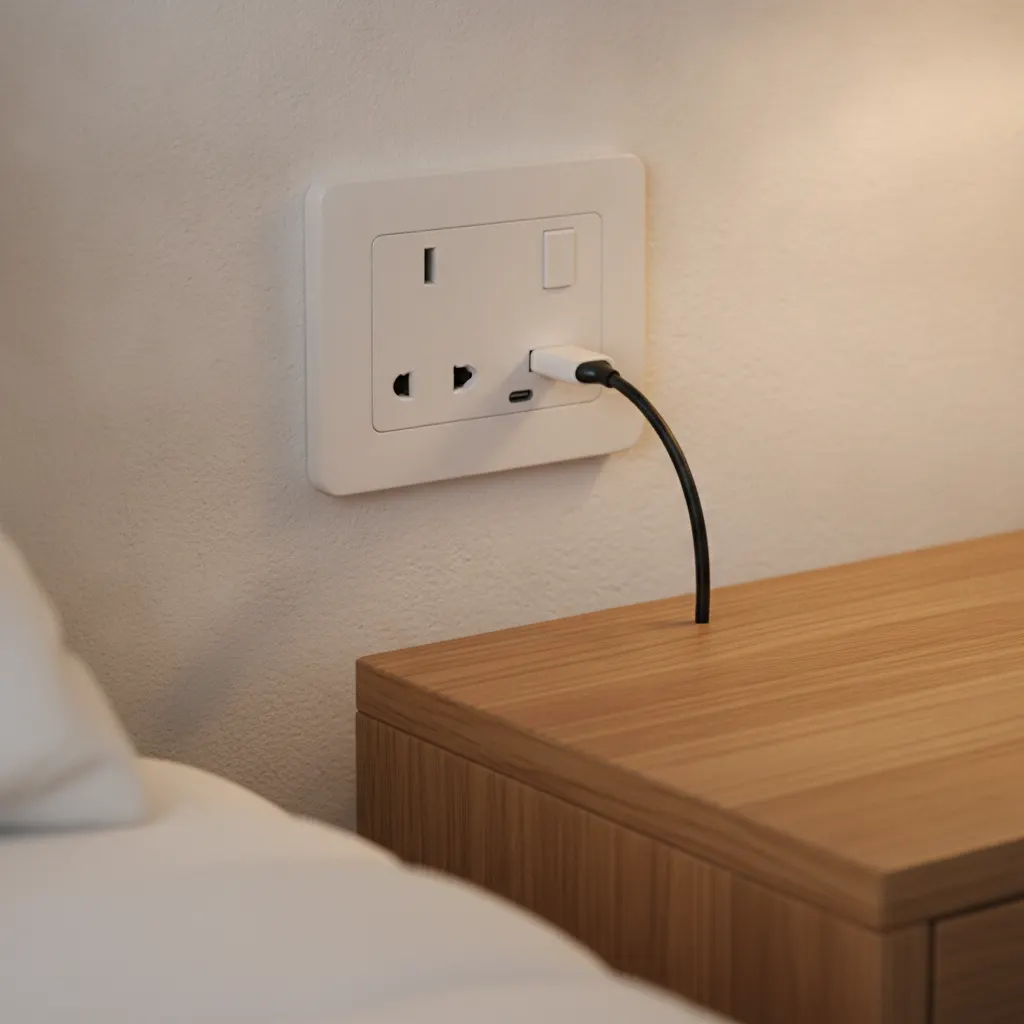
I retrofitted USB charging sockets into four Airbnb properties over about eighteen months, starting with the Edinburgh studio in late 2023 and finishing with the Lake District barn in early 2025. The decision wasn't driven by a single guest complaint — though there were a few — but by something more boring: I kept noticing USB extension leads in bedrooms after guests left. Guests were providing their own charging infrastructure because mine wasn't adequate.
That's not a great look in a £155-per-night property.
Here's what I installed, what it cost, what didn't work, and the one property where I couldn't make it happen at a sensible price and took a different route.
The basic question: USB-A or USB-C?
This matters more than it used to. Up until about 2022 you could fit USB-A sockets — the rectangular slot type — and cover 90% of guest needs. Now a meaningful share of guests have phones, tablets, and laptops that charge via USB-C. And USB-C fast charging (PD, or Power Delivery) requires different circuitry than standard USB-C.
I went with dual USB-A plus USB-C sockets for three of the four retrofits. The MK Electric 45W USB double charger, which has two USB-A ports and one USB-C port on a single fascia, is what I specified. Around £18–£22 per socket at typical trade prices. The USB-C on that model outputs at up to 30W, which is fast enough for modern phones and tablets. Not fast enough for charging a laptop under load, but guests with laptops should be bringing a power supply.
In the barn I went slightly different — Knightsbridge make a model with two USB-A and two USB-C ports on one plate. More expensive (around £28–£32) but the barn sleeps six and the likelihood of two guests wanting to charge simultaneously at the same bedside point is real. Four months in, no complaints. One piece of feedback specifically mentioning "thoughtful charging setup." Worth the extra tenner.
Where to install them
Bedside is the obvious location and where I started. One per bedside in every bedroom that had only a standard twin-socket outlet within reach of a bed. That covers the most common use case — charging a phone overnight.
But bedside isn't the only location that matters. I added a USB socket at desk height in the Marchmont Edinburgh two-bed bedroom because that property attracts business travellers who want to charge a laptop or work from a desk. And I added one in the kitchen of the Brighton seafront flat — at the counter, where guests tend to leave phones while cooking — because I'd had two mentions of "no charging point near the kitchen" in reviews.
In bathrooms: no. USB sockets in bathrooms require appropriate IP ratings and more complex installation. Not worth it for a charging point. Put a hook on the wall and a small shelf. Guests who need to charge in the bathroom can use an extension from the bedroom.
Installation: what it actually involves and what it costs
Every socket replacement in England and Wales is electrical work. Whether it's notifiable work under Part P depends on the scope — like-for-like socket replacement in a non-bathroom, non-kitchen location can sometimes be done without notification, but I'd always recommend using a Part P registered electrician regardless. If you're letting a property, you don't want any ambiguity around the electrical work.
I used the same electrician for all four properties — a guy in Brighton and a contact of his in Edinburgh — and the cost per socket replacement came out at around £65–£85 fitted, including the socket itself. That's for a straight swap of an existing double socket for a USB-equipped replacement. If you need a new socket position — new cable run, new back box — expect £120–£200 depending on the cable run required.
Four properties, roughly eight to ten sockets in total: I spent around £600–£700 all in on the installation work. Two of those sockets required new positions with cable runs, which pushed the cost up.
The property where it didn't work
The fifth property — a ground-floor flat in Edinburgh's New Town, pre-1900 construction with original cornices and a conservation area restriction — is where I drew the line. The electrician quoted £380 to add a single new bedside socket position in the main bedroom because of the cable routing required through protected stonework. The existing socket was on the wrong wall and too far from the bed to be useful without an extension.
For that property I bought two Anker USB charging hubs — the compact cube type with two USB-A and two USB-C ports, around £22 each — and plug them in at the existing sockets. Guests can move them to wherever they need them. It's not as clean as a fitted socket but it works. One guest mentioned them in a review as "handy." The Anker hubs have been in place for about fourteen months and show no signs of wearing out.
Not every solution has to be permanent wiring. Sometimes a well-chosen piece of kit does the same job for a tenth of the cost.
What guests actually said
Before: in 18 months across those four properties, I had five review mentions of "not enough sockets" or "had to unplug the lamp to charge my phone." Not catastrophic, but consistent.
After: in 18 months post-retrofit, one mention — a guest in the barn who wanted more USB-C ports specifically, despite there being two. And two positive mentions of the charging setup. The negative mentions essentially stopped.
What I didn't expect: the USB sockets also reduced questions in the pre-arrival message thread. Guests used to ask "is there somewhere to charge near the bed?" about twice a month. Now almost never. I don't think that's coincidence.
A note on smart sockets
I looked at smart plug solutions that combine USB charging with remote monitoring. The idea being you can see whether something's drawing power from the socket and use that for rough occupancy monitoring. In practice: too complicated for guest properties. Guests interact with them unexpectedly, the app needs to be configured, and I already have Minut for occupancy sensing. A charging socket should just charge. I chose the dumbest possible option that does the job well.
Would I do it again?
Yes, without hesitation. At £600–£700 total across four properties — roughly £150–£175 per property — it's one of the cheaper amenity upgrades I've made and one of the more consistently positive in terms of review sentiment. The payback time against even one fewer sub-five-star review is negligible.
If you're doing a full bathroom or bedroom refresh anyway, add it to the scope. The electrician is already there, the marginal cost of an extra socket position drops significantly, and you'll likely recoup it inside a few months of bookings.
And if you're in a conservation area with impossible wiring — go Anker. Nobody will know the difference.
Ready to streamline your inventory?
Start managing your rental inventory smarter with automated stock tracking.
Start Free Trial