Waste and recycling instructions for UK Airbnb guests: the laminated card that stopped three neighbour complaints
Hoststock Team
25 July 2026
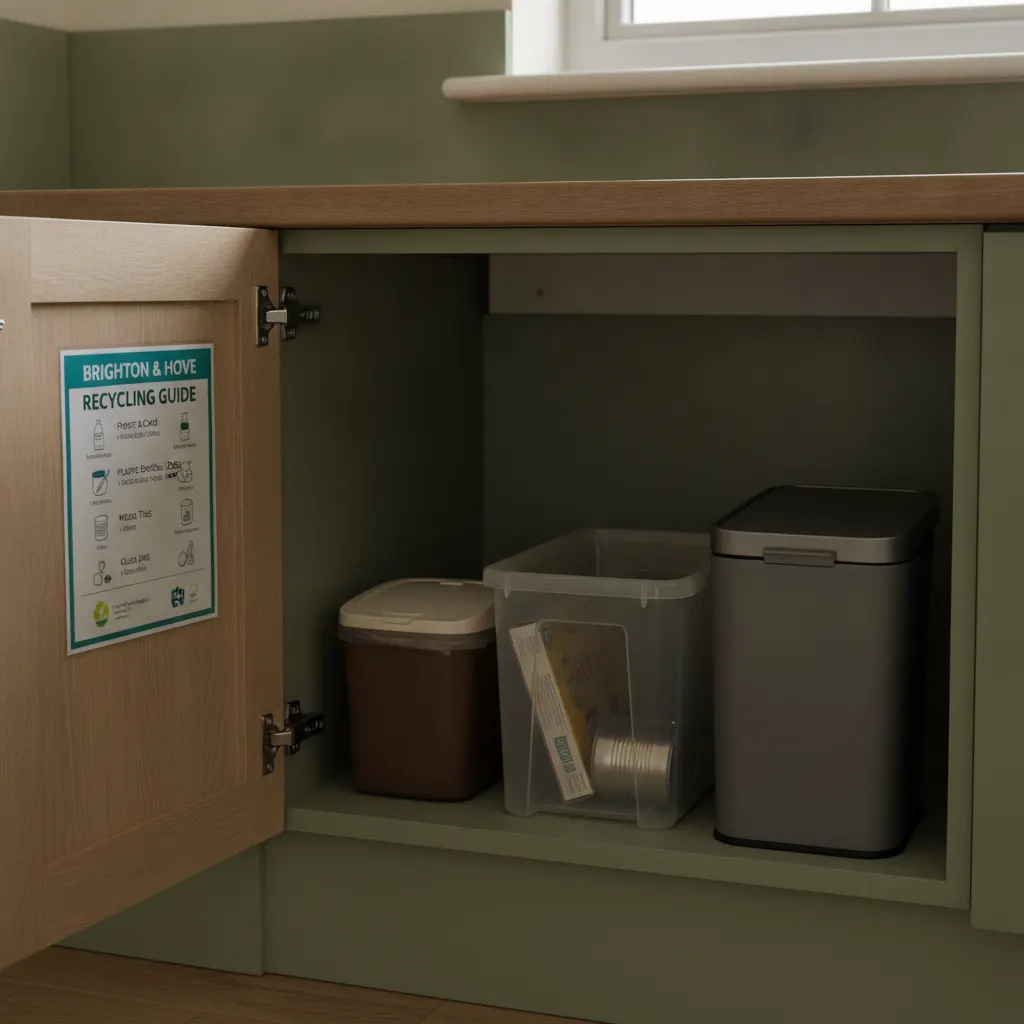
I'm going to tell you about a recycling card. I know how that sounds. But this particular card has prevented three neighbour complaints, saved me from at least one awkward conversation with the building manager, and taken waste-related guest questions from a minor weekly annoyance to essentially zero.
It took me two years to make it. That's the embarrassing part.
Why UK recycling is a genuine problem for Airbnb guests
In the UK, waste and recycling collection is handled by local authorities. Which means the rules are different in Brighton than they are in Edinburgh than they are in the Lake District. Different bin colours, different collection days, different what-goes-where rules, different bagging requirements.
A guest who has perfectly good recycling habits at home in London might arrive in Brighton and have no idea that Brighton & Hove Council collects food waste separately, uses a green wheelie bin for mixed recycling, and absolutely does not want plastic bags in the recycling bin. They'll put everything in the wrong bin and nobody will say anything until the bins don't get collected.
Or a neighbour will.
My first complaint was from the building manager at my Edinburgh flat, about bins that had been left in the stairwell rather than taken to the collection point in the basement car park. I genuinely hadn't thought to tell guests where the bins were. I'd assumed — this was naive — that guests would figure it out. They didn't. Or rather, they solved the immediate problem of where to put a full bin bag by leaving it in the nearest convenient location.
My second complaint was from a neighbour in Brighton about contaminated recycling. Plastic bags stuffed full of recyclables, which is exactly what you're not supposed to do — recyclables should go in loose. I knew this. My guests didn't.
Both of these were my fault for not communicating clearly.
What the card actually says
I have a version of this card in each property. Each one is specific to the local council and the specific setup in that flat or cottage. But the structure is the same:
Section 1: What goes where. Very specific. "Food waste goes in the small brown caddy under the sink. Grey bin: general rubbish only. Green bin: recycling (cardboard, tins, plastic bottles, glass) — loose, not in bags. Blue bin: paper and cardboard only."
I include one or two "not obvious" items. Takeaway pizza boxes don't go in the paper recycling bin because grease contaminates the cardboard. Plastic bags don't go in the recycling bin. Batteries go in the small box by the front door, not in any bin. These are the mistakes that guests make not because they're careless but because the rules vary.
Section 2: Collection days. "General rubbish: collected on [day]. Recycling: collected on [alternate week — odd weeks]. Food waste: collected weekly on [day]." I update this if the council changes the schedule, which happens occasionally.
Section 3: Where the bins live. Photo, not description. I tried describing bin locations in text and it didn't work — "the communal bin store to the left of the entrance" turned out to be interpretable in at least four different ways. A photo of the bin store with an arrow is unambiguous.
Section 4: What to do with extra bags. If they've generated more waste than the bins can hold, I'd rather they message me than improvise. So the card says: "If the bins are full, please message me and I'll arrange collection before checkout." This has been used twice in two years and both times it was fine. I'd rather a message at 8am than a pile of bin bags in the hallway.
Format and placement
Laminated A5 card. Printed at home, laminated at Ryman for 80p a sheet. Mounted on the inside of the cupboard door under the kitchen sink, which is where the bin caddy lives and where guests look when they're dealing with rubbish.
Why laminated? Because guests use the kitchen, and information that sits near the kitchen gets splashed on. A laminated card survives this. A printed sheet of paper doesn't. I've had to replace a couple of cards at inspections but mostly they last years.
I also mention the bins briefly in the pre-arrival information message and in the check-in guide, but with a pointer to the physical card rather than trying to replicate all the detail in a message. "Waste and recycling instructions are on the card inside the cupboard under the kitchen sink" takes up one line. Full details live on the card itself.
The neighbour relationship dimension
This is the thing that's actually worth more than the practical waste management benefit. Neighbours of short-term let properties have, often reasonably, a complicated relationship with the fact that there's an Airbnb in their building. Shared bin areas that are poorly managed are one of the most common complaints I hear from neighbours who resent short-term lets. Bins that are always overflowing, always contaminated, always left in the wrong place.
Getting this right is partly courtesy and partly politics. I'm not going to win over every neighbour by managing my bins well. But I'm much less likely to have a neighbour who actively campaigns against my presence in the building if the bins are fine. It removes one legitimate grievance.
The three neighbours at my Edinburgh flat are indifferent to my Airbnb operation, which in that building counts as a win. One of them told me at the building's AGM that she'd had no complaints since I'd improved the information about the bins. Small thing. Real thing.
Council rules change — keep the card current
Brighton & Hove, Edinburgh City Council, and the Lake District districts have all changed their recycling guidance at least once in the four years I've been running these properties. New categories, different bagging rules, different collection frequency.
I check the local council website each January and update the cards when anything has changed. Takes about fifteen minutes per property. I also check my cards during the quarterly walk-through inspection and replace any that have got damaged or outdated.
This is the kind of maintenance task that's very easy to skip because nothing immediately bad happens if you don't do it. Then a bin collection gets missed, a neighbour sends a message, and you remember.
Template if you want to start one
Go to your local council's waste and recycling page — search "[council name] recycling what goes where" and it will usually come up within the first two results. Make note of: bin colours, what goes in each, collection frequency, and any specific don'ts (no plastic bags, no contaminated cardboard, etc.). Add the location of the bins specific to your property, and a note about what to do if the bins are full. That's the whole thing. Print it, laminate it, put it where the bins are.
You'll think it's too simple to be worth doing. Make the card anyway.
Ready to streamline your inventory?
Start managing your rental inventory smarter with automated stock tracking.
Start Free Trial