Wine glasses for Airbnb: polycarbonate vs regular glass across five flats and two years of breakage data
Hoststock Team
22 August 2026
The birthday group booking that made me pay attention
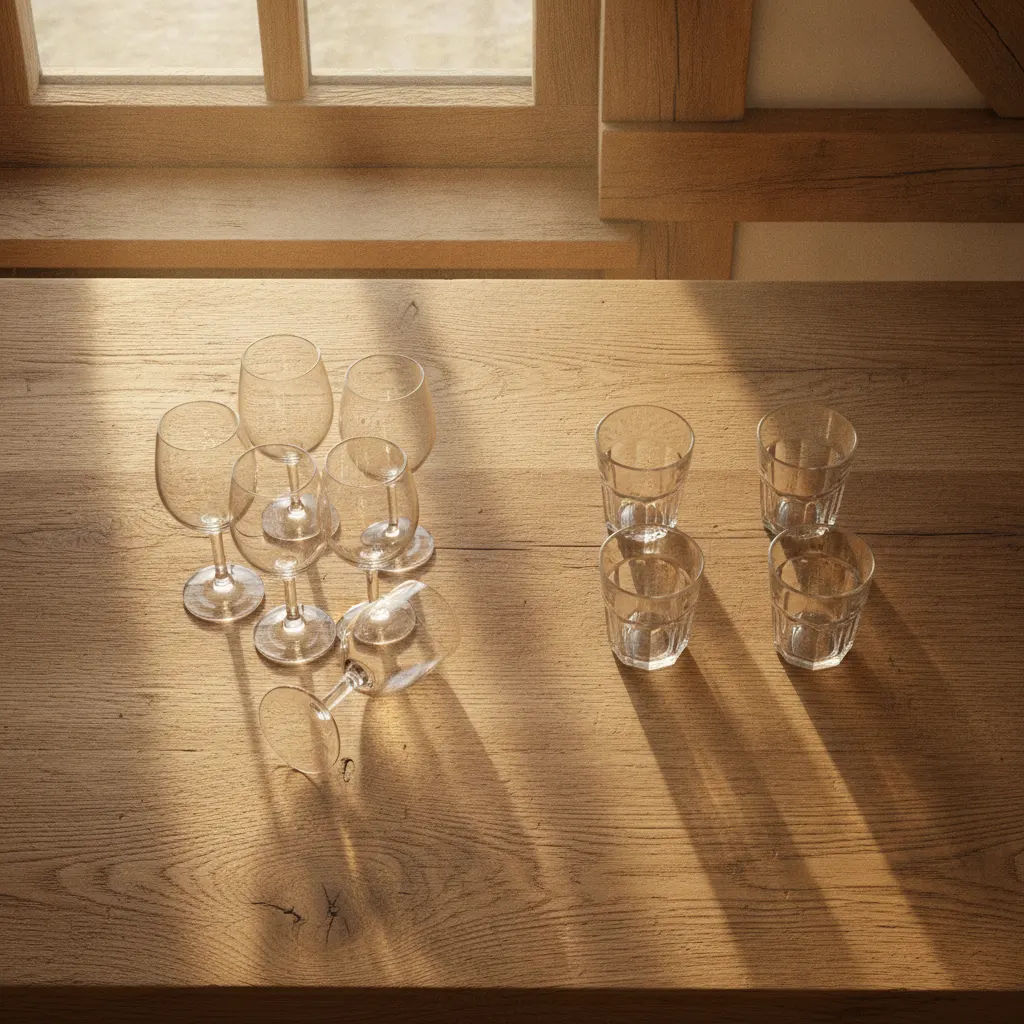
Six guests, a birthday weekend in Edinburgh, and eight wine glasses before the booking. I found four at checkout. Three broken in the recycling bin (fair enough, they cleaned up after themselves), one completely missing. I'd bought those glasses from IKEA about four months earlier — the Ikea Storhet, pack of six for about £6. So I wasn't weeping about the financial loss. But I was at the property at 10am on a Sunday replacing glasses before a same-day check-in and I thought: there has to be a better way.
That was the start of a slightly obsessive two years of tracking glass breakages across five properties. Not because I needed a spreadsheet to tell me glasses break — I knew that — but because I wanted to know whether the alternative (polycarbonate stemless glasses, the ones that look like glass but don't shatter) was actually worth switching to, or whether I'd be spending more money on breakage-resistant glasses than I'd save in replacement costs.
The data I collected (informally)
Not a rigorous study. My cleaners report broken or missing items after each turnover, and I log it. Over two years across five properties, I counted:
- 63 wine glasses broken or missing. The IKEA Storhet (stems) and IKEA 365+ (stemless) were the most common casualties.
- Of the 63, 41 were stemmed wine glasses, 22 were stemless.
- The Edinburgh Old Town flat had the highest rate — probably six or seven short-stay groups per month with multi-night stays.
- My Lake District barn had the lowest breakage rate despite being the most remote and having the least "careful" demographic (hikers and outdoor groups). The barn has the most storage space so glasses aren't crammed into tight cupboards.
Stems snap. This is the main finding. Stemmed wine glasses break at roughly double the rate of stemless glasses. The stem is the weak point — knocked over, stacked carelessly, gripped too tight by a guest who's had a few glasses. If you're buying stemmed glasses for an Airbnb and wondering why they keep breaking: that's why.
The polycarbonate experiment
I switched my Brighton flat to polycarbonate stemless wine glasses about eighteen months ago. These are the ones that look and feel almost like glass but flex rather than shatter when dropped. I used Rink Drink polycarbonate glasses — they come in packs of eight, cost around £18-20 per pack, and are designed for outdoor use at events rather than restaurants.
Results after eighteen months:
- Zero breakages. None. The glasses have been scratched, one has a small crack around the top rim that I should probably replace, but no shattering, no clean-up, no explaining to guests why there are only three glasses instead of eight.
- Three guest comments, all positive: two mentioned the "outdoor safe glasses" specifically in messages when asking if they could use them on the balcony. One mentioned in a review that the property was "well-equipped for outdoor dining."
- One guest complaint: they "didn't feel like proper wine glasses." To be fair, they don't. If you pour an expensive Burgundy into a polycarbonate glass, you'll notice. For a city break Airbnb where guests are more likely to be drinking a £9 Sauvignon from the Tesco Metro around the corner, this matters less.
Why I haven't switched everywhere
The Lake District barn is a different proposition. The guests there tend to stay longer (four to seven nights rather than two to three), tend to cook properly (they book specifically because the barn has a good kitchen), and they do genuinely care about glassware. I've had two specific mentions in reviews about "proper glasses" — which I'd never have noticed if I hadn't been tracking review content.
For the barn I use Duralex Picardie tumblers for everyday use — these are the classic thick French bistro glasses that don't break easily because they're not thin-walled. For wine specifically at the barn I use Borgonovo Capitole stemless wine glasses — thick enough to survive careless handling, thin enough that you'd use them without feeling you're drinking from a mug, and significantly cheaper (around £1.50-2 per glass) than anything from Riedel or Schott Zwiesel.
The Edinburgh properties sit in the middle. One still has regular stemless glasses (IKEA 365+ at 70p per glass, replaced about twice a year). The other has a mix of Duralex and polycarbonate depending on the cupboard location — polycarbonate near the exterior door, Duralex in the main kitchen cupboard. It's not a principled system, it's just what I've ended up with.
The replacement cost calculation
At 63 glasses over two years across five properties, my replacement glass spend was roughly £40-50 in actual purchase cost (I buy IKEA when I'm nearby, Amazon Business in bulk otherwise). That's before I switched the Brighton flat to polycarbonate. Since the switch, that property's glass replacement cost has dropped to effectively zero.
The polycarbonate glasses cost me £18 for eight. IKEA stemless glasses cost about £6 for six (around 70p each), so £5.60 for eight. The premium for polycarbonate is roughly £12.40 per set of eight, or about £1.50 per glass. If I'm breaking 8-10 glasses a year at the Brighton flat at 70p each, the polycarbonate set pays for itself in about a year and a half. If I'm breaking them faster (birthday weekends, hen parties, any booking with six guests), it pays for itself sooner.
For a property that regularly hosts groups, the switch to polycarbonate is financially obvious. For a property that mainly hosts couples, IKEA stemless is probably fine and cheaper to replace when they do break.
What I've stopped buying entirely
Stemmed wine glasses. Done. Whatever the aesthetic argument for them in an Airbnb — and there is one, it does look nicer in listing photos — the operational reality of a stemmed wine glass in a property with multiple turnovers per week is that you're just buying time until the next breakage. I photographed my Brighton flat for a listing refresh last autumn with the polycarbonate stemless glasses in shot and nobody has ever commented on it in a question or booking message.
I've also stopped buying champagne flutes. I had them in two properties. They broke at roughly three times the rate of wine glasses because the stems are even more fragile, and guests who arrive with a bottle of Prosecco to celebrate something don't care what glass it's in — they're already celebrating.
The honest answer to "polycarbonate or glass?"
Group bookings, urban flats, properties with outdoor space: polycarbonate. The breakage saving is real, the review risk from a shattered glass in a kitchen bin is real (finding broken glass as a guest is unpleasant even when it's clean and contained), and modern polycarbonate looks acceptable.
Longer stays, rural properties, properties where food and drink is part of the appeal: thick-walled glass. Duralex or similar. Not stemmed. Not thin. Not IKEA's thinnest option. The Duralex Picardie has been in production since the 1950s for a reason — it's the cockroach of glassware, essentially indestructible under normal use.
The answer is probably different glasses for different properties, which is slightly annoying from a procurement standpoint. But it's what the two years of breakage data says, and I'd rather buy the right thing than the consistent thing.
Ready to streamline your inventory?
Start managing your rental inventory smarter with automated stock tracking.
Start Free Trial