Washing machine drum size for Airbnb turnovers: 8kg vs 10kg vs 12kg across three properties
Hoststock Team
2 July 2026
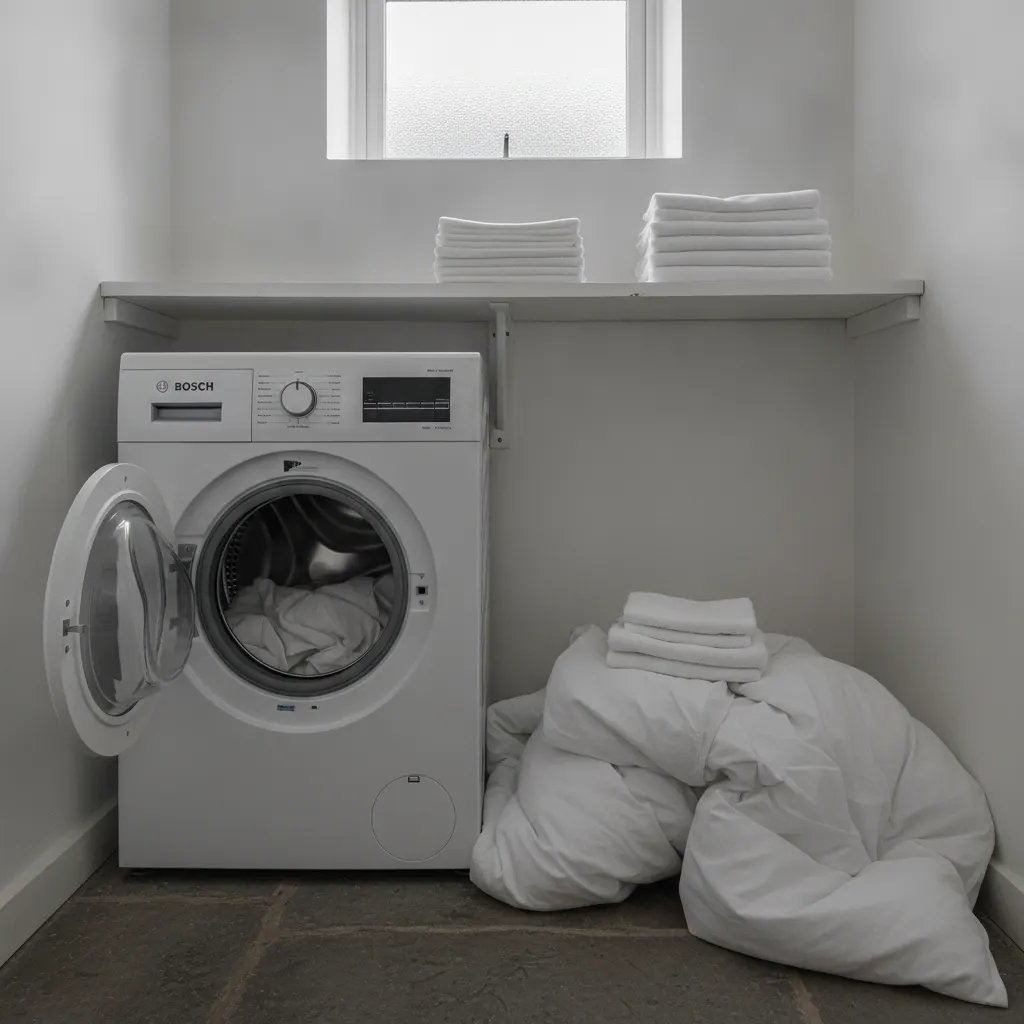
When I set up my first Edinburgh flat, I bought an 8kg washing machine. It was the size my parents had when I was growing up. It seemed like plenty. It wasn't — not once I started doing two turnovers a week, which is the reality of a well-booked property in Edinburgh Old Town from about April through September.
Fourteen months later I replaced it with a 10kg machine, which cost me more than I wanted to spend on an appliance I'd already bought once. The original 8kg machine went to my parents (they were delighted; I was less so). The 10kg has been running for about 18 months now without complaint, and I think it's the right call — but the decision was more complicated than I expected.
This post is about the actual maths behind drum size selection for short-term let properties. Not the general guidance you'll find on appliance comparison sites, which tells you '8kg is fine for a family of four.' You're not a family of four. You're doing commercial-scale laundry on a residential machine, and the two are different problems.
The turnover laundry load: what you're actually washing
Let me be specific about what a 2-bed flat turnover produces in terms of laundry. Standard configuration in my Edinburgh flat: one king room, one twin room.
Per turnover:
- 1 king duvet cover: typically around 700–800g dry
- 1 king fitted sheet: around 500–600g
- 1 king flat sheet (or top sheet, if you use them): around 400–500g
- 2 king pillowcases: around 200–250g combined
- 2 twin duvet covers: around 600–700g combined
- 2 twin fitted sheets: around 500–550g combined
- 4 single pillowcases: around 200–250g combined
- 4 bath towels: typically 600–800g each depending on GSM, so 2.4–3.2kg combined
- 2 hand towels: around 600–800g combined
- 2 bath mats: around 600–800g combined
- Kitchen tea towels and cloths: typically 400–600g
Add it up: roughly 7–9kg of laundry per turnover in a 2-bed flat, before accounting for additional items like extra throw blankets or the odd tea towel that went rogue.
An 8kg machine, in theory, fits a standard 2-bed flat turnover in two loads. In practice, because wash loads shouldn't be packed to the brim (items don't clean properly), you're often looking at three loads: one for bedding, one for towels and bath mats, one for smaller items.
Why 8kg became a problem
The Edinburgh flat has high occupancy — roughly 80% year-round, higher in peak season. That means roughly 32 turnovers a month at peak. Even at half that, I'm doing 15–16 turnovers a month.
Three wash loads per turnover, each running 40–60 minutes on a quick cotton cycle: that's two to three hours of washing per turnover, minimum. With a single machine and a cleaner who often needs the flat back in service within four to five hours, this creates a real bottleneck.
The 8kg machine was running for about six hours on heavy turnover days. The motor was straining. The bearings went at 14 months. The repair quote was close enough to a new machine that I decided to upgrade.
The 10kg machine fits the full 2-bed turnover in two loads more comfortably — the king bedding plus some towels in load one, remaining towels, bath mats and smaller items in load two. Two cycles of 45 minutes is still 90 minutes of washing, but it's better than three, and the machine runs less stressed.
When a 12kg machine makes sense
My Lake District cottage is a different story. It's a 3-bed property — two doubles, one twin — and when it's full, the laundry load per turnover is closer to 12–14kg. I've got a 12kg machine there, and honestly it still takes two loads for a full-capacity turnover.
The rule of thumb I now use: drum capacity (kg) should be at least 1.5x your average per-turnover laundry weight for the property. This gives you comfortable loading — not packed, not underloaded — and means you can get through a turnover in two loads rather than three.
For a 1-bed flat, average turnover laundry is about 4–5kg. An 8kg machine is more than adequate.
For a 2-bed flat, average turnover laundry is 7–9kg. You want 10kg minimum.
For a 3-bed property, average turnover laundry is 11–14kg. You want 12kg, ideally 14kg if you can find one.
This is different from the domestic guidance, which tells you 8kg is fine for a family of four. A family of four doing laundry twice a week has completely different requirements from a rental property doing it 15–30 times a month.
The spin speed question
One thing I underestimated when choosing my 8kg machine: spin speed. My original machine spun at 1200rpm. My replacement spins at 1400rpm. The practical difference is towels that come out noticeably drier — which matters when you're either tumble-drying (faster, less moisture to remove) or air-drying (faster drying time, especially important in Edinburgh in winter, where 'air drying' can mean 'still damp after six hours').
For STR laundry, I'd prioritise 1400rpm over 1200rpm for anything you're not tumble-drying. The extra cost is usually marginal on mid-range machines. My current machine is a Bosch Serie 4 — not the cheapest, not the most expensive. It's been solid. I'm not recommending it specifically because I don't know what your property configuration looks like, but mid-range Bosch and Miele are what I see most often in recommendations from hosts who've been through a few washing machine casualties.
What about using a laundry service instead?
For some properties, particularly rural ones where machine breakdowns are a logistics nightmare, this is worth the conversation. I've written previously about the maths on linen hire vs own-and-launder — the short version is that it depends heavily on property size, occupancy, and proximity to a usable laundry service.
But for urban properties with reasonable access to appliance repair and a moderate turnover rate, an in-house machine is cheaper per-item than a laundry service in almost every scenario I've costed out. The initial capital outlay is higher; the per-use cost is lower. And you control the schedule.
The tumble dryer question
I added a tumble dryer to the Edinburgh flat about six months after buying the 10kg washing machine, and I wish I'd done it sooner. Edinburgh is not a climate that's sympathetic to air-drying. The flat's radiators can only do so much. Guests were occasionally getting towels that weren't quite dry, which is the kind of thing that gets mentioned in reviews.
The dryer I have is a heat pump condenser — slower than a vented or conventional condenser dryer, but significantly cheaper to run (typically around 60–70% less energy than a conventional condenser dryer, from what I've found, though exact savings depend on the model and load). For a property doing 15+ turnovers a month, the energy savings add up over a year.
If you're only running one machine, the priority order I'd suggest: washing machine first, tumble dryer second. Get the right drum size on the washer, then add the dryer when budget allows. Running a too-small washing machine to save money on the dryer is the wrong trade-off.
What I'd buy now, per property type
For a 1-bed or studio flat: 8–9kg washing machine, 1400rpm spin. A condenser dryer if you don't have outdoor drying or a utility room with good airflow.
For a 2-bed flat: 10kg minimum, 1400rpm spin. Tumble dryer if turnover frequency is above 10 per month or your climate is unreliable (so: most of the UK).
For a 3-bed property: 12–14kg. No compromise here — you'll be doing two loads regardless, but you want comfortable loads, not packed ones.
The washing machine isn't the most glamorous purchase in your hosting setup. But it's one of the most consequential. Mine failing at 14 months cost me an emergency replacement, a day of delayed turnovers, and one irritated cleaner who had to air-dry towels over radiators. The right machine from the start would have been cheaper in every sense.
Ready to streamline your inventory?
Start managing your rental inventory smarter with automated stock tracking.
Start Free Trial