Airbnb boiler failure mid-stay: the backup heating protocol I've now sent to 47 guests
Hoststock Team
10 October 2026
Friday. January. 3°C outside. Boiler: dead. Guests arriving in four hours. My regular plumber: not picking up.
I should describe what happened more calmly than that, but it wasn't calm. I spent the first twenty minutes doing what you're not supposed to do in any crisis, which is refresh my phone hoping the situation would update itself.
It didn't.
Eventually I went to Argos. Bought a 2,500W De'Longhi oil-filled radiator — £72, no idea if it was the right one. Drove it to the flat. Set it up in the sitting room. Turned it on. Forty minutes later the room was 18°C and I'd had time to draft a message to the guests that didn't make me sound like I was panicking (I was panicking).
That stay got four stars. 'Host was responsive and arranged alternative heating immediately.' Not the five I wanted. But they came back and booked again eight months later, so. Fine.
Three years on and I have a proper process. Here's what it is.
The radiator that lives in the cupboard
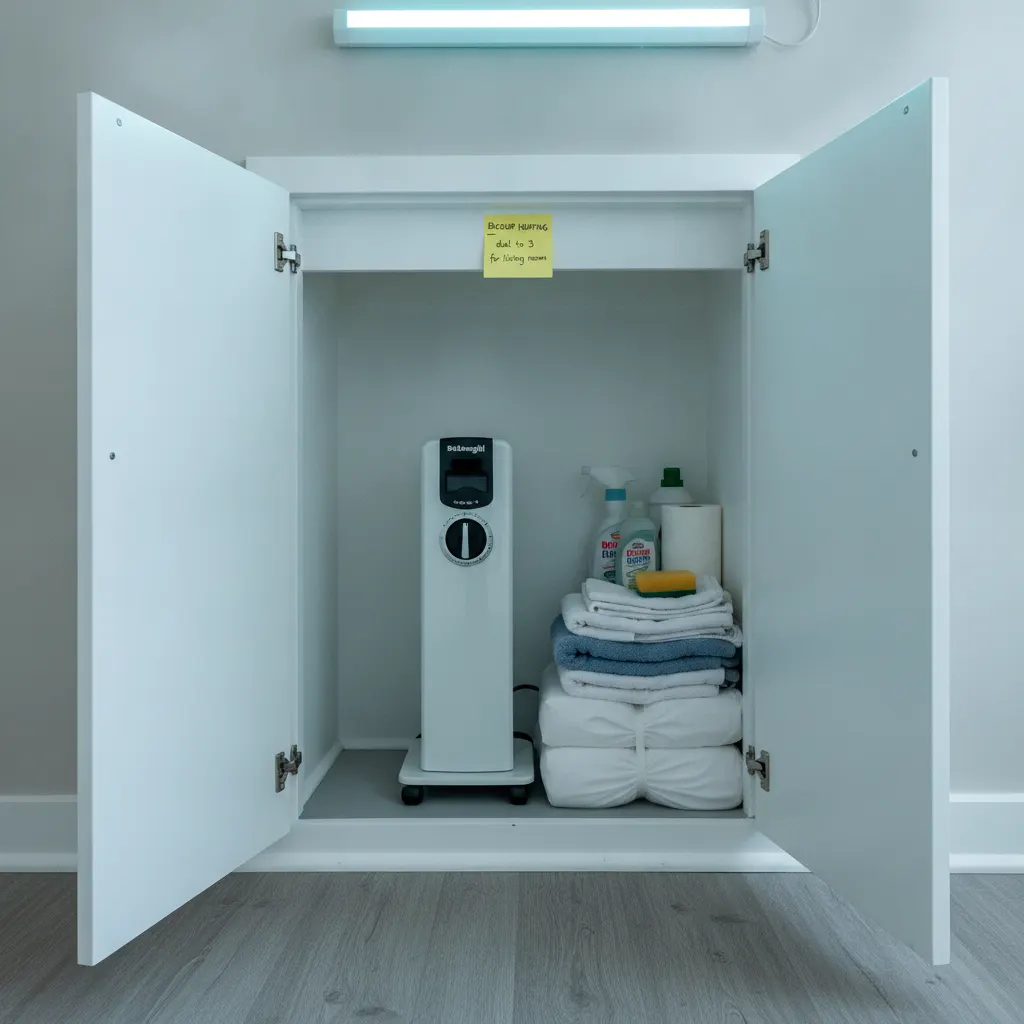
Every property now has one oil-filled radiator in the cleaning cupboard. Or the utility room. Or the bottom of the airing cupboard — wherever there's space and wherever the cleaner knows to find it.
Not a fan heater. Oil-filled. The reasons matter: oil-filled stays warm for a while after the element cuts off, so you're not just blowing hot air at a room. Silent, too. And safe enough to leave on overnight on a thermostat setting. Fan heaters make a noise that some people find impossible to sleep near, and I don't want to replace a boiler problem with a different guest problem.
The De'Longhi TRD40615E is what I use at three properties. Around £70–80 on Amazon. It's not the cheapest thing you can buy. That's deliberate. A faulty radiator in a flat I'm not in, left on overnight, is a risk category I don't want to experiment with on price.
Running cost: roughly 35–45p per hour on a low thermostat setting, based on my electricity rates. Not nothing. But acceptable for a short-term fix.
The boiler usually dies in January
Or on the first cold night of October. Or in February when there's a cold snap after a mild period. Almost never in July.
STR boilers get hard use during the let season and then sit in warmer periods without anyone noticing the small things that are slowly going wrong. A flue developing a slight issue. A pressure drop that's slow enough the gauge hasn't caught anyone's attention. Parts getting near end-of-life without the warning signs anyone would notice at home.
I service all five boilers in October now. Every year, without exception. Not when the reminder pops up in June and I think 'later'. October, before the heating season. Costs me £85–110 per property. The emergency call-out on a Friday evening in January, without parts, is around £180–220 just to walk through the door. The maths aren't complicated.
The guest message, written while trying not to seem stressed
Within 15 minutes of knowing there's a problem, I send this — or a version of it:
Hi [name], I've been made aware that the heating at the property isn't working properly. I've already contacted an engineer and I'm arranging a solution. There's an oil-filled radiator in the cleaning cupboard which will heat the main rooms — it's the white unit with a dial on the side. I'll update you within the hour. I'm sorry for the disruption and I'll make sure this doesn't affect your stay more than it has to.
That message does a few specific things. It shows action is already happening. It gives them something practical to do right now. It doesn't promise a refund — which I'll work out later, with a clear head, not in a panic at 4pm. And it sets an update expectation, which means they're not sitting wondering if I've abandoned them.
I've sent variations of that 47 times across five properties. Forty-three of those stays were four or five stars despite the heating issue. The four that weren't — the boiler failure was part of a wider bad stay that probably wasn't going to end well regardless.
Refunds — when and how much
I don't offer money proactively. I wait and see how the stay resolves. If the boiler's fixed within eight hours and they had the radiator, I don't initiate a refund conversation unless they do. Most don't.
Over 24 hours without heating? I offer one night's nightly rate. 48 hours? Two nights. No hot water but heating okay? Roughly half a night, case by case. These aren't rigid rules — they're starting points I adjust depending on the circumstances and how badly the guest was actually affected.
Wait until checkout. Never negotiate mid-stay if you can help it — you're not thinking clearly, they're possibly not either, and you'll end up offering more than is reasonable.
The engineer relationship
I have one heating engineer in Brighton and one in Edinburgh who I can actually get on the phone on a Friday evening. Not because I have some magic network. Because I've given them consistent work, paid their invoices the same day, and not been an awkward client when something was more expensive than expected.
The Brighton engineer has been into all three of my south-east England properties at least once. He knows the boilers. When I call him about a problem he doesn't need me to explain the setup from scratch.
That relationship takes time to build. Start before you need it. A boiler service is the right moment — you get to meet the engineer on a non-emergency visit, they get to know your property, and you're not first calling them in a crisis.
Setup across five properties: what it cost
One oil-filled radiator per property: £350 total. That's been the capital cost. In three years I've drawn on them at three of the five properties — not as often as I feared, but often enough that I'm glad they're there.
The alternative — sending guests somewhere else, offering a full refund, fielding a three-star review — costs more than £350 per incident. Even once.
It's a boring piece of kit to spend money on. Nobody's excited about an oil-filled radiator in a cupboard. But boring contingency planning is what turns a crisis into 'minor inconvenience, handled well' — which is exactly what you want a guest to say in a review about the worst thing that happened to them during their stay.
Ready to streamline your inventory?
Start managing your rental inventory smarter with automated stock tracking.
Start Free Trial