Cleaning product quantities per Airbnb turnover: my exact list across a 2-bed flat
Hoststock Team
5 July 2026
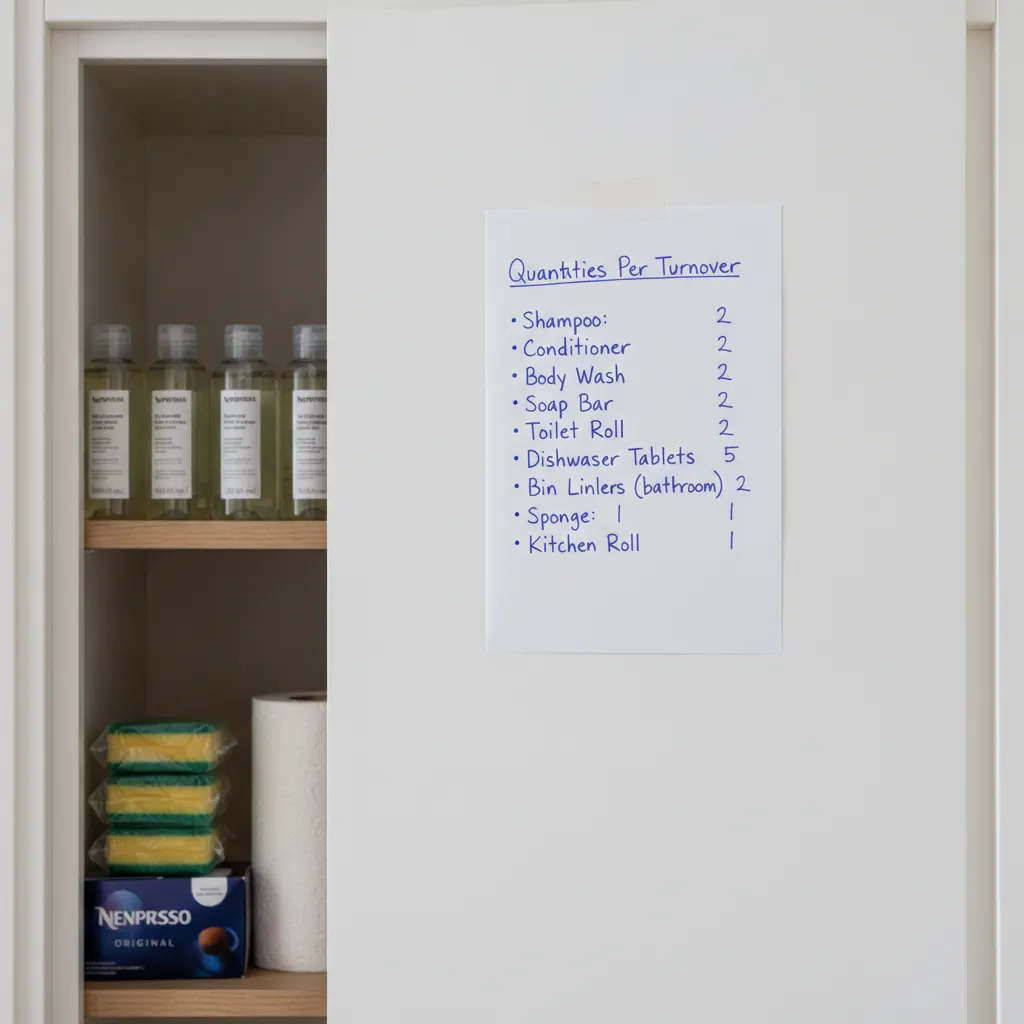
The 'top it up' approach to cleaning product quantities is the invisible cost in most Airbnb operations. You tell your cleaner to top up the toilet bleach, the hand soap, the surface spray. They top it up. What 'top it up' means to your cleaner and what it means to you are often two different things. I had one cleaner who treated a 500ml refill of hand soap as a single-use item. She wasn't wrong, exactly — she wanted the guest to find a full dispenser. But across 30 turnovers a month, the difference between 'refill the hand soap' and 'leave 80ml in the dispenser' is about £40 a month in soap costs. Which I wasn't tracking, which is why it took me eight months to notice.
The fix was a quantities sheet. Specific amounts per item per turnover, laminated and stuck inside the supply cupboard. Not 'top up the soap' — 'hand soap dispenser should show between 40–60% full on check-out inspection. Refill from the 500ml bottle to that level only.' It took me a Saturday afternoon to write, cost about 50p to laminate at the library, and saved me significantly more than that in the first month.
Here's my quantities sheet for the Brighton 2-bed flat. I'll walk through the reasoning on the ones that need explaining.
Bathroom quantities
- Toilet rolls per bathroom: 2 rolls on holder/shelf, spare roll visible under the sink. 3 per bathroom per turnover. Not 6. Not a pyramid of twelve on the back of the cistern.
- Hand soap dispenser: Refill to 80–100% on check-out for each booking of 2 nights or less. For stays of 3+ nights, top up only if below 50%.
- Shower gel (100ml individual): 2 units per guest, placed in shower. So a 2-bed flat that sleeps 4 gets 8 units total across both bathrooms.
- Shampoo (100ml individual): Same as shower gel — 2 per guest.
- Conditioner (100ml individual): 1 per guest. Fewer people use conditioner than shampoo; I've tested this and it's roughly true across my properties.
- Toilet bleach: Pour approximately 50ml under the rim, leave for 5 minutes, scrub, flush. The bottle is not left out for guests. It lives under the sink. Top up the bottle when it drops below 200ml (about 4 uses remaining).
- Surface spray (bathroom): Available under sink, full bottle at turnover. Replace bottle when empty or below 20%.
- Cotton buds and cotton wool pads: Top up to full on every turnover. These are cheap and guests notice them being gone.
Kitchen quantities
- Washing-up liquid: Leave enough for roughly 3–4 washing-up sessions — about 30–40ml in a refillable bottle, or 30–40% full on the bottle at the sink. For longer stays (3+ nights) leave a full bottle.
- Dishwasher tablets: Leave 6 tablets in the dishwasher tablet box, regardless of the booking length. 6 is enough for up to 3 nights, and guests can always ask for more. I find leaving 20 tablets just means some disappear in luggage.
- Kitchen roll: 1 full roll on holder. Full. Not a roll with 40% left. Full.
- Sponge: New sponge every turnover. Not every few turnovers — every turnover. I buy them in packs of 30 from Amazon Business. Cost is negligible. The smell of an old sponge is not.
- Coffee pods (Nespresso Original): 6 pods for a 1–2 night stay, 10 for a 3–4 night stay. I've found this broadly matches consumption without being excessive. Guests who want more can buy more; I usually get a nice message when I've left a 'generous' supply and that goodwill is worth something.
- Tea bags: 10 individual bags, regardless of booking length. Small container on the counter top.
- Sugar (sachets): 8 sachets. Not a sugar bowl that accumulates forever. Sachets mean the amount is controlled and the product is always fresh.
- Bin liners (kitchen): New liner in the bin plus 2 spares under the bin or in the drawer. So 3 total per turnover.
Cleaning product quantities (for the cleaner's use, not guest-facing)
These aren't left out for guests. They're in the cleaning cupboard. But I still specify quantities to control consumption.
- Antibacterial spray: One 750ml bottle per flat, replace when below 20%. Cleaners don't need to bring their own — it's in the cupboard. But it should be checked against the guest-facing products, which are replenished separately.
- Glass cleaner: One bottle per flat, replace when empty. Used for mirrors and windows on every turnover.
- Floor cleaner: Used per the product instructions — typically a capful (about 20–30ml) per bucket of water. Not half the bottle.
- Rubber gloves: My cleaners bring their own. I provide a spare pair in the cupboard for emergencies, replaced monthly regardless of whether they've been used.
The bedrooms
No cleaning products left out in bedrooms — this is guest space, not cleaning space. But there are a few consumable items I standardise:
- Water glasses per bedside table: 1 per bedside table, clean and empty. Not filled with water. Guests know how to fill a glass.
- Tissues (bedroom box): Replace when below 30% full. I buy the 80-count boxes from Costco and they last for two or three turnovers typically.
What this actually saves
Before the quantities sheet, I was spending roughly £3.20–£3.80 more per turnover in cleaning product costs than I do now, based on a back-of-envelope comparison using my Amazon Business order history. Across 15 turnovers a month for the Brighton flat, that's about £50–£55 a month. Or £600–£660 a year, just from one property.
The saving isn't all from over-generous top-ups. Some of it is from the opposite problem — cleaners who ran low on a product and didn't mention it because they weren't sure what level was acceptable. Specificity helps both ways. 'Leave 6 dishwasher tablets' means the cleaner knows 6 is correct, doesn't stress about whether to leave more, and doesn't silently drop to 2 without telling me.
Getting the cleaner on board
I was slightly nervous about introducing a quantities sheet to cleaners who'd been working with me for more than a year. Would it feel like I didn't trust them? Like I was micromanaging?
Actually, no. Every cleaner I've given the sheet to has been relieved. They now know exactly what to do. They don't have to make judgment calls about whether to use the last of the hand soap or save it. They don't have to decide whether 'top up the coffee pods' means leave 4 or leave 20. The quantities sheet removes ambiguity, and cleaners — who are usually balancing multiple jobs with tight time windows — love clarity.
One cleaner told me it was the best thing I'd done since I started giving her the photo checklist. Which is either high praise or a commentary on how low my bar was previously. Both, probably.
One thing to get right first
Don't write the quantities sheet until you've watched the consumption for a month. My first version was wrong about dishwasher tablets (I'd underestimated) and wrong about conditioner (I'd overestimated). I updated it after about six weeks and the version I have now has been stable for about a year.
The sheet is the output of observation, not a starting point for it. A month of paying attention to what gets used, what gets wasted, and what guests comment on gives you a much more accurate document than anything you could write from first principles.
Ready to streamline your inventory?
Start managing your rental inventory smarter with automated stock tracking.
Start Free Trial