Airbnb inventory reorder triggers: the signals I use across five properties
Hoststock Team
29 June 2026
For the first six months of running more than one property, I ordered supplies when I remembered to. Or when a cleaner texted me to say there was no kitchen roll. Or when a guest left a note that the coffee pods were gone. It was reactive, chaotic, and surprisingly expensive — not because individual items cost much, but because last-minute orders meant Amazon Prime prices, not bulk prices, and the mental load was relentless.
I don't run a particularly large operation. Five flats and one converted cottage. Brighton, Edinburgh, and one in the Lake District that I've described in previous posts as 'the property that teaches humility.' But five properties is enough to make gut-feel reordering fall apart quickly. You lose track of which site has what stock. You forget that the Edinburgh flat uses a different coffee machine to the Brighton ones. You order twelve rolls of cling film for properties that already have eight.
So I built a trigger system. It took about four months to get right, and I've been refining it since. What follows is the actual list — not a theoretical framework, just the specific numbers and events that tell me to order something.
Why 'par levels' alone didn't solve this
I'd read about par levels. Plenty of STR blogs describe the concept: minimum stock quantity per property, reorder when you hit it. And yes, par levels are part of what I do now. But on their own they're not enough, for a few reasons.
First, stock levels change faster in some seasons than others. A Lake District cottage in August goes through toiletries at roughly twice the rate it does in January, because occupancy is higher and guests tend to stay longer. A static par level set for winter will have me reordering constantly in peak season if I'm not careful.
Second, some items aren't just about quantity — they're about condition. A bath mat at eight pieces might technically be 'above par' but if three of them have anti-slip backings that are peeling, you've got a problem that raw numbers don't catch.
And third, some reorder triggers aren't about the item at all. They're about events: an upcoming back-to-back booking run, a change of cleaner, a particularly heavy weekend of turnovers. Context matters.
The system I ended up with builds all three of those triggers in — but it doesn't require a separate spreadsheet or a laminated card. In HostStock you can give each item a consumption rate (per guest per night, per stay, per clean) and a seasonal multiplier, and the pre-stay forecast uses those with each booking's guest count, so a property with five guests in August is forecast to burn through towels faster than the same property with two guests in January. Every morning, pre-stay shortage warnings check the confirmed bookings arriving in the next two days and flag anything that is already low or that the stay is forecast to use up (the forecast and pre-stay warnings are part of the AI Intelligence add-on). And restocking alerts fire when stock actually drops below your thresholds, not on a calendar. Those three things together — forecasts that account for consumption rate and season, warnings tied to confirmed bookings, and alerts the moment stock drops — are what I couldn't get from a spreadsheet.
My system now has three types of trigger: quantity-based, condition-based, and event-based. Here's how each works in practice.
Quantity-based triggers
These are your classic par-level alerts. I set them property by property, not as a single number across all sites, because consumption varies. The Brighton two-bed runs at roughly 65% occupancy year-round. The Edinburgh Old Town flat peaks hard over the fringe and Christmas, then goes quieter in February. Different properties need different thresholds.
But I do have a consistent formula: par level = (average weekly usage × 2) + safety buffer of one week's usage. So if a property goes through about six toilet rolls a week on average, par level is 18. When I'm at 18, I order.
Here are my current par levels for the Brighton two-bed, as an example:
- Toilet rolls: 18 (reorder trigger: 18 remaining)
- Kitchen roll: 6 (reorder: 6 remaining)
- Dishwasher tablets: 30 (reorder: 30 remaining)
- Washing-up liquid (750ml): 3 (reorder: 3 remaining)
- Antibacterial spray (750ml): 4 (reorder: 4 remaining)
- Nespresso Original pods: 40 (reorder: 40 remaining)
- Shower gel/shampoo (100ml): 20 units (reorder: 20 remaining)
- Hand soap refill (500ml): 2 (reorder: 2 remaining)
These look generous. They are. I used tighter numbers early on and ended up with three emergency orders in January when occupancy spiked unexpectedly over New Year. The buffer is worth it — you're not paying for the safety stock, you're paying for the peace of mind that a cleaner never opens a cupboard and finds nothing.
How I actually track stock levels
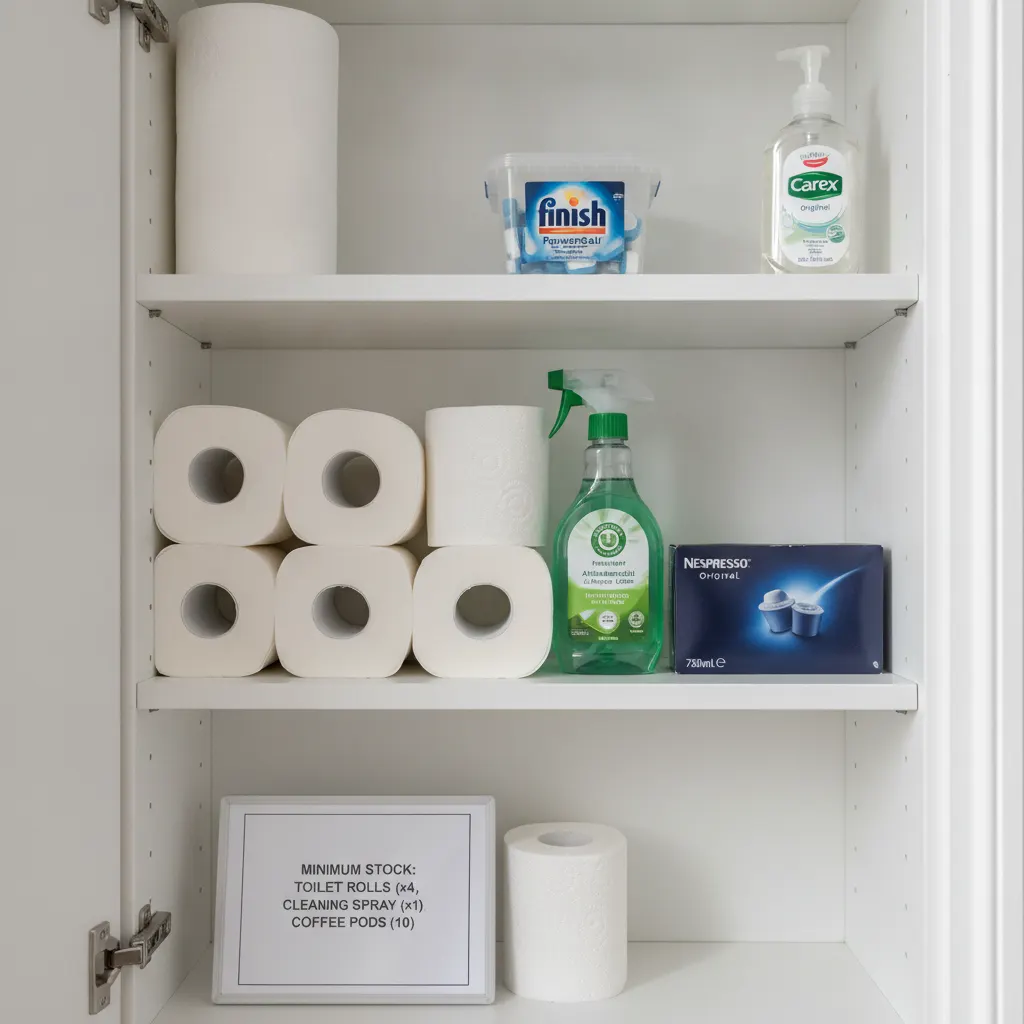
This is where I'll lose some of you. I don't use a fancy app. My cleaners send me a WhatsApp photo of the supply cupboard after every turnover — just a quick snapshot, takes about eight seconds — and I check it against a laminated card on the inside of the cupboard door that shows minimum stock levels. When a category drops below the card, they drop a message: 'toilet roll low.' I reorder within 24 hours.
It's not sophisticated. But it works across six sites with three different cleaning teams, and it cost me nothing to set up beyond printing six A5 laminated cards.
I've tried two property management systems that had built-in inventory modules. One made it more complicated than this. The other kept resetting my quantities. I went back to WhatsApp photos and laminated cards. Sometimes the unglamorous solution is actually the right one.
Condition-based triggers
This is the category that quantity tracking misses entirely. Some items need replacing not because you've run out, but because they've degraded to a point where guests notice.
My condition triggers:
- Bath mats: Replace when anti-slip backing shows any bubbling or peeling, or after 40 washes — whichever comes first. I track wash count with a small tally mark on the label with a laundry marker. Fiddly, but effective.
- Towels: Replace when any towel has a visible snag, a stain that's survived three washes, or a frayed edge longer than about 2cm. I do a towel inspection every two months — pull them all out, check them under good light.
- Pillows: The fold test. Fold the pillow in half. If it doesn't spring back, it's done. I replace on this trigger plus a 12–18 month calendar rule, whichever comes first.
- Mattress protectors: Replace when any waterproofing area shows cracking, when the elastic is gone around the corners, or after roughly 80 turnovers. The crinkle sound is also a signal — guests notice a noisy mattress protector.
- Cleaning cloths and sponges: These get replaced at the start of every turnover. Not every batch — every turnover. It sounds wasteful. It isn't, because a sponge that smells is the fastest route to a hygiene complaint.
The condition checks happen on a schedule: monthly for smaller items, quarterly for linen and towels. I put a recurring calendar reminder on my phone. Boring but effective — and it's maybe two hours a month across all six properties if I'm on top of it.
Event-based triggers
These are the context signals that pure quantity tracking misses. They're situations or calendar events that tell me to pre-stock, even if current levels look fine.
A run of consecutive short stays (1–2 nights). Each turnover burns through toiletries, coffee pods, and cleaning supplies faster than a longer stay. If I've got eight 2-night bookings in a row, I stock up before the run starts. The par level doesn't change, but I want two weeks of buffer instead of one.
A new cleaning team. New cleaners go through supplies differently. Some are meticulous. Some are heavier-handed with the antibacterial spray than I'd like. For the first month with a new cleaner, I run higher stock levels and monitor more closely. Once I know their patterns, I adjust.
Bank holidays and school holiday windows. Occupancy in my properties typically jumps 20–30% in the two weeks around any UK bank holiday window. I reorder about 10 days before these periods regardless of current stock levels.
A guest complaint about an amenity. If someone messages about running out of X, I reassess the par level for X immediately — not just top up and forget. The complaint is data. Usually it means my par level is wrong.
End of season stock rotation. I do a full property audit in late March and early October. At March, I rotate winter stock out (extra duvets, blankets, hot water bottles, Lemsip — yes, I leave Lemsip, guests love it). At October, I bring winter kit back in. At each rotation, I also clear anything that's been sitting in a cupboard for six months and looks tired.
The one trigger I wish I'd set up earlier
The supplier lead time trigger. This one I added after a painful week when I ran out of the specific 100ml shower gel I use across the Brighton properties — a Molton Brown dupe I'd found on Amazon Business at about 38p per 100ml — and the delivery estimate kept slipping. Seven days without stock in two properties.
Now, for any item where I'm locked into a specific product (because it matches my aesthetic, because I've printed labels, because it's a specific machine-compatible pod), I track delivery lead time and set my reorder trigger earlier to account for it. Items that ship next-day get the standard trigger. Items where the supplier takes five-plus days get an earlier trigger. Coffee pods from a specific bulk supplier I use — not Amazon — typically take four to six working days. My reorder trigger for those is 20% higher than my base par level.
What this actually saves
I haven't done a precise before-and-after calculation — I didn't track costs carefully enough in year one to make that comparison clean. But I know a few things. Emergency same-day or next-day Amazon orders for single items used to cost me roughly £140–£180 extra per quarter across all properties, purely because I was paying retail and Prime prices instead of bulk prices. That's mostly gone now. The mental load reduction is harder to quantify but real — I estimate I spend about two hours a month less on supply anxiety than I used to.
More importantly, I haven't had a guest complaint about a missing essential in eight months. Before the trigger system, I averaged two or three a quarter. That alone was worth building it.
What I'd do if I were starting this from scratch
Pick two properties. Set par levels for 10 key consumables per property using the formula above (2x average weekly usage + 1 week buffer). Get a WhatsApp photo from your cleaner after every turnover for 30 days. Adjust the par levels based on what you see. Add condition triggers for towels and bath mats in month two. Add event triggers in month three.
Don't try to build it all at once. The system I use now took four months to develop. Start with quantity triggers and build from there. Condition triggers feel pedantic until you get a three-star review mentioning a sponge that smelled.
And keep it as simple as you can. A laminated card on the inside of a cupboard door, a WhatsApp message, a 10-day pre-holiday buffer. You don't need software to do this. You need a system you'll actually follow.
HostStock builds the system this post describes into a single dashboard across all your properties — per-item consumption rates and seasonal multipliers, pre-stay shortage warnings tied to your booking calendar, and restock alerts the moment stock drops below your thresholds. No spreadsheet, no laminated card.