Portable air conditioning for UK Airbnbs: which unit I tested and whether guests mentioned it
Hoststock Team
8 July 2026
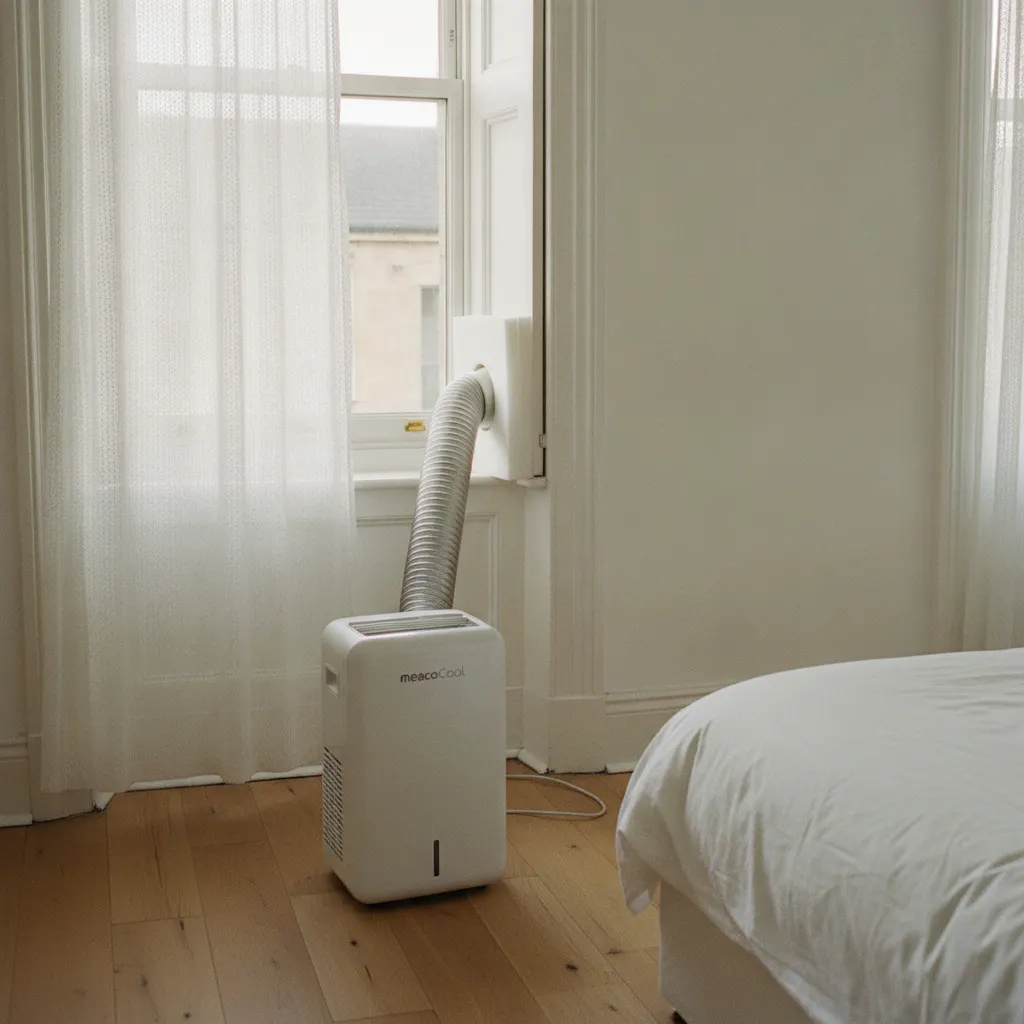
I held off on air conditioning for longer than I should have. My reasoning was: it's Edinburgh, it's fine. Then came the summer of 2024, which wasn't fine at all. Three 4-star reviews across my Edinburgh and Brighton properties, all mentioning heat. One guest in the Edinburgh flat left a note saying they'd slept with the window open all night and been kept awake by the street noise. Bit of a catch-22.
So I started looking at portable units. And quickly got lost in a sea of BTU ratings, ampere ratings, R290 refrigerant disclaimers, and Amazon listings that seemed to have been generated by someone who'd once seen a photograph of an air conditioner. Here's what I actually found out.
Why portable and not fixed
Fixed split-system air conditioning — the kind with a wall unit and an outdoor compressor — is genuinely better in every technical sense. Quieter, more efficient, doesn't need to vent through a window. But it costs £900-£2,000 installed, requires either landlord permission or ownership, and involves drilling through walls. For a leasehold Edinburgh flat, that's not happening without a solicitor, a buildings management committee meeting, and someone's uncle who works for a surveyor.
Portable units plug into a standard 13-amp socket, move between rooms on casters, and vent through a window using a flexible hose about the diameter of a large drainpipe. They're noisier than fixed units and less efficient. But they work. And they cost a fraction of the alternative.
The units I looked at
The market for portable AC in the UK splits pretty clearly into three tiers:
Budget, under £250. Lots of Chinese-manufactured units with brand names that read like a wifi password. Some work adequately. Most are loud. Reliability data is thin because the brands turn over faster than the warranty period.
Mid-range, roughly £350-£450. This is where the MeacoCool MC Series Pro sits. Also the De'Longhi Pinguino. These have proper UK support, longer warranties, and quieter operation. The 9,000 BTU version of the MeacoCool MC Series Pro is around £389-£400 from Meaco direct or major retailers. This is what I went with for the Edinburgh flat.
Larger units, £550 and up. 12,000 BTU and above. For a big open-plan space or a property in southern England that gets genuinely brutal heat. My Lake District cottage hasn't needed one yet. My Brighton flat might, eventually.
What I actually bought and why
MeacoCool MC Series Pro 9000 BTU. I bought it from Meaco's own website at £389. It arrived in two days, the instructions were in English written by someone who understood English, and the window venting kit covered a range of sash and casement window types without modification.
The Edinburgh flat bedroom is roughly 14 square metres. The unit took about 25 minutes to bring it from 28°C to a comfortable sleeping temperature when I tested it in the middle of July. That's slower than a fixed system but fast enough. At around 26p per kilowatt-hour (the current Ofgem unit rate cap through this quarter), a 9,000 BTU unit draws roughly 1 kWh, so it's costing about 26p an hour to run. A typical August night — four to five hours of cooling — is running about £1.05-£1.30 in electricity. Over a sixty-night summer season at four hours a day, that's approximately £53.
I've factored £60 into my summer electricity estimate per property that has one. It's not nothing but it's not significant relative to the rate improvement I've seen.
The installation reality
Two things I didn't anticipate. First, the window venting hose. It's about 15cm in diameter and extends to around 1.5 metres. You need a sash window that opens to at least 25cm or a casement that lets the hose exit cleanly. The Edinburgh flat has sash windows, which made it easy — the foam sealing panel that comes with the unit slots in below the raised lower sash. My Brighton flat has tilt-and-turn windows and needed a slightly different approach. I cut a piece of 6mm foamboard to fill the gap around the hose. Costs about £3, takes 20 minutes, looks fine.
Second: condensate drainage. Some portable AC units drip condensate into a removable tray that needs emptying. Others have continuous drainage via a tube you run out to a drain. The MeacoCool 9000 has auto-evaporation — it routes most of the condensate out through the exhaust hose. In very humid weather it does fill a small tray. I tell guests to empty it if they see it getting full, and I've added a note in the app guidebook. In two seasons I've had one condensate overflow, which was a small puddle on the windowsill. Not a disaster.
What guests have said
Three mentions in reviews so far. Two positive — one guest specifically called out 'great that there's actually an air conditioner, made the flat perfect for our August stay.' Another mentioned 'appreciated the cooling — Edinburgh in July was hot this year.' One less positive: a guest who found the unit 'quite loud when sleeping'. Which it is. It's not silent. I've since added a note in the listing saying the unit produces low-level white noise comparable to a dehumidifier, which manages that expectation.
My overall star rating on the Edinburgh flat went from 4.72 to 4.84 over the summer after I installed it. I can't isolate the AC as the only variable, but I've had zero heat-related complaints since.
Storage between seasons
This is more of a question than I expected. The unit weighs 29kg and takes up a corner of the cupboard. In winter it goes in the linen storage space and I tell guests it's available if they want it. Nobody has ever wanted it in October. I drain it fully, wipe out the filter, and store it vertically in the box.
I've not tested leaving it out year-round. Some hosts do. My concern is guests fiddling with a window-vented unit that's not set up to vent — if they run it without the exhaust hose properly installed it just pumps hot air into the room and achieves nothing except a confused guest and a hot flat.
Is it worth it for your property?
Honestly, it depends heavily on the property type, location, and guest profile. My Edinburgh flat is a top-floor tenement flat — heat gathers up there in a way the ground-floor Brighton flat doesn't. Edinburgh gets significantly hotter in August than it used to, and August is my highest-rate period.
For a property that regularly gets 28°C+ in summer, in a top-floor or heavily south-facing location, yes. The £389 for the unit is roughly the margin on two summer weekend stays. If I can convert two more heat-complaint 4-stars to 5-stars per year, it's paid for itself within a season.
For a ground-floor flat in a temperate northern location that gets three properly hot weeks in an average year? Probably more marginal. A £40 Dyson-style fan per bedroom and an explicit 'cool in summer' note in your listing might do the same job for less money.
But if you've had heat complaints, you know who you are. A portable AC unit won't fix every one of them, but it takes a specific type of 4-star review off the table. That's worth something.
Ready to streamline your inventory?
Start managing your rental inventory smarter with automated stock tracking.
Start Free Trial