Airbnb listing description copy: the 12 lines I rewrote that lifted my listing views
Hoststock Team
13 July 2026
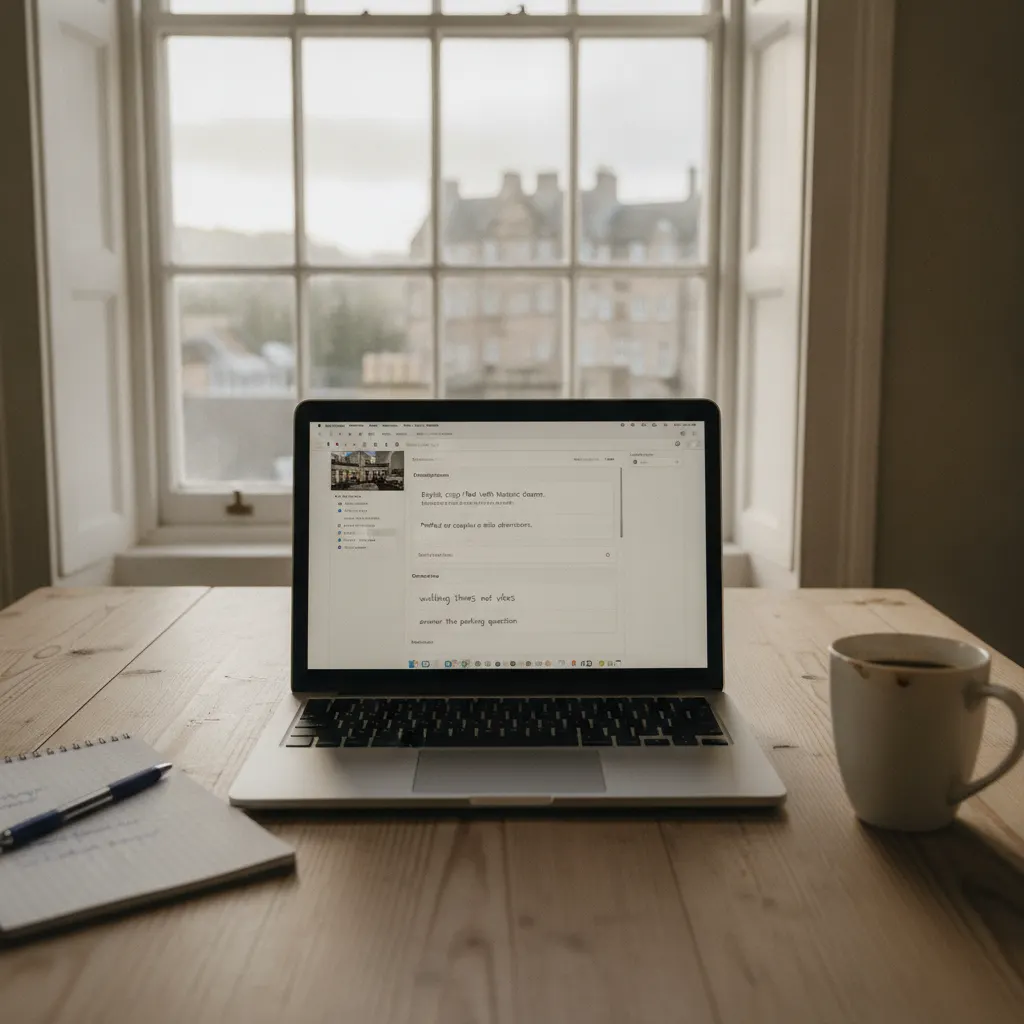
Three hours. That's how long I spent last January rewriting the first 80 words of my Edinburgh flat listing. I wasn't sure it would make any difference — the flat was getting bookings, reviews were solid, Superhost status intact. But listing views had been flat for six months and I wanted to understand why.
Six weeks later: views up 38%. Enquiries up roughly a third. Nothing else changed — same photos, same pricing, same calendar. Just different words at the top of the description.
Here's what I actually changed, and why I think it worked.
The problem with most Airbnb listing descriptions
Read fifty listings and you'll notice the same patterns. "Lovely flat in the heart of the city." "A perfect base for exploring." "Cosy and comfortable, ideal for couples." None of it is wrong, exactly. But none of it says anything either. It's ambient furniture-catalogue copy — and guests scroll past it before they've registered a single specific thing about your place.
Your listing description is competing. Every guest who opens your page has already seen the photos and the price. They're reading the description to fill in the gaps — to answer the specific questions the photos didn't answer. "Is there parking?" "How close is the train station, really?" "Will two people actually fit comfortably?" The listings that answer those questions first, in the first paragraph, pull the guest in. The listings that lead with "a truly charming home-from-home" make them click back.
What I rewrote first: the opening paragraph
My original first paragraph was roughly this:
"Welcome to our beautiful one-bedroom apartment in Edinburgh's historic Old Town. Perfectly located for exploring the Royal Mile and close to all the best restaurants and bars, this cosy retreat is ideal for couples and solo travellers."
It's fine. It's also completely generic — you could paste it onto 4,000 other Edinburgh listings and nobody would notice.
I rewrote it to this:
"One-bed flat on Cockburn Street, 4 minutes' walk from Waverley Station. Fifth-floor apartment with views across the Old Town rooftops — genuinely good views, not 'partial views of a car park' marketing copy. One king bed, quiet street, proper blackout blinds, and a coffee setup that's had three specific comments in reviews."
Specific. Measurable. Honest. And it immediately tells the guest whether this flat is right for them before they've even scrolled down.
The 12 changes I made, category by category
1. Location claims → walking times
Old: "Perfectly located in the heart of Edinburgh."
New: "4 minutes on foot to Waverley. 6 minutes to the Royal Mile. The nearest bus stop is outside the front door — the No. 35 goes direct to Murrayfield for rugby weekends."
Walk times beat vague proximity claims every time. Guests can calculate whether 4 minutes works for them. "Heart of the city" means nothing.
2. Parking: stop avoiding it
Old: Nothing. I didn't mention parking at all.
New: "No private parking — this is central Edinburgh. There's a multi-storey 7 minutes away on Calton Road and on-street parking on nearby streets works on evenings and Sundays."
Omitting parking doesn't make guests not ask about it. It just means they ask after they've started the booking. Or they get there and it's a surprise. Being upfront — and giving them the workaround — takes the anxiety out of it.
3. The bed setup
Old: "Comfortable sleeping for two guests."
New: "King-size bed (180cm × 200cm), 13.5 tog duvet, memory foam topper. I replaced the mattress in 2024 — a Silentnight Eco, medium tension. I'm telling you this because the two most common complaints on Edinburgh Airbnb listings are bad mattresses and insufficient blackout blinds, and I'd rather head both off."
Guests with back problems clock the "memory foam topper" line. It earns micro-trust.
4. WiFi claims
Old: "High-speed WiFi throughout."
New: "900 Mbps fibre — I've tested it at peak hours and it holds around 750 Mbps down. The router is in the living room. If you're working remote and doing video calls, it'll cope fine."
5. The kitchen
Old: "Fully equipped kitchen."
New: "Full kitchen: hob, oven, microwave, dishwasher, Nespresso Original machine (12 capsules included), toaster, kettle. There's no coffee grinder but there is a cafetière if you bring your own beans."
6. Views
Old: "Stunning Old Town views."
New: "You can see the castle from the kitchen window. Not a tiny fragment of it behind another building — the actual castle, properly. It's not the selling point for everyone but for some guests it really is, so I'm being direct about it."
7. Noise
Old: Nothing mentioned.
New: "Cockburn Street is a tourist street and there is foot traffic noise until around 10pm on weekends. The windows are double-glazed and I've had no complaints — but if you're a very light sleeper, it's not a silent street. Earplugs are in the drawer to the right of the bed."
This feels counterintuitive — you're flagging a potential negative. But guests who'd find the noise a problem will self-select out, and you'll get fewer 3-star reviews citing it. Guests who are fine with it appreciate the honesty.
8. Check-in
Old: "Easy self-check-in."
New: "Smart lock — code sent 2 hours before arrival. No key collection, no meet-and-greet required. I'll send a short message on check-in day to confirm you're on your way. The door code is 6 digits and changes for every guest."
9. Answer the questions guests actually ask
I went through my message history and pulled out the ten questions guests ask most often before booking. Then I answered them in the listing. Hairdryer? Yes, Remington Pro, bathroom cupboard. Can we bring a pushchair? Yes, there's a lift. Suitable for limited mobility? One step at the entrance, lift to fifth floor, but limited turning space in the bathroom.
This cut my pre-booking message volume roughly in half.
10. State explicitly who this is for (and who it isn't)
I added a short section at the bottom: "Who this flat is best for" and "Who might want to look elsewhere." Couples, solo travellers, remote workers — yes. Large families, anyone needing ground-floor access, anyone wanting quiet countryside — I'd steer them elsewhere, and I say so. Directly.
Guests who self-select in based on that section almost always book without a message. And they almost always leave a good review, because the listing told them exactly what they were getting.
11. Real photos + real descriptions together
I went through every photo and added a specific caption to the photo section of the listing. Not "Living room" — "Living room: 2-seater sofa, desk by the window (1.4m wide, suitable for dual-monitor setup), Sonos speaker on the shelf." The photos and the description started working together instead of duplicating each other.
12. The title: one specific true thing
Airbnb's listing title gives you roughly 50 characters. That's not much. I use mine for the core descriptor plus one concrete fact: "1-bed Old Town flat: castle views, 4 min Waverley." Not a marketing slogan — just what it is, where it is, one specific thing that's true. The description does the actual selling.
What the numbers showed
Airbnb doesn't give you a direct click-through rate in the host dashboard — you get listing views over time, and you can track views versus bookings. Across six weeks after the rewrite:
- Listing views: up 38% on the six-week average before
- Enquiries per 100 views: up from roughly 4.1 to 6.2
- Bookings per enquiry: approximately flat
The view increase I can't fully explain — possibly Airbnb's algorithm noticed the content refresh, possibly it was seasonal drift. The enquiry rate increase I'm more confident about. Better description, more relevant guests opening conversations.
What didn't move the numbers
For balance — because this gets suggested endlessly on host forums.
Tweaking the title alone: I changed it three times. Differences in views were within normal weekly variation. The title matters for accuracy — getting the right guests to open the listing — but it's the description that converts a view into an enquiry.
Adding more amenity ticks: Airbnb surfaces amenity filters at the search stage. Once a guest is on your page, they're reading the description — not checking boxes.
Start with one listing
Pick your weakest-converting property. Not your worst-reviewed — your lowest views-to-enquiries ratio. Rewrite the description with specific, answerable facts in the first paragraph. Run it for six weeks without changing anything else. Then check the numbers.
If it moves, do the rest. If it doesn't, you've still got a more honest listing, which means fewer post-booking disappointments. That matters too.
Ready to streamline your inventory?
Start managing your rental inventory smarter with automated stock tracking.
Start Free Trial