Cleaning costs on your UK Airbnb tax return: what's deductible and what my accountant flagged
Hoststock Team
12 July 2026
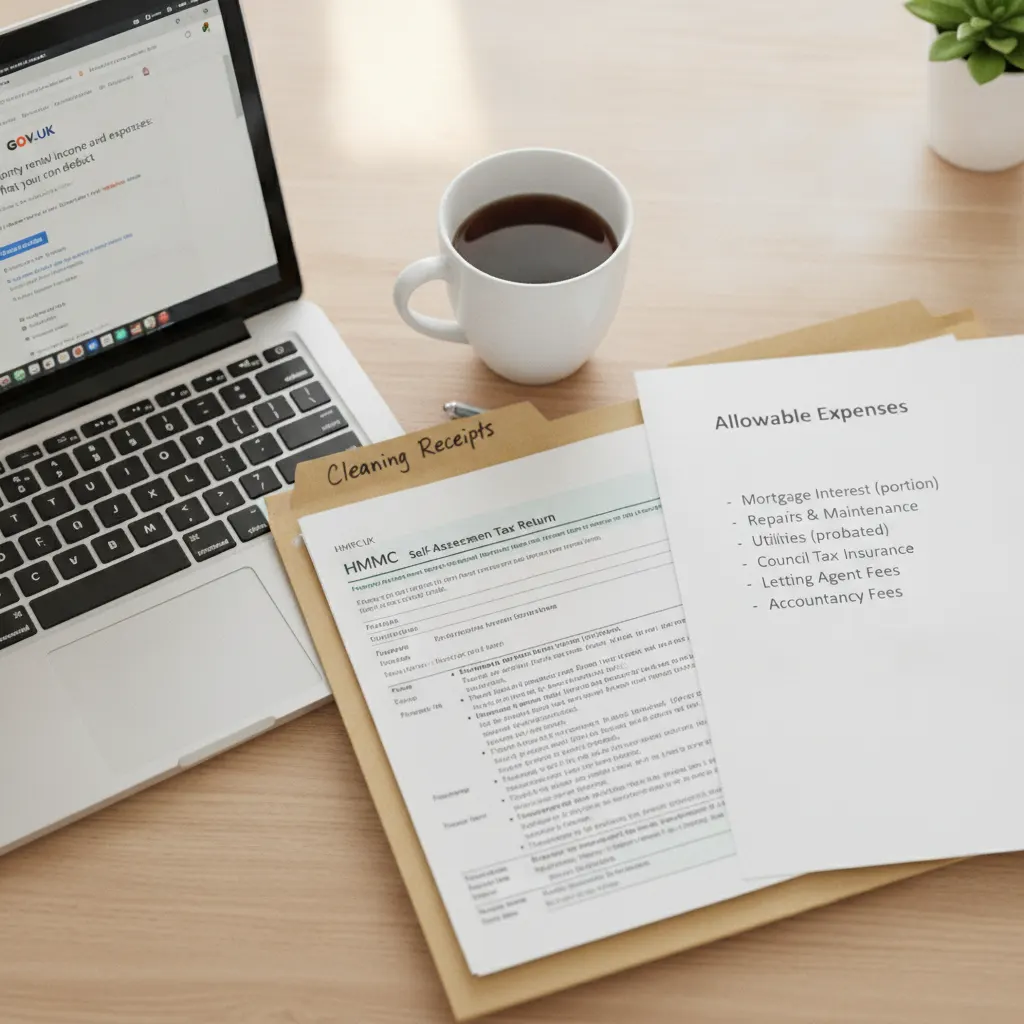
I spent April 2025 on the phone with my accountant more than I had in any single month since I started hosting. The FHL regime going was the first major change to my tax setup in four years, and I had to understand what it meant for how I was claiming expenses — including the four different cleaning-related costs that go through my accounts every month.
Most of what I've read about this online either predates April 2025 or focuses almost entirely on the headline changes (mortgage interest, capital allowances, pension contributions). Almost nothing discusses the basics: can I still claim my cleaner? What about cleaning products? What about the laundry service I use for the Edinburgh properties?
Here's what I found out, with actual source material.
The simple answer first
Yes. Cleaning costs are deductible against UK property rental income, including Airbnb income. GOV.UK guidance on rental income expenses explicitly lists 'costs of services, including the wages of gardeners and cleaners' as an allowable deduction.
This hasn't changed with the FHL abolition. The FHL regime gave certain hosts access to capital allowances and other benefits that ordinary landlords don't get. But the basic allowable expense rules — which include cleaning — always applied to both FHL and non-FHL property income. They still do.
What changed was the additional stuff you could claim as an FHL host: capital allowances on furniture and equipment (which let you claim the full cost of a washing machine in year one rather than amortising it); the ability to offset property losses against other income; pension contribution treatment based on FHL profits. Those went. The everyday running costs didn't.
What counts as 'cleaning costs'
My cleaner: yes. I pay a self-employed cleaner for each turnover across three of my properties. That's a direct service cost, paid wholly for the purpose of operating the rental — straightforwardly deductible.
My cleaning products: yes, with a caveat. If I buy cleaning products solely for the rental property (bleach, multi-surface spray, dishwasher tablets, laundry capsules, loo roll I stock for guests), these are revenue expenses 'wholly and exclusively' for the rental. The key rule is that phrase: 'wholly and exclusively for the purposes of renting out the property.' If the bleach goes under the sink at the rental property and is only ever used there, it qualifies.
If you're doing anything weird — running products through for your own home cleaning, buying in bulk and splitting between personal and rental use — that's where the proportional allocation headache starts. My accountant said: if you can't demonstrate it was exclusively for the rental, keep a receipt and be ready to justify the allocation.
Laundry service: yes. I use a hotel laundry contractor for the Edinburgh properties for linen. The invoices go directly against the rental income as a service cost. Clear paper trail, no question.
A new washing machine: different answer. Washing machine I bought to replace the one in the Edinburgh flat — that's not a cleaning cost, it's a capital item. Under the old FHL regime I could have claimed 100% in year one via capital allowances. Now, I can use replacement domestic items relief — which lets me claim the cost of replacing like-for-like household items for furnished lets, including white goods. So I can deduct the cost of the new machine up to the original cost of the one I replaced, in the year I bought it. The improvement element (if the new machine is significantly better spec than the old one) isn't claimable.
The documentation problem
Here's where my accountant got specific and where most hosts I've spoken to are underprepared.
Cash payments to cleaners: my accountant was not happy when I told her I'd been paying one of my cleaners in cash and hadn't been keeping records. Not because it's inherently wrong — plenty of legitimate cleaning arrangements are cash-based — but because HMRC expects you to be able to justify the expense. 'I paid a cleaner £800 in cash and don't have a receipt or name' is a deductible claim that HMRC can and will challenge. She asked me to, at minimum, get a written receipt from the cleaner for each payment, even a simple handwritten one with a date and amount.
Better: have a written agreement with your cleaner, even an informal one. Date, agreed rate per turnover, any materials included. Then pay by bank transfer if possible, or get a receipt for cash. The evidence doesn't need to be elaborate. It needs to exist.
Cleaning supplies bought on Amazon: I order consumables through Amazon Business for three of my properties. The order history creates an automatic paper trail. My accountant said this is genuinely useful — the order history shows what was bought, when, and delivered to which property address. She said the main risk is if the delivery address is your home rather than the property. Deliver to the property, or if that's impractical (I sometimes take a batch to Edinburgh in the car), keep a note of what was for which property.
Mixed household and rental purchases: if you do a Costco run that includes both personal and rental supplies, log what was for what at the time, not three months later when you're trying to work it out from memory for your tax return. I have a simple notes file on my phone where I record this kind of thing on the day.
The replacement domestic items relief (RDR)
This replaced capital allowances for furnished residential lets after the FHL regime ended, and it's the mechanism most hosts will use for replacing white goods and furniture. The rules:
- The let must be furnished (you must provide items like bedding, crockery, furniture)
- You're replacing an existing item, not buying for the first time
- The deduction is limited to the cost of a like-for-like replacement — if you upgrade to a more expensive model, only the cost of the equivalent basic replacement is deductible
- You must stop using the old item in the property (you can't keep the old washing machine and also claim for the new one)
This is less generous than capital allowances for brand-new properties, because RDR only applies to replacements, not first-time purchases. But for an established STR with existing furnishings, it works reasonably well for the ongoing replacement cycle.
What I changed after the FHL abolition
Three things. First: I started tracking cleaning costs more carefully. Under the FHL regime I had a lot of other tax things to think about. Now cleaning is one of my larger remaining deductible expense categories, so it's worth tracking properly.
Second: I moved my cleaner from cash to bank transfer. She was fine about it. The paper trail is cleaner — no pun intended — and I feel better about it at year end.
Third: I've started filing my capital items separately from my revenue items as I buy them, not doing a sweep at year end. Under FHL it mostly didn't matter because everything went through capital allowances anyway. Under the current regime, the line between a revenue repair and a capital improvement matters much more, and I need to know which category things fall into as I buy them. My accountant charges by the hour and the less sorting she has to do, the better.
The tax position for Airbnb hosts post-FHL is less generous than it was. But cleaning costs — the actual day-to-day cost of making the property ready for guests — were never an FHL-specific benefit. They're basic property income expenses. They're deductible. Just keep the receipts.
Ready to streamline your inventory?
Start managing your rental inventory smarter with automated stock tracking.
Start Free Trial