Airbnb property manager contracts UK: the clause I didn't read that cost me £1,200
Hoststock Team
9 July 2026
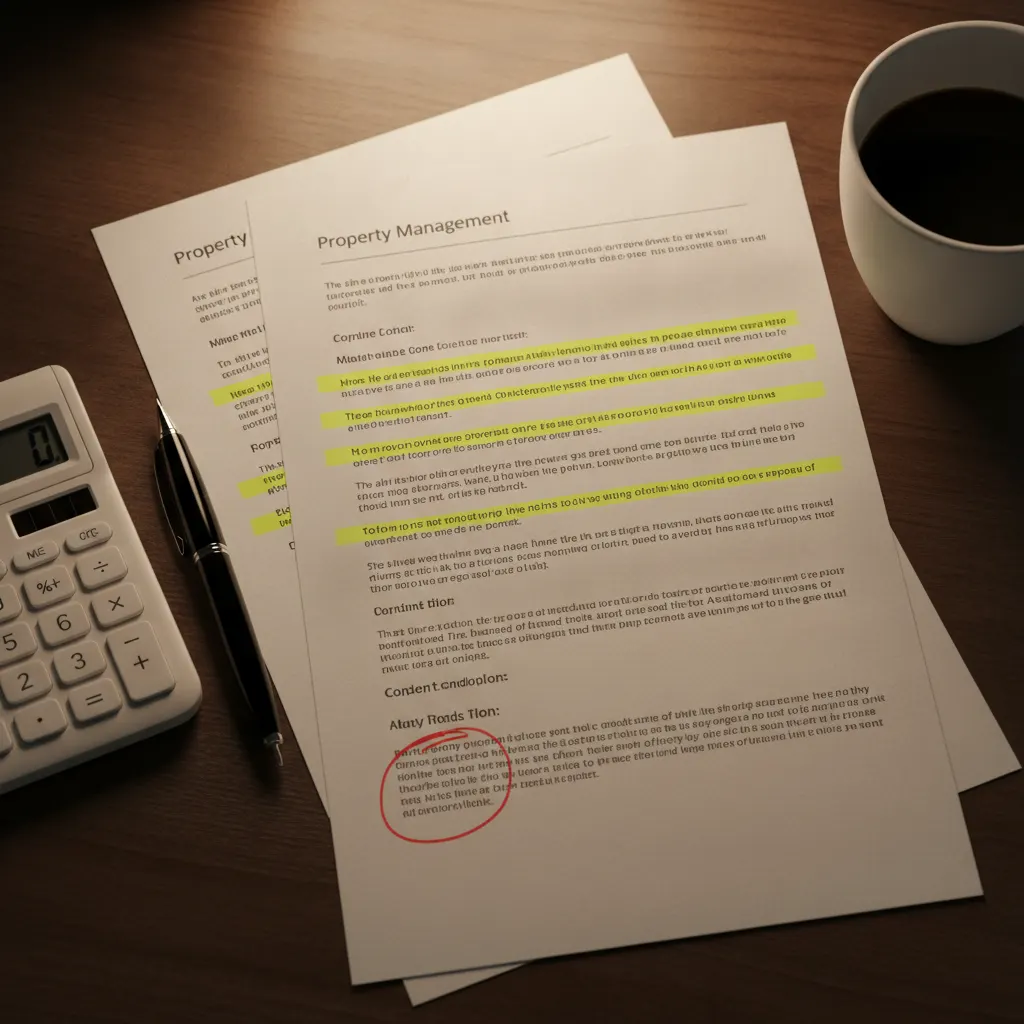
About two years ago I handed the Edinburgh Old Town flat to a letting agency. I had five properties at that point and the Edinburgh one was the hardest to manage remotely — it's a fourth-floor tenement, tricky access, guests who struggle with the sash window latch, and a cleaning agency that had cycled through three different staff in three months. I wanted someone local to handle it.
I signed the contract after reading it for approximately twelve minutes. Which was a mistake I'm sharing here so you don't make the same one.
What I signed, and what it meant six months later
The contract looked standard. Management fee of 18% of gross booking revenue (this is typical for short-term let agencies in Edinburgh; I've since learned that range runs from about 15% to 25% depending on the agency and what's included). Set-up fee of £250. Monthly reporting. They handled guest communication, turnover coordination, emergency call-outs.
Clause 11, which I did not read carefully enough: a 'continuance fee' covering any guest who had booked during the management period and returned within 24 months to rebook, whether directly or through any other platform. If I moved the property back to my own management and a former guest of theirs rebooked through my direct booking site, I owed 18% of that booking to the agency.
It sounds outrageous. It's actually fairly common in sales agency contracts (estate agents use similar clauses) and I'd just never seen one in a short-term let context before. When I left after six months, they invoiced me for three direct bookings I'd received in the following months from guests they'd hosted. The total was £1,200.
I paid it. The clause was clear and I'd signed it. But I was furious with myself.
The clauses that actually matter
I've since read four more property manager contracts for STR properties — two from friends who asked me to look over them, one I got from a different agency for comparison, and one I'm using now for a Lisbon property via a local manager. Here's what I check now.
Continuance or post-termination fees. The clause above. Look for any language around 'introductions', 'guests sourced during the management period', or 'continuance of services.' If the contract says the management fee applies to future bookings from guests introduced during the management period, you need to know: for how long, and what's excluded. A six-month continuance clause is less bad than a 24-month one. Negotiate it down or ask for an explicit carve-out for guests you can demonstrate came through your own channels.
Termination notice period. Mine was 60 days. The agency's. Which meant that when I decided to leave in month six, I had to either pay 60 days of management fees without any management service (they were no longer doing anything by that point), or go through a formal handover process over two months which they managed as slowly as possible. Aim for 30 days, maybe 45. 60 is standard in this sector; it doesn't mean it's fair.
Guest data ownership. Who owns the guest list? The guest email addresses, phone numbers, booking history? This is blurry in most STR management contracts and worth asking directly. Some agencies treat guest contact information as their proprietary data. If you want to run a direct booking channel after leaving, you need your guest history. Some agencies will share it, some won't, and the contract often doesn't specify. Get something in writing.
Maintenance spending authority. Most contracts give the manager authority to spend up to a certain amount on maintenance without prior approval. Reasonable. But check the limit. I've seen contracts where the manager could authorise up to £500 per incident without approval. For a £150/night property, that's a meaningful amount. I'd want the threshold closer to £200-250, with proper invoices for everything above £50.
Float and cash handling. Agencies often hold a float for the property — say £200-300 for minor supplies and consumables. Check: when is it refunded on termination? How is it accounted for? I had a £150 float that took three requests and five weeks to get back after I left.
Pricing authority. Does the manager set nightly rates, or do you? Some agencies run their own dynamic pricing and you see the results only in the monthly report. That's fine if you trust them. But you should understand what pricing tool they're using (PriceLabs is common in this sector, also Wheelhouse) and whether you can see the rate calendar and override it if needed.
What a fair contract looks like
In my experience, the better agencies write cleaner contracts because they don't need the punitive clauses to retain clients — the service does that. The agency I use now for one of my Brighton properties has:
- No post-termination continuance fee
- 30-day termination notice on either side
- Explicit language that guest contact data is owned by the property owner
- Maintenance authority capped at £150 per incident, with invoices required for all spend
- Monthly reporting with the full booking breakdown, not a summary total
Management fee is 20%. Higher than the 18% I was paying in Edinburgh. Worth every pound of the difference.
The questions I now ask before signing
I ask these verbally, get written confirmation of the answers, and cross-reference against the contract before I sign.
What happens to guests who booked through you if I terminate and they rebook direct? Is there any fee owed?
What is the termination notice period, and does it go both ways?
Who retains access to guest contact information after the contract ends?
What is your maintenance spend authority without my prior approval?
How is pricing set? Can I see the rate calendar and request changes?
What reporting do I receive and in what format?
A good agency answers all of these without hesitation. An agency that deflects, says 'it's all in the contract,' or takes three days to come back with answers to straightforward questions is showing you something about what it will be like to work with them.
Is using a property manager worth it?
For the right property and the right manager, yes. Emphatically. The Edinburgh flat was a mess to manage remotely and I was spending mental energy on it out of proportion to its revenue. The six months with the agency — despite the contract problem — meant I wasn't fielding midnight calls about window latches from guests who'd had three glasses of wine.
The number I use to evaluate a management arrangement now is: what is the actual hourly rate I'm paying for the time saved? A 20% management fee on a property generating £2,000/month is £400/month. If the manager saves me 15 hours of hosting work across the month, that's £27/hour for my time. That's a bargain. If the property barely generates £800/month and the manager saves me three hours, I'm paying £160/month (20%) for £27/hour of time saving — which is closer to £54/hour — and maybe that's too much.
The key is to run the numbers, read the contract properly, and know what you're actually buying. The continuance clause I missed is the kind of thing that only stings you once. The second contract you read, you'll know where to look.
Ready to streamline your inventory?
Start managing your rental inventory smarter with automated stock tracking.
Start Free Trial