Setting up a new Airbnb in 2026: the opening stock list, what I over-bought, and what I'd actually spend
Hoststock Team
22 October 2026
Setting up a new Airbnb in 2026: the opening stock list, what I over-bought, and what I'd actually spend
My first Airbnb setup was a financial disaster in slow motion. I bought everything I thought a guest could possibly need, stocked it to hotel standards on day one, and then discovered that about 40% of what I'd bought either didn't get used, deteriorated before guests touched it, or wasn't the right thing for the property type.
Three properties later — the Edinburgh New Town flat last summer, my Glasgow setup in spring — I've got this down to a reasonably efficient process. Opening stock doesn't need to be perfect. It needs to get you through the first month of bookings without a guest messaging you about missing essentials. Everything beyond that, you learn from the first few stays.
What I spent first time vs what I'd spend now
First property (Brighton, 2022): around £740 in opening supplies, before furniture. I bought premium everything — Molton Brown toiletries, twelve sets of towels for a two-bed flat, branded welcome hampers from a Waitrose supplier. A full medicine cabinet stocked like a minor pharmacy. Extra cushions. A scented reed diffuser collection that cost £85 and that I eventually stopped using because the fragrance was too strong for some guests.
Fourth property (Glasgow, 2026): £385 in opening supplies. Everything I actually needed, not much I didn't. That's the number I'd aim for now on a one-bed or two-bed property in 2026. For a larger property or a luxury-tier listing, scale accordingly — but the proportions stay similar.
The actual list
I'll break this down by room. These are the quantities I use for a one-bed flat as the base. Two-bed, multiply towels and bed linen by 1.5-2, add an extra bathroom set, adjust toilet roll accordingly.
Bedrooms
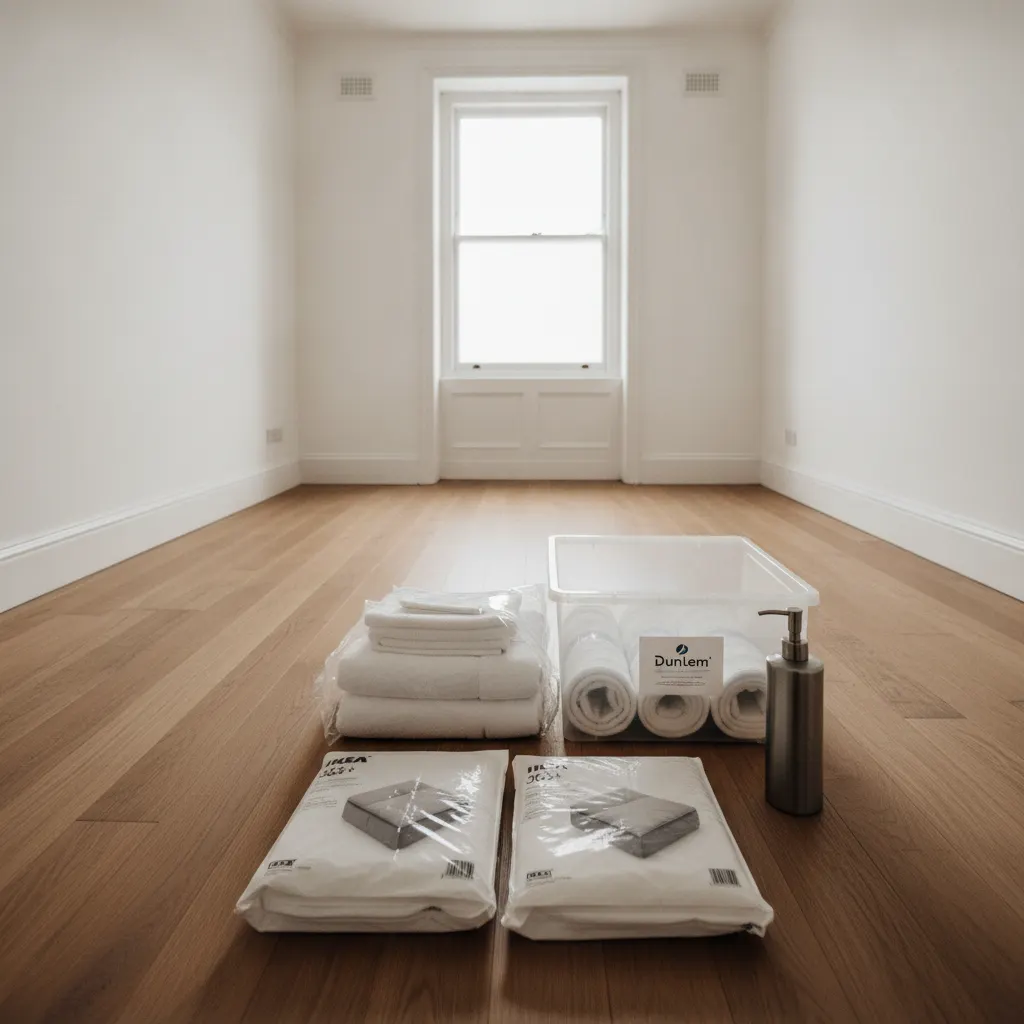
Duvet covers (2 per bed). I use percale cotton from IKEA's 365+ range — currently around £16 per double cover. Fitted sheets (3 per bed — one on, one spare, one in wash when needed). Pillowcases (4 per pillow — same logic). All white or near-white. Wash at 60°C without problems.
Pillow protectors (2 per pillow). Often overlooked in opening stock lists. Don't skip these. A pillow without a protector gets stained quickly. The Dunelm waterproof ones are around £4-6 each.
Mattress protector (1 per bed). Go waterproof. Not because guests are incontinent — because accidents happen and an unstained mattress is worth £60-80 of mattress protector cost across three years easily.
Extra blanket (1 per bed, folded at foot as mentioned above).
Hangers (12 per bedroom — a mix of wooden and velvet). Budget £12-18 per bedroom.
Bathrooms
Bath towels (4 per bathroom). Hand towels (2 per bathroom). Face cloths (4 per bathroom). I buy the 500 GSM cotton towels from Richard Haworth's hospitality range, around £8-12 per bath towel. Not the cheapest but they last — I've got towels from my first Richard Haworth order that are still in rotation.
Bath mat (1 per bathroom, plus 1 spare). The spare matters. Bath mats need to be washed frequently and you need one ready while the other's in the wash.
Toiletry dispensers (2 per shower — shampoo/conditioner combo and body wash). I use Simplehuman or IKEA KNAGGLIG-compatible pump dispensers rather than individual bottles. Fill from bulk at each restock.
Initial bulk toiletry stock: 1L body wash (Method or Baylis & Harding from Costco), 500ml shampoo, 500ml conditioner. This fills the dispensers about four to six times.
Toilet roll: 8 rolls per bathroom to start. More in the cupboard. I stock 24 rolls in the flat's supply cupboard at opening — enough for three typical bookings before first restock.
Toilet brush, cleaning spray, limescale remover (HG Limescale Remover or similar), bathroom bin with small liners.
Kitchen
Dishwasher tablets (box of 30 — Finish Powerball Max or own-brand equivalent). Kitchen roll (2 rolls). Bin bags (30 litre — one pack of 20). Washing-up liquid (1 large bottle). Sponges (4 — keep them in the supply cupboard, not on the sink). Washing machine capsules or liquid (enough for 8-10 washes). Foil (one roll). Cling film (one roll).
Olive oil (a small bottle). Salt and pepper grinders. A few sachets of common condiments (ketchup, brown sauce, soy). Not a full condiment station — just the things people reach for when they're unpacking shopping at 10pm and realise they've forgotten something.
Filter coffee or a basic coffee setup — pods, filter bags, or instant, depending on what machine you've fitted.
Cleaning and utility
Kitchen spray (Flash or Method equivalent). Bathroom spray (Harpic Power Plus). Glass cleaner (one bottle). Mop and mop heads (keep two spare heads). Vacuum cleaner bags if applicable. Rubber gloves (two pairs). An old towel for cleaning use — not for guests, kept in the cleaning supplies area for the cleaner.
First aid and safety
Smoke alarm (already required by law, but make sure it's fresh and tested). CO detector if you have any gas appliances. Small first aid kit — plasters in multiple sizes, an antiseptic wipe or two. That's it. I wrote about the bathroom cabinet question in detail elsewhere; the short version is keep it simple and check with your insurer.
What I over-buy and later pull back
Candles. I put four scented candles in my first setup. Guests used two, left one burned halfway down and one untouched. One guest mentioned the smell gave her a headache. I now leave one unscented tea light holder with tea lights. Cheaper, less divisive.
Tea selection. I bought twelve varieties of loose leaf and bagged tea for my first property. Six varieties still had full boxes after three months. Now I buy: English Breakfast, Earl Grey, peppermint, and one fruit option (usually Twinings Summer Fruits). Four. Done.
Premium toiletries in individual bottles. Molton Brown and Aesop are wonderful. Guests do notice them. But I've tracked this carefully and the review score difference between premium individual bottles and good bulk-dispensed toiletries is genuinely minimal — I ran a comparison across two similar properties for six months, and the high-spend property outperformed by 0.07 on the location category. Not worth the cost per stay.
Spare sets of everything. I bought duplicate kitchen equipment on my first setup — two of each pan, two sets of crockery, etc. — thinking I'd need them when things broke. What I actually needed was to track what broke, then replace it. The duplicate stock just took up cupboard space for two years.
The honest total for a one-bed flat in 2026
Bed linen (duvet covers, fitted sheets, pillowcases, protectors): £80-110. Towels (8 bath, 4 hand, 8 face cloths, 2 bath mats): £120-160 depending on quality tier. Kitchen consumables opening stock: £45-60. Bathroom consumables opening stock: £35-50. Cleaning products initial set: £25-35. Miscellaneous (hangers, hooks, bin liners, extra bits): £30-40.
Total: around £335-455. Call it £380-400 as a working figure for a competently stocked one-bed in 2026. Not a bargain basement setup — the Richard Haworth towels alone push the cost up — but everything in it is purposeful and will last.
The thing nobody tells you about opening stock
You won't get it right first time. You'll under-stock something (my Edinburgh flat ran out of bathroom bin liners in week two — I'd simply not thought to include them) and you'll over-stock something else (I have forty unused branded coasters from my first property still in a box in my garage). The goal isn't a perfect opening stock list. It's one that doesn't generate negative guest messages in the first month, gives you a solid baseline, and teaches you what this specific property actually needs.
After the first two or three bookings, you'll know what guests are using and what they're not touching. Adjust accordingly. A standard list is a starting point. Your property's usage pattern is the real data.
Ready to streamline your inventory?
Start managing your rental inventory smarter with automated stock tracking.
Start Free Trial