Kitchen kit for a new Airbnb: what I bought, what broke in year one, and what I'd do differently
Hoststock Team
7 June 2026
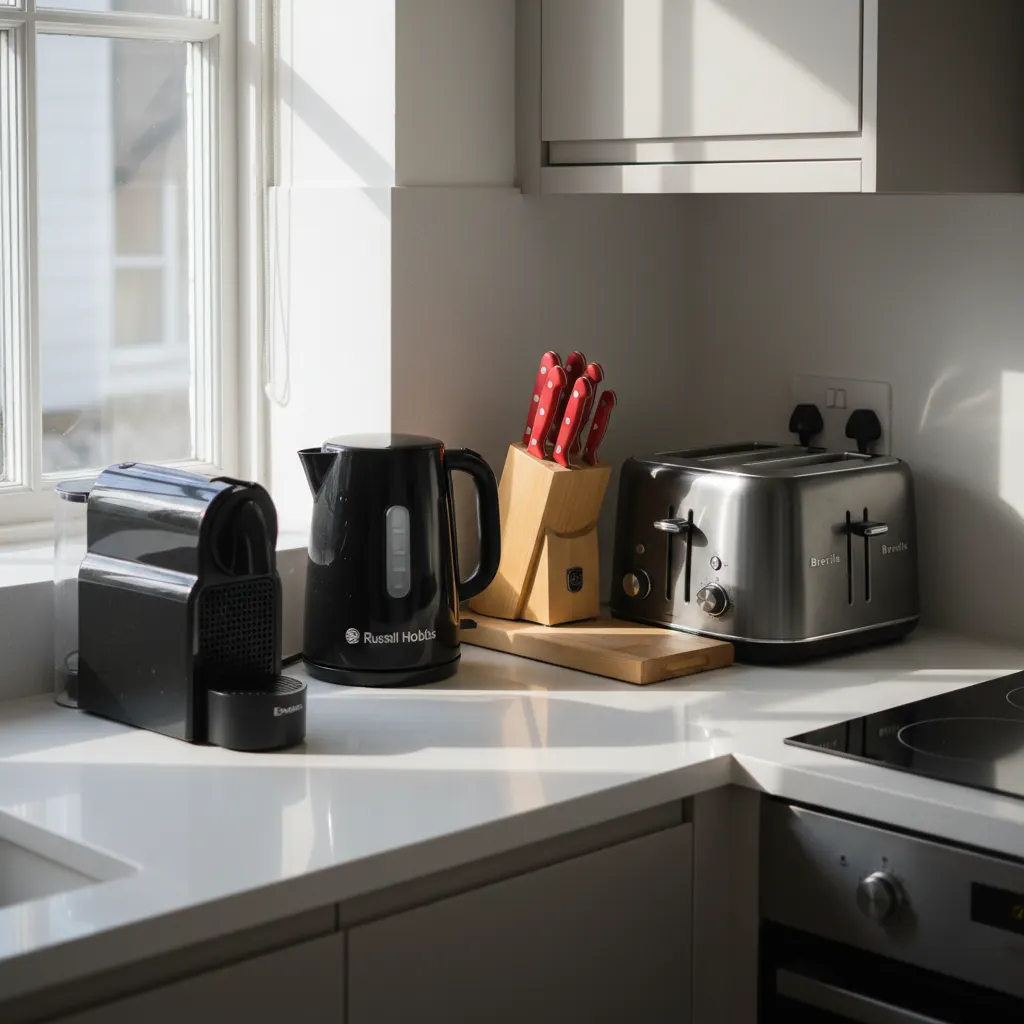
The first Airbnb kitchen I stocked was in 2021 — a two-bed flat in Brighton that I'd just finished refurbishing. I went to John Lewis, spent about £600, and bought what I thought a well-equipped holiday let should have. Six months later I'd replaced the kettle, two frying pans, three mugs, a colander, and whatever sad little thing was serving as a cheese grater.
The fifth kitchen I stocked last year, I spent £340, replaced nothing in twelve months, and the guest reviews specifically mention the kitchen being well-stocked and well-equipped. The gap between those two outcomes is what this post is about.
The core problem with how most people stock STR kitchens
We equip them like we'd equip our own homes. Which means we choose things based on aesthetics, what we like to cook, what we'd reach for in the morning. Guests are not us. They're making breakfast in an unfamiliar kitchen, often running late, often with friends or children present, often slightly hungover, and they are absolutely not being careful with your kit.
The equipment that survives short-term rental use is not the equipment that looks nicest in a product photo. It's the equipment that's heavy enough not to get chucked around, simple enough not to get broken through confusion, and cheap enough that replacing it when it does break doesn't require a decision.
What breaks fastest
Kettles. The most replaced item in my five kitchens over four years. The failure mode is almost always the same: guests fill them to maximum, with hard water if you're in Brighton or anywhere on chalk, and leave limescale to build up over 30-40 stays without descaling. A £25 Russell Hobbs from Amazon lasts about 8 months in my experience before the filter clogs and the element starts struggling. I've tried more expensive kettles — didn't make enough difference to the lifespan to justify the cost. Now I just budget one kettle per property per year.
Non-stick frying pans. Guests use metal utensils on non-stick. Every time. I have never managed to get a frying pan through more than 12 months in an STR setting with the coating intact. The solution I've landed on: cast iron or stainless steel where possible, or budget non-stick replaced annually. The budget version is actually fine — a £15 pan from Ikea or Asda cooks perfectly well for 8-10 months. When it starts looking rough, out it goes.
Mugs and glasses. Mugs get chipped, glasses get broken. Not out of carelessness particularly, just out of use. I started buying them in sets of 8 rather than 4. The spares live in a labelled box in the kitchen cupboard, and when my cleaner notices chips she swaps them out without messaging me. I check and replenish once a quarter.
Tin openers. Disappear or break with startling regularity. I don't know why. Buy a cheap one, keep a spare in the drawer.
Colanders and sieves. Generally fine until someone uses them with boiling water and then leaves them on the hob ring by mistake. A melted colander hole is a particular type of discovery. Now I buy metal sieves only, no plastic.
What doesn't break
Cast iron casserole dish — I have a Lodge one in the cottage kitchen that's been there since 2022 and looks better than it did when I bought it. Basically indestructible. Guests either don't use it or use it correctly because it looks serious.
Ikea 365+ stainless steel pots — I've had the same two saucepans in my Edinburgh flat since 2022. The handles have got a bit more food-sticky than I'd like, but they're structurally fine. A good boiling and scrub every few months keeps them in service. Stainless in general is the right call for high-turnover pots.
A mid-range toaster — mine is a 4-slice Breville. Two years, no issues. Toasters are lower-abuse items than I expected. Clean the crumb trays, they're fine.
Decent knives — counterintuitively, a decent knife block has survived better in my kitchens than cheap sets. Cheap knives go blunt faster and guests then use them more aggressively. I use Victorinox Fibrox handles — they're what commercial kitchens use, they're dishwasher-safe, they're priced around £25-35 per knife. They look serious enough that guests are slightly more careful with them.
The full list I'd stock a new kitchen with today
For a two-bed property:
Kettle — budget Russell Hobbs (~£25). Toaster 4-slot (~£30, Breville or equivalent). Microwave — a basic mid-size unit, around £60. Stainless 2-piece saucepan set (~£30). One good-sized non-stick frying pan (~£15, buy two). Cast iron grill pan or casserole (~£35-45, Lodge is worth it). Ikea 365+ mixing bowls (set of three, ~£15). Colander — metal (~£10). Knife block, Victorinox 5-piece (~£80). Wooden spoon, spatula, ladle set (~£8). Ikea 365+ mugs x8 (~£20). Glasses x8 — IKONA from Ikea (~£12). Plates x8 and bowls x8 — plain white, Ikea OFTAST (~£20 for the set). Baking dish, one large — Pyrex (~£14). Tin opener, two in the drawer (~£6). Kitchen scissors — one decent pair (~£8). Chopping boards — one large, one small, both plastic and dishwasher-safe (~£15).
Total: roughly £350-380. Under budget, practical, replaceable without agonising over it.
The things worth spending properly on
The coffee setup. If you're offering Nespresso or similar, the machine itself is worth getting right — a Nespresso machine that's confusing to operate generates support messages and disappointment. Keep it simple, clean-looking, and well-maintained.
A bin with a foot pedal. It sounds minor but a kitchen with a lidded pedal bin that works properly is one less thing a guest interacts with awkwardly. The £6 open bins from Ikea are fine until someone knocks one over at 7am. Not the end of the world, but you know.
What I track now
I keep a simple log per property of kitchen replacements — what I bought, when, and what it replaced. After four years it's the most useful data I have for budgeting. Across five properties I spend about £280-320 per year on kitchen replacement kit. Not exciting to know, but useful. It means I can set a line item, not be surprised, and not have to make a conscious decision every time a colander dies.
Ready to streamline your inventory?
Start managing your rental inventory smarter with automated stock tracking.
Start Free Trial