Airbnb bathroom toiletries: how much to put out per booking (with actual numbers)
Hoststock Team
8 June 2026
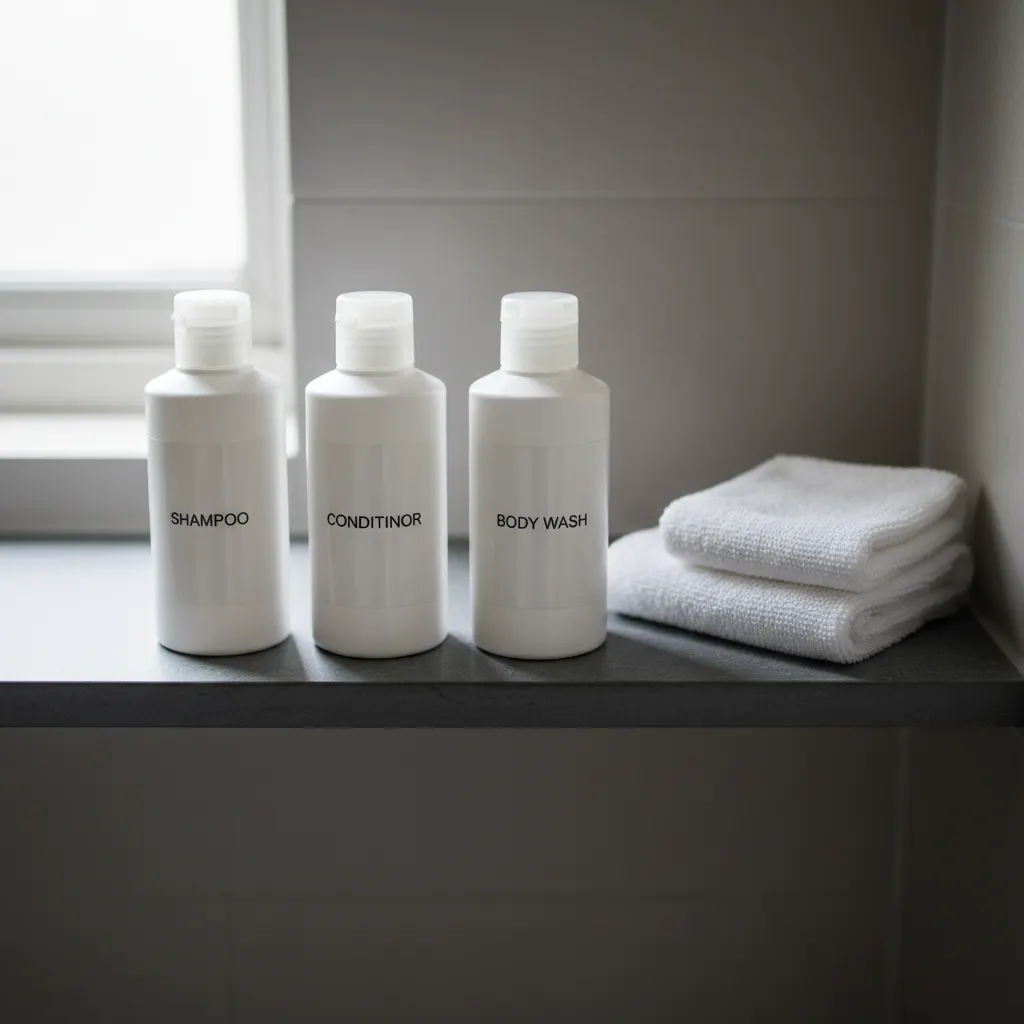
I'll be honest — for my first eighteen months I just eyeballed the bathroom before every check-in. A squirt of whatever shampoo bottle looked low. Two or three sachets of body wash chucked on the shelf. Half a bar of soap if there was one, a new one if there wasn't. It worked, in the sense that I didn't get complaints. But I had absolutely no idea what I was spending.
Then I sat down with a year of receipts and worked it out. About £6.40 per turnover in bathroom toiletries across five flats — roughly £1,700 a year. For products that mostly disappear into guests' bags, get opened and abandoned, or go down the drain at a rate I can't control.
Now I run fixed quantities per booking. It took me a week to dial in the numbers and maybe an hour to change my ordering habits. My cost is £2.20 per turnover. Same guest satisfaction scores.
The formula I use
It's not complicated. I work out how many nights the average booking is (across my five properties it's 3.1 nights) and how many guests. Then I set quantities based on that, not on gut feel.
For a standard two-guest booking of three to four nights, this is what I put out:
- Shampoo: Two 30ml sachets or a 60ml bottle (enough for two washes each, realistically one for most guests)
- Conditioner: One 30ml sachet — half my guests don't use it at all
- Body wash: One 60ml bottle — I stopped doing sachets because they look cheap and guests go through two or three
- Hand soap: Half a 250ml pump bottle, full if it was more than halfway down from the previous guest
- Shower gel bar: None. I stopped. Every single one got left half-used and I had to throw it.
- Toilet roll: Two full rolls visible, two more under the sink — I cover toilet roll separately
For longer bookings (six nights or more) I add a second body wash bottle and replace the conditioner sachet with a small pump bottle. For solo bookings I cut quantities by about a third.
What I actually buy and from where
I went through the whole premium toiletry obsession phase. Molton Brown, L'Occitane, even a brief and expensive flirtation with the Cowshed range at one point. The reviews didn't move — not meaningfully. What guests actually notice is whether the bathroom looks clean, whether there's enough product, and whether the packaging looks intentional rather than 'leftover from the last guest'.
These days I use two product lines depending on the property. For my four mid-range Edinburgh and Brighton flats I use the Gilchrist & Soames hotel-format range — 30ml sachets at around 18–22p each, neutral branding, looks considered without being fancy. For my Lake District barn, which skews towards older couples and families who book three-plus nights, I use Bramley's refillable bottles (about £3.80 each at 200ml), which I top up between guests. That property gets a significantly better review response to the bathrooms.
Amazon Business gives me 5–8% off the hotel sachet range once you're ordering in cases. I order six cases at a time, about every two months. Per-sachet cost works out at roughly 16p for the 30ml size.
The toilet roll maths everyone gets wrong
The accepted wisdom among UK hosts is two rolls per stay. That's fine for a two-night solo booking. For a four-person family for a week, it's inadequate and you'll get a comment.
My rule is: one roll per person per two nights, rounded up, plus one spare. A four-person, six-night booking gets six rolls out — four in the bathroom, two under the sink. A two-person, three-night gets three out. This sounds excessive until you run the numbers: a four-pack of Andrex at Costco works out at about 28p per roll. The cost of being slightly over-generous is pennies. The cost of a guest messaging you at 10pm to say there's no toilet roll is a nightmare, a small gift voucher to apologise, and a probable four-star review.
Dispensers vs individual products
I tested wall-mounted shower dispensers in two of my Brighton flats for eight months. The theory: cheaper per ml, less waste, looks tidy. The reality: two cleaners complained they were difficult to refill, one dispenser cracked at the mounting bracket, and I got a comment in a review about the 'communal hotel shampoo' feeling.
I've gone back to individual bottles. The disposable-feel criticism is real, but you can counter it with slightly nicer packaging and by not using anything with 'hotel' or 'hospitality' on the label. Guests don't mind single-use if it feels like it was bought for them rather than decanted from a drum.
The leaving-behind problem
Guests leave things. A half-empty bottle of Pantene. An opened pack of cotton pads. Two out of twelve cotton buds used.
My policy: throw it. All of it, every time. I know some hosts keep and reuse partially used products — I did for about three months. Then I got a one-star deduction on cleanliness from a guest who found what was clearly the previous guest's face wash under the sink. The cost of the disposal is nothing compared to that risk. I factor it into the per-turnover cost.
What actually moves review scores
I've been tracking bathroom-specific mentions in reviews for about eighteen months. The things guests mention positively: 'great shower pressure', 'properly clean', 'smelled lovely', 'nice toiletries'. The things they mention negatively: running out of toilet roll, soap that looked used, no conditioner, hair in the drain.
None of those are about spending more. They're about having a system. Put out the right amount before every stay, throw away the remains every time, and make sure the cleaner knows the restocking protocol. That's it.
My bathroom supply cost went from £6.40 a turnover to £2.20. My cleanliness scores went up, not because I'm spending more but because I stopped guessing and started counting.
My actual per-turnover numbers (five flats, 2025)
Across 217 turnovers last year, my average bathroom consumable cost was £2.18 per turnover. That covers two 30ml shampoo sachets, one 30ml conditioner, one 60ml body wash bottle, hand soap top-up, toilet roll (averaged across booking lengths), and a half-sachet of bubble bath for two of the properties where I know the demographic books for romantic weekends. Total annual spend: about £473. Down from an estimated £1,388 the year before.
The difference is a spreadsheet with one tab and about ten minutes a month to update quantities. If you haven't done this maths yet — do it this week. It's boring, it takes an afternoon to set up, and it'll save you a hundred pounds a month.
Ready to streamline your inventory?
Start managing your rental inventory smarter with automated stock tracking.
Start Free Trial