Airbnb towel rotation and retirement: how I track 42 bath towels across five properties and when I bin them
Hoststock Team
26 July 2026
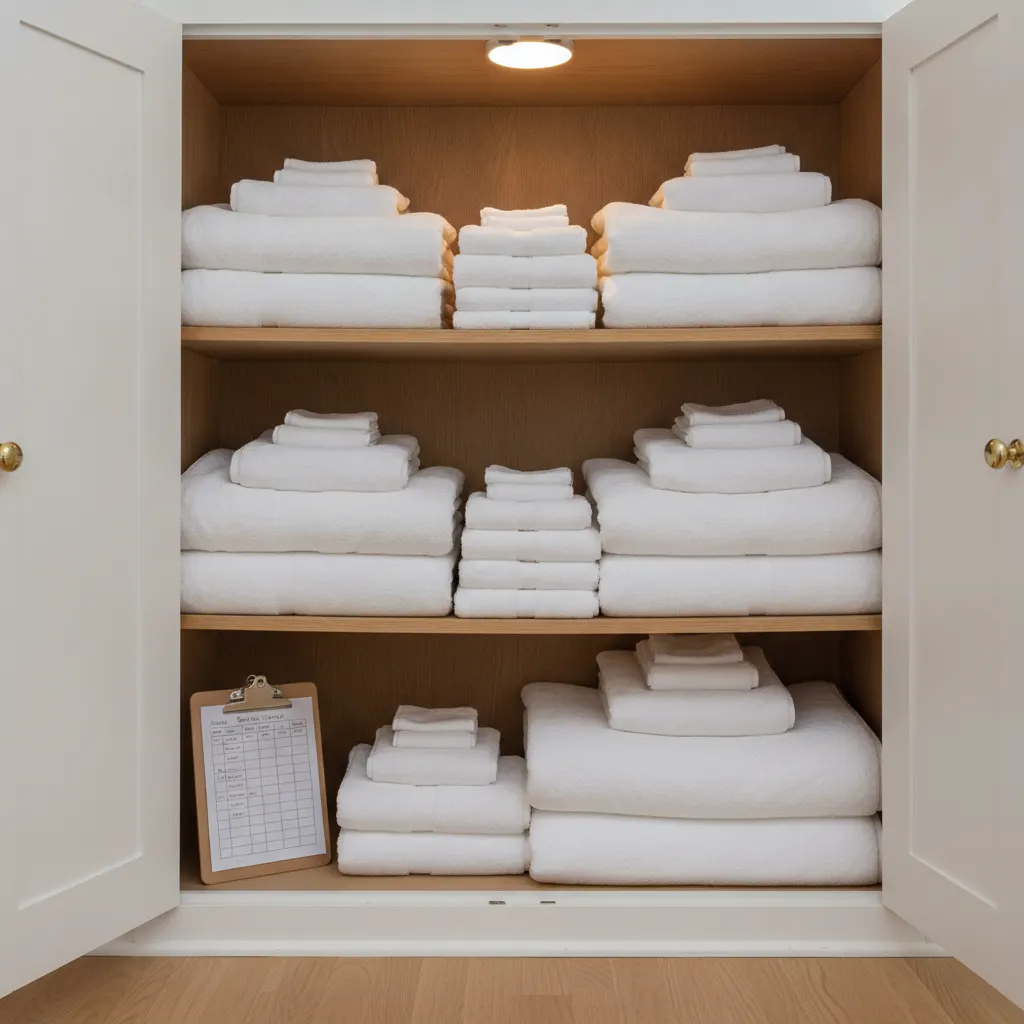
I have 42 bath towels. Eight bath sheets, sixteen bath towels, and eighteen hand towels, spread across five properties. I know this because I counted them last quarter, partly for restocking purposes and partly because I'd convinced myself I was losing towels to guests at a higher rate than I actually was.
I was not. The towels were fine. But the counting exercise was still useful, because it made me sit down and actually think about my towel rotation for the first time in four years of hosting.
Why towel lifespan in a short-term let is different
A towel in a domestic context might get washed once or twice a week at 40°C and last five or six years. A towel in a short-term let gets washed between every guest at 60°C, potentially multiple times a week during busy periods. The higher washing temperature kills bacteria — which is necessary — but it also degrades fabric faster than domestic washing.
Cotton fibres shorten and lose structure with repeated hot washes. GSM doesn't tell you how long a towel will last, though it's often misread that way. A cheap 500 GSM towel will degrade faster than an expensive 500 GSM towel because the difference is yarn quality and weave construction, not weight. Weight tells you how much cotton there is. Quality tells you how well it's been made.
In my experience, budget towels from IKEA's 365+ range start looking tired after about 60-70 washes. The Richard Haworth hotel-grade towels I've tried in the Edinburgh flat are still looking reasonable after what I estimate is close to 120 washes. The price difference per towel is roughly £4 vs £11. Over the lifecycle, the more expensive towel costs less per wash.
I use Richard Haworth for the Edinburgh flat and Lake District cottage — higher-demand properties where presentation matters more — and IKEA 365+ for the Brighton properties where I replace more frequently anyway and the guest expectations are slightly more forgiving.
The three visual tests I use
I don't replace towels on a fixed schedule. Some towels in lower-occupancy properties still look new after two years. Some towels in high-turnover city flats look past it at fourteen months. I check every towel in each property at my quarterly walk-through using three tests.
The fold test. Fold the towel neatly and stand it on the shelf as you'd display it to a guest. A towel in good condition holds its shape with crisp edges. A towel that's nearing the end of its life will have fraying at the edges, visible pilling on the surface, or a thinness where the pile has worn flat. If it looks tired when folded, it'll look tired on the towel rail.
The scratch test. Run your fingers across the pile in both directions. A towel that's had too many 60°C washes without proper care will feel slightly rough rather than soft, because the cotton fibres have shortened and the pile has stiffened. This is also usually when you start noticing it absorbs less well — the pile is doing less work. If you notice the scratch before a guest does, you've retired it at the right time.
The stain test. Anything that's survived washing and is still visible fails immediately. I've had some stains that laundered out on the second attempt, but anything still present at the walk-through is not going back on a towel rail. The threshold here is absolute: no visible staining, ever. A guest who finds a stained towel will mention it in the review before they mention anything else.
I fail maybe 20% of towels at any given quarterly inspection. Not because they're damaged — mostly just visually tired. The ones that fail the fold test go into cleaning rags or the back of my van for property use. Nothing gets binned if it can still absorb liquid, it just stops being a guest towel.
The tracking sheet
This is genuinely simple. For each property, I have a row for each towel type (bath sheet, bath towel, hand towel) with three columns: current quantity, last replacement date, and reorder trigger. The reorder trigger is the minimum quantity before I order more — usually 20% buffer. So if a property needs six bath towels, the reorder trigger is when I'm down to four.
Every time I do the quarterly inspection, I update the quantities. Any towel that fails a visual test, I mark as retired. If the quantity drops below the reorder trigger, I place an order before I leave the property.
I've been doing this for about eighteen months. Before it, I was replacing towels reactively — either after a guest complaint or when I happened to notice during a turnover. Now I replace before the problem, which means no guest ever sees the tired towel.
What I buy
For high-demand properties: Richard Haworth via their website or Amazon Business (they sell to the trade). 500 GSM Egyptian cotton. I usually buy in cases of twelve. The per-towel cost is higher but the lifecycle cost is lower. They also hold their white colour better through commercial washing, which matters for the visual impression.
For lower-demand or coastal properties: IKEA 365+ or similar. Not because they're better — they're not — but because the replacement frequency and order size make the economics work differently. Restocking twice a year at £6 a towel is easier to manage than ordering twelve at £12 and tracking whether they've been used or lost.
I don't buy towels in sets. Sets are priced for domestic convenience. The towels in a set are often different thicknesses and different construction, which means they wear at different rates and you can't replace individual pieces without visual mismatches. I buy all bath towels from one range, all hand towels from one range, maintain visual consistency, and replace individual pieces when they fail inspection.
The question I get asked most
Other hosts often ask me: how do you stop guests taking them? And the honest answer is — I don't. I have a policy in my house rules that towels are not to be taken from the property, but I also know some of mine have walked. I price this in rather than trying to prevent it. I lose maybe two towels a year across all five properties. At £10 a towel that's £20, which is less than a month of tracking stress.
I also keep a small note in the bathroom — not a sign, just a card in the welcome booklet — that says there are plenty of good-quality towels at the local M&S or Boots if guests need one for the beach. It's friendly, and it probably stops at least one impulse grab per summer.
The thing I actually care about
Towels are the first thing a guest touches in your bathroom. Before they've turned on the shower or checked the shelves, they've picked up a towel. A white, fluffy, well-maintained towel signals everything is cared for. A limp, greyish towel with a fraying edge signals nothing is.
I've seen hosts obsess about thread counts and GSM specs and forget to check whether the towels are actually clean and soft and white. The spec matters less than the condition. And the condition is a maintenance task, not a purchase decision.
Forty-two towels. Quarterly inspection. Three visual tests. Reorder when stock drops below trigger. That's the whole system. I started with one towel per guest and I've ended up here. It's duller than it sounds. It also works.
Ready to streamline your inventory?
Start managing your rental inventory smarter with automated stock tracking.
Start Free Trial